編號 100179805

編號 100179805
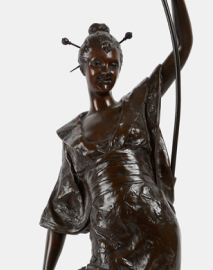
Belle Époque gilt spelter sculpture – Young Peasant Girl with Rake, circa 1900
⸻
Artist
Victor Rousseau
Victor Rousseau was one of the most important Belgian sculptors of the late 19th and early 20th centuries. Trained at the Académie Royale des Beaux-Arts de Bruxelles, he became a leading figure of Belgian Symbolism and poetic realism, bridging academic sculpture and early modern sensibilities.
Rousseau is particularly admired for his humanist approach, refined modelling, and sensitivity to everyday subjects, often depicting workers, rural life, and allegorical figures with restraint and emotional depth. His work stands apart from purely decorative production by its calm dignity and sculptural coherence.
He was awarded several distinctions during his career and represented Belgium internationally at major exhibitions.
⸻
Notable works by Victor Rousseau
Among his best-known and documented works are:
• “La Source”
• “La Terre”
• “L’Âme des Violons”
• “La Leçon”
• “Le Printemps”
• “La Jeunesse”
These works illustrate Rousseau’s recurring themes: youth, nature, labor, and quiet symbolism.
⸻
Museum collections
Victor Rousseau’s works are held in major public collections, including:
• Musées royaux des Beaux-Arts de Belgique (Brussels)
• Musée d’Ixelles (Brussels)
• Royal Museums of Fine Arts of Belgium
• Various municipal and regional Belgian museum collections
His presence in national museum holdings confirms his importance within Belgian sculpture.
⸻
Description of the present sculpture
This Belle Époque sculpture depicts a young rural girl holding a rake, a subject emblematic of Rousseau’s interest in humble labor and pastoral life. The figure is rendered with a gentle, introspective expression, naturalistic posture, and carefully observed costume, including apron and layered skirt.
The sculpture is cast in spelter (régule) with a warm gilt / bronzed patina and mounted on its original stepped wooden base. Spelter versions were produced for the decorative art market at the turn of the 20th century and are often unsigned, in contrast to bronze editions.
The quality of modelling, facial treatment, and compositional balance strongly support the attribution to Victor Rousseau.
⸻
Period
Circa 1895–1910 (Belle Époque)
⸻
Materials
• Spelter (zinc alloy), gilt / bronzed patina
• Original wooden feet
Attribution
Attributed to Victor Rousseau, based on stylistic comparison with documented works by the artist and known spelter editions produced in Belgium and France around 1900.
Also a similar sculpture was found on the net with another feet that was signed Rousseau.
Its the same sculpture just with a signed feet, which is why we attribute it to Victor Rousseau.
Se enclosed pictures.(the ones with white background, which is the signed one found on the net)
⸻
Summary
A refined Belle Époque decorative sculpture attributed to one of Belgium’s most respected sculptors, combining artistic quality, historical context, and decorative appeal. An excellent example of early 20th-century figurative sculpture connected to a museum-represented artist.