
雕刻, Asterione - 41 cm - 青銅色


Catawiki買家保障
在您收到物品前,我們會妥善保管您的付款。查看詳情
Trustpilot評分 4.4 | 135538 則評論
在Trustpilot獲得極佳評等。
賣家描述
ASTERIONE – THE MINOTAUR (Bronze Sculpture, Lost-Wax Casting)
Height 41 cm | Width 28 cm | Depth 13 cm
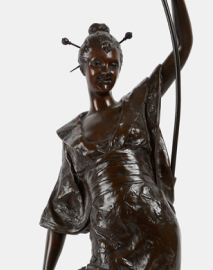
Asterion, known in myth as the Minotaur, is not merely a monster of the Labyrinth but a living threshold between instinct and consciousness. In this bronze sculpture, cast using the traditional lost-wax technique, the figure emerges as both presence and enigma: half-human, half-bull, suspended in a state of inner tension and silent power.
Rather than depicting the Minotaur as a defeated creature, this work reclaims him as an archetype of the untamed psyche — the force we exile in order to become “civilized,” yet which continues to shape our deepest desires and fears.
The surface of the bronze preserves the energy of the modeling process, with light catching the anatomical contrasts and amplifying the sense of movement contained within stillness. Asterion stands as a guardian of the labyrinth within us, inviting the viewer to confront what is hidden, repressed, and profoundly alive.
In this interpretation, the myth is not a story of defeat, but of recognition: the moment when we no longer flee the monster, but begin to see it as part of ourselves.
ASTERIONE – THE MINOTAUR (Bronze Sculpture, Lost-Wax Casting)
Height 41 cm | Width 28 cm | Depth 13 cm
Asterion, known in myth as the Minotaur, is not merely a monster of the Labyrinth but a living threshold between instinct and consciousness. In this bronze sculpture, cast using the traditional lost-wax technique, the figure emerges as both presence and enigma: half-human, half-bull, suspended in a state of inner tension and silent power.
Rather than depicting the Minotaur as a defeated creature, this work reclaims him as an archetype of the untamed psyche — the force we exile in order to become “civilized,” yet which continues to shape our deepest desires and fears.
The surface of the bronze preserves the energy of the modeling process, with light catching the anatomical contrasts and amplifying the sense of movement contained within stillness. Asterion stands as a guardian of the labyrinth within us, inviting the viewer to confront what is hidden, repressed, and profoundly alive.
In this interpretation, the myth is not a story of defeat, but of recognition: the moment when we no longer flee the monster, but begin to see it as part of ourselves.

