Satake SWORD SMITH - 廚刀 - Deba bōchō - 鋼 - 日本 - 日本锻造的 DEBA



03
天
05
小時
22
分鐘
55
秒

 | €1 |
|---|
Catawiki買家保障
在您收到物品前,我們會妥善保管您的付款。查看詳情
Trustpilot評分 4.4 | 137313 則評論
在Trustpilot獲得極佳評等。
賣家描述
Crafted in Seki (関), in the heart of Japan, where blades of exceptional quality have been forged for over seven centuries.
这句话体现了真实传统与其 refined contemporary evolution 之间的完美平衡。
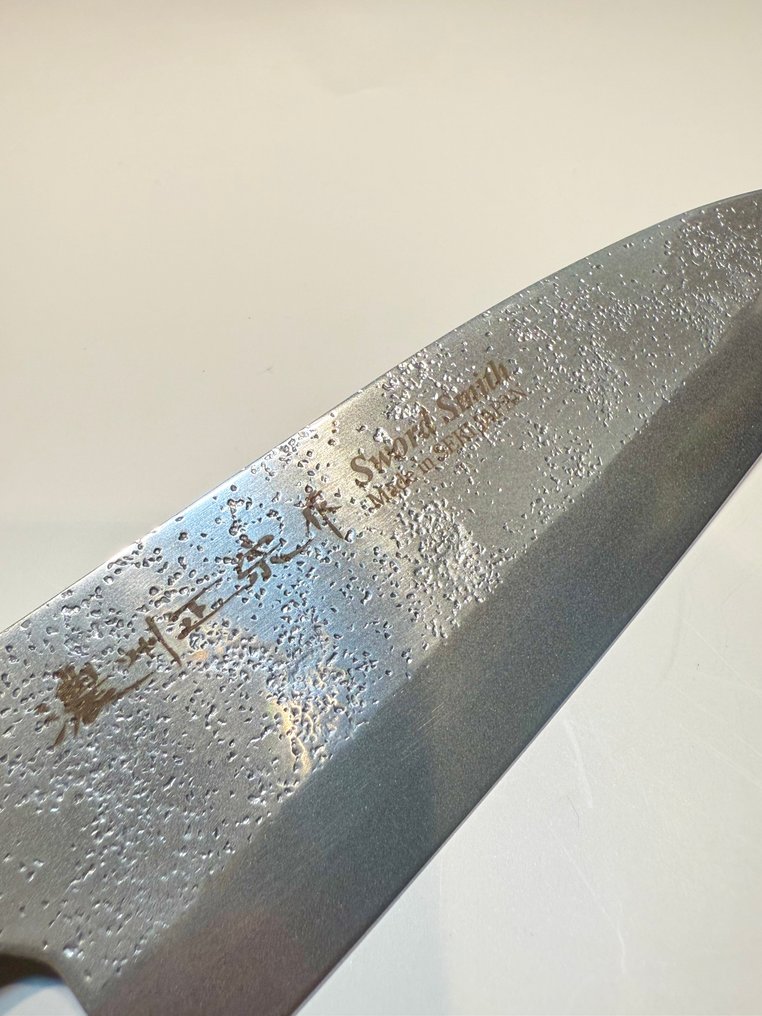
The distinctive Nashiji finish resembles the texture of traditional Japanese pear skin, adding both aesthetic appeal and functionality. The DEBA knife is specifically designed for cutting and filleting fish and chicken, offering exceptional durability, sharpness, and precision.
独特的 Nashiji 光泽类似传统日本梨皮的质感,兼具美观与实用性。DEBA 刀专为切割与片鱼、禽而设计,具备卓越的耐久性、锋利度与精准度。
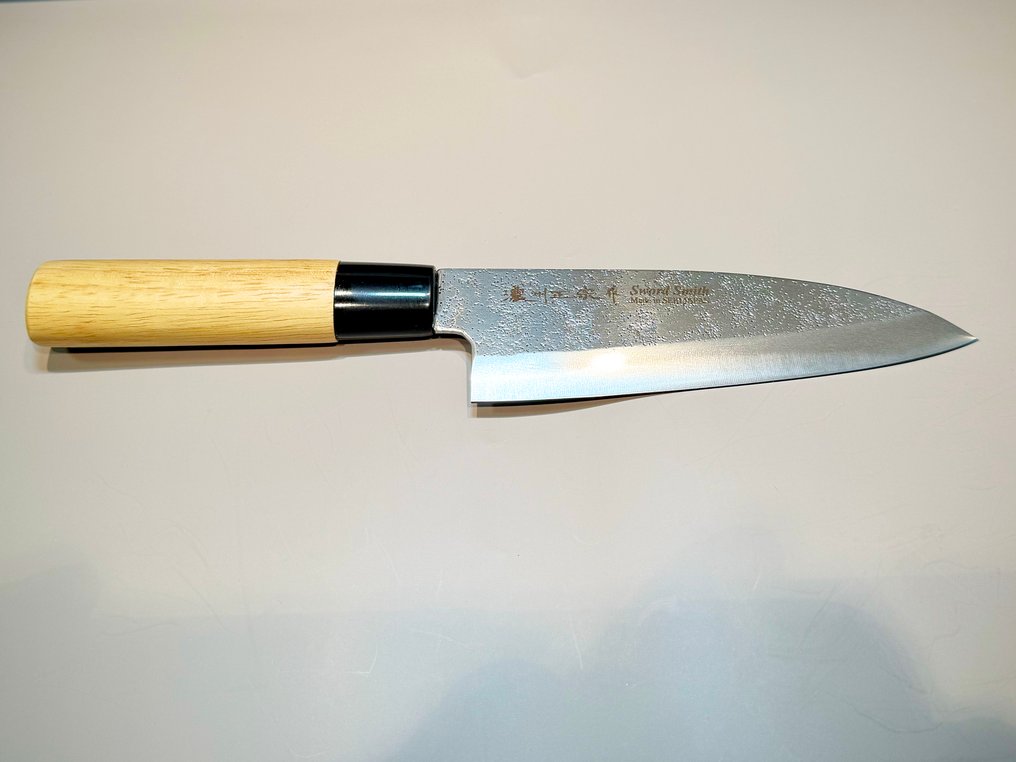
The knife is made of high-carbon stainless steel. Its blade (Jinbu 刃身) measures 15.5 centimeters and has a sharpening angle of 17-20° degrees (Kireha 切刃) on ONE side only, making it optimal for prolonged and highly precise cutting tasks.
刀身采用高碳不锈钢材质。刀刃长约 15.5 厘米,单面磨刃角度为 17-20°(Kireha 切刃),适用于长时间、高精度的切割任务。
This design is specifically made for right-handed users, but it can also be used without particular issues by left-handed users.
该设计专为右手使用者打造,但左手使用同样可用,不会带来明显问题。
The hardness rating in HRC is 55-57°, making the knife extremely easy to sharpen while ensuring a long-lasting edge.
硬度等级为 HRC 55-57,刀具在保持锋利的同时,极易打磨,edge 保持更久。
The handle (E 柄) is made of wood with an oval section and measures 12 centimeters, giving the knife a total length (blade plus handle) of 29 centimeters.
握把(E 柄)采用木质材料,截面为椭圆形,长12厘米,总长度(刀身+握把)为29厘米。
Please note that this is an original Sword Smith (master bladesmith) product made by Satake, entirely manufactured in Seki, Japan.
请注意:这是 Satake 出品的原装 Sword Smith(大师锻刀匠)产品,全部在日本岐阜关市制造。
The box displays all official manufacturer information on the back, serving as a full guarantee of authenticity.
盒背面印有厂商的全部官方信息,作为正品真实性的全面保证。
As an enthusiast of Japanese culture and craftsmanship, I personally select the finest knives from the most prestigious producers and master bladesmiths.
作为日本文化与匠心的爱好者,我亲自从最负盛名的生产商与大师锻刀匠那里挑选最优质的刀具。
Each knife is carefully packaged in its original box, wrapped in handcrafted and personalised rice paper, and shipped from Monaco (with all import duties from Japan already settled), using secure and trackable packaging to ensure it arrives intact and ready to be admired.
每把刀都小心地放在原厂盒中,外裹手工制作、个性化的米纸,并从摩纳哥发出(日本进口关税已结清),使用安全且可追踪的包装,以确保刀具完好无损、并 ready to be admired。
Authentic, Not an Imitation – Here’s Why It Matters
正品,非仿冒——原因如下
For those who are not deeply familiar with Japanese cutlery, distinguishing a genuine knife from a copy is not always immediate.
对于不太熟悉日本餐具的人来说,区分真刀与仿品并非总是立刻就能判断。
Yet the difference is real — and becomes evident especially when you can hold the knife in your hand.
但差异确实存在——尤其当你手持刀具时,差异会变得更加明显。
With online purchases this evaluation is more difficult, but there are several reliable indicators:
在网上购买时,这种判断更为困难,但有若干可靠的指示:
• Place of Production
日本以制造出色刀具而著称。
如果产品未明确标注制造商和确切生产地(如“岐阜关市”),而只标注“日本”,很可能是来自中国或印度的仿品。
避免海外组装、仅声称使用“日本钢”的刀具。
• Price
价格过低是一个明显警示:许多在线销售的刀具价格甚至低于进口关税本身——关税可能超过工厂价值的 30%,还不含运费。
• Essential Design
正宗日本刀优先考虑功能性而非装饰性。
过于华丽、色彩鲜艳或花哨的设计往往表示非正品。
• Handle
握把通常为木质,设计用于日常使用,随时间可更换。
避免过于装饰性或色彩太鲜艳的握把,这是低质量产品的常见特征。
• Weight
日本刀普遍较轻,得益于高质量钢材,使刀片更薄而更强。
警惕过于沉重或刀刃过厚的刀具。
Note: the photographs show one sample item. The item received may therefore present slight aesthetic differences, such as variations in the tone of the wooden handle or in the finish and pattern of the blade. On some models, small traces of protective material or fixing/working material may also be present, due to the artisanal assembly process. These elements do not constitute defects and can be easily removed with simple cleaning. The item is supplied in its original factory condition, without any preliminary cleaning.
注:照片仅显示一个样品。所收到的商品可能在木柄色调、刀身饰面及花纹等方面存在轻微的美观差异。在某些型号上,由于人工组装过程,可能还存在少量保护材料或固定/加工材料的痕迹。这些并非缺陷,可通过简单清洁轻松去除。商品以原厂状态提供,未进行任何初步清洁。
Warnings:
警告:
The blades of these knives are extremely sharp and should be used responsibly with utmost care to avoid injury. They must be hand-washed (never in a dishwasher) and thoroughly dried to preserve their quality and edge over the years and to prevent damage to the handle.
这些刀具的刀锋极其锋利,使用时须极度小心,避免受伤。应手洗(切勿放入洗碗机),并彻底擦干,以保持长期的质量与锋利度,防止握把受损。
For sharpening, which should be done only as needed, we recommend using quality sharpening stones with the following characteristics:
如需磨刀,请仅在需要时进行,我们建议使用高质量的磨石,具备如下特征:
- Grit JIS 80-400: For realigning the edge (only if the knife has suffered damage to the edge)
- Grit JIS 600-800: To refine the edge
- Grit JIS 1000-3000: To revive the edge
- Grit JIS 4000-8000: To achieve a polished edge
- JIS 80-400 粒度:用于重新对齐刀口(仅当刀口受损时使用)
- JIS 600-800 粒度:用于细化刀口
- JIS 1000-3000 粒度:用于恢复刀口
- JIS 4000-8000 粒度:用于获得抛光刀口
We suggest sharpening with grits between 600 and 1000 JIS for an optimal result with minimal effort.
建议使用 600-1000 的粒度进行磨削,以获得最佳效果且耗力最小。
Anatomy of the Japanese knife.
- Blade / Jinbu 刃身: The entire extension of the knife from the tip to the handle.
- Edge / Hasaki 刃先: The part of the blade that first pierces the ingredient.
- Primary Bevel / Kireha 切刃: The part of the blade that performs the cutting action, carefully designed to ensure sharpness and precision.
- Distinct Line or Ridge / Shinogi 鎬: The part where the flat sides of the blade (Hira) and the main edge of the blade (Kireha) meet.
- Blade Flat / Hira 平: The flat surface of the blade that extends from the shinogi line to the spine of the knife.
- Spine / Mune 棟: The unsharpened upper edge of the blade.
- Tip / Kissaki 切先: The part of the knife where the cutting edge and the spine meet.
- Belly / Sori 反り: The working surface of the knife.
- Heel / Hamoto 刃元: The part of the blade closest to the handle (opposite of the Kissaki).
- Collar or Ferrule / Kakumaki 角巻: The part where the handle meets the blade.
- Handle / E 柄: The grip of the knife.
- Butt / Ejiri 柄尻: The end or bottom of the knife handle.
日本刀具解剖图。
- 刃身 / Jinbu:刀尖至手柄的全部延伸。
- 刃先 / Hasaki:刀片首先刺入材料的部分。
- 切刃 / Kireha:执行切削动作的刀片部分,精心设计以确保锋利与精度。
- 鎬 / Shinogi:刀身的平面侧与主刃相遇的线。
- 平 / Hira:从 shinogi 线延伸到刀脊的刀片平面。
- 棟 / Mune:刀片的上缘未磨边。
- 切先 / Kissaki:刀锋与刀脊相遇的部位。
- 反り / Sori:刀的工作面。
- 込元 / Hamoto:靠近手柄的一端(与 Kissaki 相对)。
- 角巻 / Kakumaki:握把与刀身连接的部位。
- 柄 / E:刀的握持部。
- 柄尻 / Ejiri:刀柄的末端。
The Legend of Seki
关之传说
In the heart of Japan, Seki (関) is a city that has represented excellence in blade craftsmanship for centuries. Its history dates back to the 14th century when the legendary master Kaneshige (兼重), also known as Kinju, arrived here with Kaneuji (兼氏), establishing the renowned tradition of Mino (美濃) swords. These refined and deadly weapons quickly became symbols of honor and power for daimyo (大名) and samurai (侍) across the country.
在日本核心地带的关市(関),这里数百年来以刀具工艺的卓越享誉全球。其历史可追溯到14世纪,传说大师 Kaneshige(兼重),又称 Kinju,与 Kaneuji(兼氏)一同来到此地,奠定了美濃(Mino)剑的著名传统。这些精炼而致命的武器很快成为全国大名(大名)与武士(侍)的荣誉与力量象征。
With the advent of the Meiji era (明治) and the modernization of Japan, the use of swords was banned, marking the end of an era. However, the artisans of Seki demonstrated great adaptability, turning their mastery to the production of knives and precision tools, preserving the ancient art in new forms.
随着明治时代的到来与日本现代化,剑的使用被禁止,标志着一个时代的结束。然而,关的工匠们展现出极高的适应性,将 their 技艺转用于刀具与精密工具的生产,以新的形式保留了这门古老的艺术。
This millennia-old tradition is still alive today, and at the Seki Swordsmith Museum (関鍛冶伝承館), you can explore this fascinating heritage and witness the creation of blades of extraordinary quality. A must-see event is on January 2nd, when the first forging of the year is celebrated with ancient rituals, offering a unique and captivating spectacle.
这一千年之久的传统至今仍然鲜活,在关剑匠博物馆(関鍛冶伝承館),你可以探索这段迷人的遗产,见证极致品质的刀 blades 的诞生。一年之初的铸造仪式于1月2日举行,辅以古老仪式,提供独特而引人入胜的场景,绝对值得一看。
賣家的故事
卖家介绍 – Grey,摩纳哥公国
凭借超过三十五年的视觉艺术、高端工艺和珠宝经验,我培养了深厚的专业技能,并结合了细腻的审美敏感度。我的工作始终以追求品质和真实性为指导,精心挑选融合传统、美丽与创新的艺术品和物件。
我与备受尊敬的日本工匠大师保持直接联系,从他们那里挑选手工制作的独一无二的作品——真正展现文化和工艺的表达。在这些精选作品之外,我还提供收藏品和国际艺术品,经过精心挑选,注重其内在价值和美学。
我在Catawiki上展示的每件商品都以其卓越的品质、真实性以及收藏或商业价值而精选,完美平衡了优雅、独特性和价格。
与此同时,我数十年来一直收藏个人珍稀宝藏,不时展示天然黄金、宝石和独家艺术品,这些藏品来自过去和现在,都是我以热情和细致的奉献精神收集而成。
由Google翻譯翻譯 Crafted in Seki (関), in the heart of Japan, where blades of exceptional quality have been forged for over seven centuries.
这句话体现了真实传统与其 refined contemporary evolution 之间的完美平衡。
The distinctive Nashiji finish resembles the texture of traditional Japanese pear skin, adding both aesthetic appeal and functionality. The DEBA knife is specifically designed for cutting and filleting fish and chicken, offering exceptional durability, sharpness, and precision.
独特的 Nashiji 光泽类似传统日本梨皮的质感,兼具美观与实用性。DEBA 刀专为切割与片鱼、禽而设计,具备卓越的耐久性、锋利度与精准度。
The knife is made of high-carbon stainless steel. Its blade (Jinbu 刃身) measures 15.5 centimeters and has a sharpening angle of 17-20° degrees (Kireha 切刃) on ONE side only, making it optimal for prolonged and highly precise cutting tasks.
刀身采用高碳不锈钢材质。刀刃长约 15.5 厘米,单面磨刃角度为 17-20°(Kireha 切刃),适用于长时间、高精度的切割任务。
This design is specifically made for right-handed users, but it can also be used without particular issues by left-handed users.
该设计专为右手使用者打造,但左手使用同样可用,不会带来明显问题。
The hardness rating in HRC is 55-57°, making the knife extremely easy to sharpen while ensuring a long-lasting edge.
硬度等级为 HRC 55-57,刀具在保持锋利的同时,极易打磨,edge 保持更久。
The handle (E 柄) is made of wood with an oval section and measures 12 centimeters, giving the knife a total length (blade plus handle) of 29 centimeters.
握把(E 柄)采用木质材料,截面为椭圆形,长12厘米,总长度(刀身+握把)为29厘米。
Please note that this is an original Sword Smith (master bladesmith) product made by Satake, entirely manufactured in Seki, Japan.
请注意:这是 Satake 出品的原装 Sword Smith(大师锻刀匠)产品,全部在日本岐阜关市制造。
The box displays all official manufacturer information on the back, serving as a full guarantee of authenticity.
盒背面印有厂商的全部官方信息,作为正品真实性的全面保证。
As an enthusiast of Japanese culture and craftsmanship, I personally select the finest knives from the most prestigious producers and master bladesmiths.
作为日本文化与匠心的爱好者,我亲自从最负盛名的生产商与大师锻刀匠那里挑选最优质的刀具。
Each knife is carefully packaged in its original box, wrapped in handcrafted and personalised rice paper, and shipped from Monaco (with all import duties from Japan already settled), using secure and trackable packaging to ensure it arrives intact and ready to be admired.
每把刀都小心地放在原厂盒中,外裹手工制作、个性化的米纸,并从摩纳哥发出(日本进口关税已结清),使用安全且可追踪的包装,以确保刀具完好无损、并 ready to be admired。
Authentic, Not an Imitation – Here’s Why It Matters
正品,非仿冒——原因如下
For those who are not deeply familiar with Japanese cutlery, distinguishing a genuine knife from a copy is not always immediate.
对于不太熟悉日本餐具的人来说,区分真刀与仿品并非总是立刻就能判断。
Yet the difference is real — and becomes evident especially when you can hold the knife in your hand.
但差异确实存在——尤其当你手持刀具时,差异会变得更加明显。
With online purchases this evaluation is more difficult, but there are several reliable indicators:
在网上购买时,这种判断更为困难,但有若干可靠的指示:
• Place of Production
日本以制造出色刀具而著称。
如果产品未明确标注制造商和确切生产地(如“岐阜关市”),而只标注“日本”,很可能是来自中国或印度的仿品。
避免海外组装、仅声称使用“日本钢”的刀具。
• Price
价格过低是一个明显警示:许多在线销售的刀具价格甚至低于进口关税本身——关税可能超过工厂价值的 30%,还不含运费。
• Essential Design
正宗日本刀优先考虑功能性而非装饰性。
过于华丽、色彩鲜艳或花哨的设计往往表示非正品。
• Handle
握把通常为木质,设计用于日常使用,随时间可更换。
避免过于装饰性或色彩太鲜艳的握把,这是低质量产品的常见特征。
• Weight
日本刀普遍较轻,得益于高质量钢材,使刀片更薄而更强。
警惕过于沉重或刀刃过厚的刀具。
Note: the photographs show one sample item. The item received may therefore present slight aesthetic differences, such as variations in the tone of the wooden handle or in the finish and pattern of the blade. On some models, small traces of protective material or fixing/working material may also be present, due to the artisanal assembly process. These elements do not constitute defects and can be easily removed with simple cleaning. The item is supplied in its original factory condition, without any preliminary cleaning.
注:照片仅显示一个样品。所收到的商品可能在木柄色调、刀身饰面及花纹等方面存在轻微的美观差异。在某些型号上,由于人工组装过程,可能还存在少量保护材料或固定/加工材料的痕迹。这些并非缺陷,可通过简单清洁轻松去除。商品以原厂状态提供,未进行任何初步清洁。
Warnings:
警告:
The blades of these knives are extremely sharp and should be used responsibly with utmost care to avoid injury. They must be hand-washed (never in a dishwasher) and thoroughly dried to preserve their quality and edge over the years and to prevent damage to the handle.
这些刀具的刀锋极其锋利,使用时须极度小心,避免受伤。应手洗(切勿放入洗碗机),并彻底擦干,以保持长期的质量与锋利度,防止握把受损。
For sharpening, which should be done only as needed, we recommend using quality sharpening stones with the following characteristics:
如需磨刀,请仅在需要时进行,我们建议使用高质量的磨石,具备如下特征:
- Grit JIS 80-400: For realigning the edge (only if the knife has suffered damage to the edge)
- Grit JIS 600-800: To refine the edge
- Grit JIS 1000-3000: To revive the edge
- Grit JIS 4000-8000: To achieve a polished edge
- JIS 80-400 粒度:用于重新对齐刀口(仅当刀口受损时使用)
- JIS 600-800 粒度:用于细化刀口
- JIS 1000-3000 粒度:用于恢复刀口
- JIS 4000-8000 粒度:用于获得抛光刀口
We suggest sharpening with grits between 600 and 1000 JIS for an optimal result with minimal effort.
建议使用 600-1000 的粒度进行磨削,以获得最佳效果且耗力最小。
Anatomy of the Japanese knife.
- Blade / Jinbu 刃身: The entire extension of the knife from the tip to the handle.
- Edge / Hasaki 刃先: The part of the blade that first pierces the ingredient.
- Primary Bevel / Kireha 切刃: The part of the blade that performs the cutting action, carefully designed to ensure sharpness and precision.
- Distinct Line or Ridge / Shinogi 鎬: The part where the flat sides of the blade (Hira) and the main edge of the blade (Kireha) meet.
- Blade Flat / Hira 平: The flat surface of the blade that extends from the shinogi line to the spine of the knife.
- Spine / Mune 棟: The unsharpened upper edge of the blade.
- Tip / Kissaki 切先: The part of the knife where the cutting edge and the spine meet.
- Belly / Sori 反り: The working surface of the knife.
- Heel / Hamoto 刃元: The part of the blade closest to the handle (opposite of the Kissaki).
- Collar or Ferrule / Kakumaki 角巻: The part where the handle meets the blade.
- Handle / E 柄: The grip of the knife.
- Butt / Ejiri 柄尻: The end or bottom of the knife handle.
日本刀具解剖图。
- 刃身 / Jinbu:刀尖至手柄的全部延伸。
- 刃先 / Hasaki:刀片首先刺入材料的部分。
- 切刃 / Kireha:执行切削动作的刀片部分,精心设计以确保锋利与精度。
- 鎬 / Shinogi:刀身的平面侧与主刃相遇的线。
- 平 / Hira:从 shinogi 线延伸到刀脊的刀片平面。
- 棟 / Mune:刀片的上缘未磨边。
- 切先 / Kissaki:刀锋与刀脊相遇的部位。
- 反り / Sori:刀的工作面。
- 込元 / Hamoto:靠近手柄的一端(与 Kissaki 相对)。
- 角巻 / Kakumaki:握把与刀身连接的部位。
- 柄 / E:刀的握持部。
- 柄尻 / Ejiri:刀柄的末端。
The Legend of Seki
关之传说
In the heart of Japan, Seki (関) is a city that has represented excellence in blade craftsmanship for centuries. Its history dates back to the 14th century when the legendary master Kaneshige (兼重), also known as Kinju, arrived here with Kaneuji (兼氏), establishing the renowned tradition of Mino (美濃) swords. These refined and deadly weapons quickly became symbols of honor and power for daimyo (大名) and samurai (侍) across the country.
在日本核心地带的关市(関),这里数百年来以刀具工艺的卓越享誉全球。其历史可追溯到14世纪,传说大师 Kaneshige(兼重),又称 Kinju,与 Kaneuji(兼氏)一同来到此地,奠定了美濃(Mino)剑的著名传统。这些精炼而致命的武器很快成为全国大名(大名)与武士(侍)的荣誉与力量象征。
With the advent of the Meiji era (明治) and the modernization of Japan, the use of swords was banned, marking the end of an era. However, the artisans of Seki demonstrated great adaptability, turning their mastery to the production of knives and precision tools, preserving the ancient art in new forms.
随着明治时代的到来与日本现代化,剑的使用被禁止,标志着一个时代的结束。然而,关的工匠们展现出极高的适应性,将 their 技艺转用于刀具与精密工具的生产,以新的形式保留了这门古老的艺术。
This millennia-old tradition is still alive today, and at the Seki Swordsmith Museum (関鍛冶伝承館), you can explore this fascinating heritage and witness the creation of blades of extraordinary quality. A must-see event is on January 2nd, when the first forging of the year is celebrated with ancient rituals, offering a unique and captivating spectacle.
这一千年之久的传统至今仍然鲜活,在关剑匠博物馆(関鍛冶伝承館),你可以探索这段迷人的遗产,见证极致品质的刀 blades 的诞生。一年之初的铸造仪式于1月2日举行,辅以古老仪式,提供独特而引人入胜的场景,绝对值得一看。
賣家的故事
卖家介绍 – Grey,摩纳哥公国
凭借超过三十五年的视觉艺术、高端工艺和珠宝经验,我培养了深厚的专业技能,并结合了细腻的审美敏感度。我的工作始终以追求品质和真实性为指导,精心挑选融合传统、美丽与创新的艺术品和物件。
我与备受尊敬的日本工匠大师保持直接联系,从他们那里挑选手工制作的独一无二的作品——真正展现文化和工艺的表达。在这些精选作品之外,我还提供收藏品和国际艺术品,经过精心挑选,注重其内在价值和美学。
我在Catawiki上展示的每件商品都以其卓越的品质、真实性以及收藏或商业价值而精选,完美平衡了优雅、独特性和价格。
与此同时,我数十年来一直收藏个人珍稀宝藏,不时展示天然黄金、宝石和独家艺术品,这些藏品来自过去和现在,都是我以热情和细致的奉献精神收集而成。
由Google翻譯翻譯詳細資料
時代
2000年後
Kitchen knife type
Deba bōchō
重量
150 g
具體原產地
SEKI (Gifu Prefecture)
標題附加資訊
Forged Japanese DEBA
原產國
日本
製造商/品牌
Satake
設計師/藝術家/製作者
SWORD SMITH
材質
鋼
狀態
全新-未使用
Height
29 cm
Width
4,5 cm
Depth
2 cm
大概年份
2020+