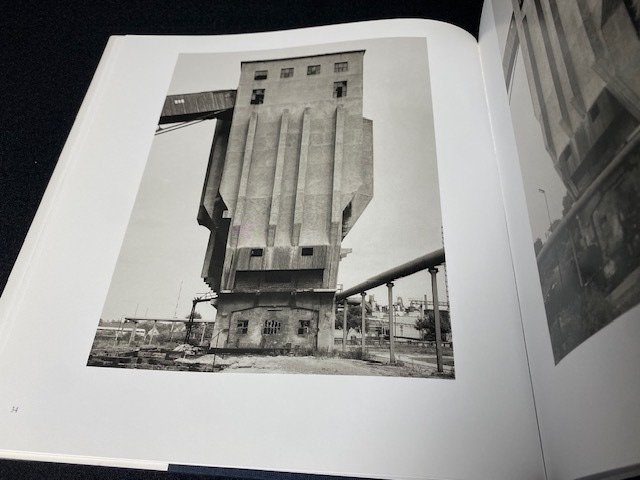
SIGNED (by BOTH); Bernd and Hilla Becher - Zeche Hannibal - 2000




08
天
08
小時
47
分鐘
11
秒

另有23人對此物品感興趣
 競投者 4991 競投者 4991 | €200 |
|---|
Catawiki買家保障
在您收到物品前,我們會妥善保管您的付款。查看詳情
Trustpilot評分 4.4 | 121899 則評論
在Trustpilot獲得極佳評等。
Zeche Hannibal,Bernd Becher 與 Hilla Becher 簽名。
AI輔助摘要
賣家描述
THIS IS THE LAST EXCLUSIVE PHOTOBOOK AUCTION by 5Uhr30.com in 2025 -
with more than 100 great lots from my personal collection and from recent acquisitions.
SUPER RARE OPPORTUNITY to purchase this IMPORTANT TITLE by Bernd and Hilla Becher -
SIGNED BY BOTH (!) ARTISTS.
VERY FRESH CONDITION.
The book was published on the occasion of the exhibition 'Bernd and Hilla Becher: The Mines. A photographic study of 10 industrial comlexes.' at 'Huis Marseille, Foundation for Photography, Amsterdam' in 2000.
This exhibition was shown before in 1999 at 'Die Photographische Sammlung/SK Stiftung Kultur' in Cologne, Germany under the title of 'Bernd & Hilla Becher: Bergwerke, Objekt und Beschreibung.'
Like always 5Uhr30.com guarantees detailed and accurate descriptions, 100% transport protection, 100% transport insurance, and of course, combined shipping - worldwide.
'Bernhard 'Bernd' Becher (1931-2007), and Hilla Becher, born Wobeser (1934-2015), were German conceptual artists and photographers working as a collaborative duo. They are best known for their extensive series of photographic images, or typologies, of industrial buildings and structures, often organised in grids. As the founders of what has come to be known as the 'Becher school' or the Düsseldorf School of Photography, they influenced generations of documentary photographers and artists in Germany and abroad. They were awarded the Erasmus Prize and the Hasselblad Award.
The Düsseldorf School of Photography refers to a group of photographers who studied at the Kunstakademie Düsseldorf in the mid 1970s under the influential photographers Bernd and Hilla Becher.
Known for their rigorous devotion to the 1920s German tradition of Neue Sachlichkeit (New Objectivity), the Bechers’ photographs were clear, black and white pictures of industrial archetypes (pitheads, water towers, coal bunkers).
Andreas Gursky, Candida Höfer, Axel Hütte, Thomas Ruff and Thomas Struth modified the approach of their teachers by applying new technical possibilities and a personal and contemporary vision, while retaining the documentary method their tutors propounded.
5Uhr30.com says MANY THANKS FOR YOUR SUPPORT THIS YEAR -
making our single-seller photobook auctions on Catawiki so successful.
Ecki Heuser & team are wishing ALL THE BEST TO YOU AND YOURS for 2026.
Schirmer and Mosel, Munich. 2000. First edition, first printing.
Hardback in linen with original dustjacket. 275 x 295 mm. 123 pages. Photos: Bernd and Hilla Becher. Text in German.
Condition:
Book inside and outside excellent, very fresh and flawless; clean with no marks and with no foxing. Dustjacket very fresh and complete with no tears, with no taped tears and with no missing parts; very light yellowing at the edges and at the spine. Overall very fine condition.
Great Bernd and Hilla Becher title in very fresh condition - signed by both artists.
The Bechers -
famous for their artist books (Martin Parr, The Photobook, vol 2, page 268/269).
The Bechers -
maker of 'Anonyme Skulpturen' (Martin Parr, The Photobook vol 2, page 266).
The Bechers -
famous for the 'Becher-Class' or 'Becher-School'.
The Bechers -
teacher of Andreas Gursky, Thomas Struth, Candida Höfer, Thomas Struth and others.
'Bernd Becher was born in Siegen. He studied painting at the Staatliche Akademie der Bildenden Künste Stuttgart from 1953 to 1956, then typography under Karl Rössing at the Kunstakademie Düsseldorf from 1959 to 1961. Hilla Becher was born in Potsdam. Prior to Hilla's time studying photography at the Kunstakademie Düsseldorf from 1958 to 1961, she had completed an apprenticeship as a photographer in her native Potsdam. Both began working as freelance photographers for the Troost Advertising Agency in Düsseldorf, concentrating on product photography. They got married in 1961.
Meeting as students at the Kunstakademie Düsseldorf in 1957, Bernd and Hilla Becher first collaborated on photographing and documenting the disappearing German industrial architecture in 1959. The Ruhr Valley, where Becher's family had worked in the steel and mining industries, was their initial focus. They were fascinated by the similar shapes in which certain buildings were designed. After collating thousands of pictures of individual structures, they noticed that the various edifices – of cooling towers, gas tanks and coal bunkers, for instance – shared many distinctive formal qualities. In addition, they were intrigued by the fact that so many of these industrial buildings seemed to have been built with a great deal of attention toward design.
Together, the Bechers first photographed with a 6x9cm camera and then (after 1961) mostly with a large format Plaubel Peco 13x18-centimeter (5x7-inch) monorail camera. They photographed these buildings from a number of different angles, but always with a straightforward 'objective' point of view. The adjustable standards of the monorail camera enabled them perspective control to maintain parallel lines in their photographs. They used a range of optics from 90mm wide-angle lenses to 600mm telephoto lenses to make similar subjects appear similarly sized despite not being able to always photograph from the same distances. They chose to work in black and white both because of its capacity to capture three-dimensional volume without the distraction of color, and its reliability and cost in relation to the sensitized color materials at the time. After working with 13x18-centimeter glass photographic plates, they shifted to 25 ASA film speed negative sheet film around 1970. They typically made two exposures for each view, with a range of exposure times from 10 seconds to a minute. The Bechers shared darkroom tasks, with Bernd developing the negatives, and Hilla making the prints. To make the sky appear white in their prints, they often photographed on overcast days but optimized their lighting for each subject (using a blue filter when the sky was blue), or photographed early in the morning during the seasons of spring and fall. Their subjects included framework houses (timber framing), barns, water towers, coal tipples, cooling towers, grain elevators, coal bunkers, coke ovens, oil refineries, blast furnaces, gas tanks, storage silos, and warehouses. At each site the Bechers also created overall landscape photographs of the entire plant, which set the structures in their context and show how they relate to each other. They excluded any details that would detract from the central theme and instead set up comparisons of viewpoint and lighting through which the eye is led to the basic structural pattern of the images being compared. This principle, which is allied to the philosophy underlying the New Topographics movement, is most obvious in the two published series, Anonyme Skulpturen: Eine Typologie technischer Bauten and Typologien, Industrieller Bau, 1963–1975, in which the images are contrasted in groups of three. Another early project, which they pursued for nearly two decades, was published as Framework Houses (Schirmer/Mosel) in 1977, a visual catalog of types of structures, an approach that characterized much of their work.
In drawing attention to the cultural dimension of industrial architecture, their work also highlighted the need for preservation of these buildings. On the couple's initiative the Zollern II/IV Colliery at Dortmund-Bovinghausen in the Ruhr, a historicism structure with the exception of the machine hall (Art Nouveau), was designated a protected landmark.
The Bechers also photographed outside Germany, including from 1965 buildings in Great Britain, France, Belgium and later in the United States. In 1966, they undertook a six-month journey through England and south Wales, taking hundreds of photographs of the coal industry around Liverpool, Manchester, Sheffield, Nottingham and the Rhondda Valley. In 1974, they traveled to North America for the first time, touring sites in New Jersey, Michigan, Pennsylvania, and southern Ontario, depicting a range of industrial structures, from coal breakers to wooden winding towers.
The Bechers exhibited and published their single-image gelatin silver prints, grouped by subject, in a grid of six, nine, or fifteen. By the mid-1960s the Bechers had settled on a preferred presentational mode: the images of structures with similar functions are then displayed side by side to invite viewers to compare their forms and designs based on function, regional idiosyncrasies, or the age of the structures. The Bechers used the term "typology" to describe these ordered sets of photographs. The works' titles are pithy and captions note only time and location. In 1989–91, for an exhibition at the Dia Art Foundation in New York, the Bechers introduced a second format into their oeuvre: single images that are larger in size — twenty-four by twenty inches — and presented individually, rather than as gridded tableaux.
In 1976, Bernd Becher started teaching photography at the Kunstakademie Düsseldorf (policy matters prevented Hilla's simultaneous appointment), where he remained on the faculty until 1996. Before him, photography had been excluded from what was largely a school for painters. He influenced students that later made a name for themselves in the photography world. Former students of Bernd's included Andreas Gursky, Thomas Ruff, Thomas Struth, Candida Höfer, Axel Hütte and Elger Esser. Bernd died in Rostock.
After Bernd Becher's death, his widow Hilla continued to reassemble their works, mostly using existing photographs.
The Bechers had their first gallery exhibition in 1963 at the Galerie Ruth Nohl in Siegen. Their work became better known in the United States with the publication of their book Anonyme Skulpturen (Anonymous Sculptures) in 1970. The Bechers were shown at the George Eastman House and in solo exhibitions at Sonnabend Gallery, New York, in 1972. In 1974, the Institute of Contemporary Arts, London, organized an exhibition of their work, which toured the United Kingdom. The couple was invited to participate in Documenta 5, 6, 7, and 11 in Kassel in 1972, 1977, 1982 and 2002, and at the Bienal de São Paulo in 1977. The Stedelijk Van Abbemuseum, Eindhoven, organized a retrospective of the artists' work in 1981. In 1985 the artists had a major museum exhibition, which traveled to the Museum Folkwang, Essen, Musée d'Art Moderne de la Ville de Paris, and Musée d'Art Moderne de la Ville de Liège, Belgium. In 1991 the artists won the Leone d'Oro award for sculpture at the Venice Biennale. The Venice installation was reworked later in 1991, in a retrospective exhibition at the Kölnischer Kunstverein, Cologne. The Typologies installation was exhibited in 1994 at the Ydessa Hendeles Art Foundation, Toronto, and at the Westfälisches Landesmuseum für Kunst und Kulturgeschichte in Münster. Other retrospectives of the couple's work have been organized by the Photographische Sammlung/SK Stiftung Kulture in Cologne (1999 and 2003), Centre Georges Pompidou in Paris (2005) and Museum of Modern Art in New York (2008).
In 2014, Hilla Becher curated "August Sander/Bernd and Hilla Becher: 'A Dialogue'" at Bruce Silverstein Gallery in New York. Unlike previous displays, the Bechers' architectural images were displayed as singular "portraits" while Sander's photographs of people were represented as typological grids. In 2022, the Metropolitan Museum of Art held a major retrospective of their photographic oeuvre, which received 'blockbuster' reviews from major art critics.
The Becher school has influenced a number of (mainly) German photographers including Andreas Gursky, Thomas Struth, Thomas Ruff, Candida Höfer, Laurenz Berges, Bernhard Fuchs, Axel Hütte, Simone Nieweg, and Petra Wunderlich. The Canadian photographer Edward Burtynsky also drews inspiration from the duo and works in a similar mode. Aside from its vital documentary and analytical qualities, the Bechers' long-term project has also had a considerable impact on Minimalism and Conceptual Art since the 1970s.
The highest price reached by one of the duo's works was when Water Towers (1972), a grid of nine photographs, sold by 441.940 US Dollar at Sotheby's Paris, on 15 November 2015.'
(Wikipedia)
賣家的故事
歡迎來到 5 點 30 分。
5Uhr30 總部位於科隆最時尚的街區埃倫菲爾德 - 設有一家商店和一個攝影陳列室。
5H30 提供非常罕見、非常美麗、非常特別的相冊 - 已售罄、現代古董和古董。我們還提供照片邀請卡、電影和照片海報、照片目錄和原始照片打印件。
5Uhr30 專門從事德國攝影出版物,
而且還有來自歐洲、日本、北美和南美各地的一系列令人興奮的相冊。旅遊手冊、兒童讀物、公司手冊……一切與攝影有關的狹義或廣義的事物都會激發我們的靈感。如果您在科隆或周邊地區,請訪問我們。你不會後悔的! :)
5:30 am 總是盡力提供最好的狀態。
5 小時 30 分全球發貨,快速、安全 -
提供 100% 保護、全額保險和追踪號碼。
如果您有任何疑問或正在尋找特別的產品,請通過電子郵件與我們聯繫,因為我們僅提供部分優惠。
感謝您的關注。
埃基·豪瑟和團隊
由Google翻譯翻譯THIS IS THE LAST EXCLUSIVE PHOTOBOOK AUCTION by 5Uhr30.com in 2025 -
with more than 100 great lots from my personal collection and from recent acquisitions.
SUPER RARE OPPORTUNITY to purchase this IMPORTANT TITLE by Bernd and Hilla Becher -
SIGNED BY BOTH (!) ARTISTS.
VERY FRESH CONDITION.
The book was published on the occasion of the exhibition 'Bernd and Hilla Becher: The Mines. A photographic study of 10 industrial comlexes.' at 'Huis Marseille, Foundation for Photography, Amsterdam' in 2000.
This exhibition was shown before in 1999 at 'Die Photographische Sammlung/SK Stiftung Kultur' in Cologne, Germany under the title of 'Bernd & Hilla Becher: Bergwerke, Objekt und Beschreibung.'
Like always 5Uhr30.com guarantees detailed and accurate descriptions, 100% transport protection, 100% transport insurance, and of course, combined shipping - worldwide.
'Bernhard 'Bernd' Becher (1931-2007), and Hilla Becher, born Wobeser (1934-2015), were German conceptual artists and photographers working as a collaborative duo. They are best known for their extensive series of photographic images, or typologies, of industrial buildings and structures, often organised in grids. As the founders of what has come to be known as the 'Becher school' or the Düsseldorf School of Photography, they influenced generations of documentary photographers and artists in Germany and abroad. They were awarded the Erasmus Prize and the Hasselblad Award.
The Düsseldorf School of Photography refers to a group of photographers who studied at the Kunstakademie Düsseldorf in the mid 1970s under the influential photographers Bernd and Hilla Becher.
Known for their rigorous devotion to the 1920s German tradition of Neue Sachlichkeit (New Objectivity), the Bechers’ photographs were clear, black and white pictures of industrial archetypes (pitheads, water towers, coal bunkers).
Andreas Gursky, Candida Höfer, Axel Hütte, Thomas Ruff and Thomas Struth modified the approach of their teachers by applying new technical possibilities and a personal and contemporary vision, while retaining the documentary method their tutors propounded.
5Uhr30.com says MANY THANKS FOR YOUR SUPPORT THIS YEAR -
making our single-seller photobook auctions on Catawiki so successful.
Ecki Heuser & team are wishing ALL THE BEST TO YOU AND YOURS for 2026.
Schirmer and Mosel, Munich. 2000. First edition, first printing.
Hardback in linen with original dustjacket. 275 x 295 mm. 123 pages. Photos: Bernd and Hilla Becher. Text in German.
Condition:
Book inside and outside excellent, very fresh and flawless; clean with no marks and with no foxing. Dustjacket very fresh and complete with no tears, with no taped tears and with no missing parts; very light yellowing at the edges and at the spine. Overall very fine condition.
Great Bernd and Hilla Becher title in very fresh condition - signed by both artists.
The Bechers -
famous for their artist books (Martin Parr, The Photobook, vol 2, page 268/269).
The Bechers -
maker of 'Anonyme Skulpturen' (Martin Parr, The Photobook vol 2, page 266).
The Bechers -
famous for the 'Becher-Class' or 'Becher-School'.
The Bechers -
teacher of Andreas Gursky, Thomas Struth, Candida Höfer, Thomas Struth and others.
'Bernd Becher was born in Siegen. He studied painting at the Staatliche Akademie der Bildenden Künste Stuttgart from 1953 to 1956, then typography under Karl Rössing at the Kunstakademie Düsseldorf from 1959 to 1961. Hilla Becher was born in Potsdam. Prior to Hilla's time studying photography at the Kunstakademie Düsseldorf from 1958 to 1961, she had completed an apprenticeship as a photographer in her native Potsdam. Both began working as freelance photographers for the Troost Advertising Agency in Düsseldorf, concentrating on product photography. They got married in 1961.
Meeting as students at the Kunstakademie Düsseldorf in 1957, Bernd and Hilla Becher first collaborated on photographing and documenting the disappearing German industrial architecture in 1959. The Ruhr Valley, where Becher's family had worked in the steel and mining industries, was their initial focus. They were fascinated by the similar shapes in which certain buildings were designed. After collating thousands of pictures of individual structures, they noticed that the various edifices – of cooling towers, gas tanks and coal bunkers, for instance – shared many distinctive formal qualities. In addition, they were intrigued by the fact that so many of these industrial buildings seemed to have been built with a great deal of attention toward design.
Together, the Bechers first photographed with a 6x9cm camera and then (after 1961) mostly with a large format Plaubel Peco 13x18-centimeter (5x7-inch) monorail camera. They photographed these buildings from a number of different angles, but always with a straightforward 'objective' point of view. The adjustable standards of the monorail camera enabled them perspective control to maintain parallel lines in their photographs. They used a range of optics from 90mm wide-angle lenses to 600mm telephoto lenses to make similar subjects appear similarly sized despite not being able to always photograph from the same distances. They chose to work in black and white both because of its capacity to capture three-dimensional volume without the distraction of color, and its reliability and cost in relation to the sensitized color materials at the time. After working with 13x18-centimeter glass photographic plates, they shifted to 25 ASA film speed negative sheet film around 1970. They typically made two exposures for each view, with a range of exposure times from 10 seconds to a minute. The Bechers shared darkroom tasks, with Bernd developing the negatives, and Hilla making the prints. To make the sky appear white in their prints, they often photographed on overcast days but optimized their lighting for each subject (using a blue filter when the sky was blue), or photographed early in the morning during the seasons of spring and fall. Their subjects included framework houses (timber framing), barns, water towers, coal tipples, cooling towers, grain elevators, coal bunkers, coke ovens, oil refineries, blast furnaces, gas tanks, storage silos, and warehouses. At each site the Bechers also created overall landscape photographs of the entire plant, which set the structures in their context and show how they relate to each other. They excluded any details that would detract from the central theme and instead set up comparisons of viewpoint and lighting through which the eye is led to the basic structural pattern of the images being compared. This principle, which is allied to the philosophy underlying the New Topographics movement, is most obvious in the two published series, Anonyme Skulpturen: Eine Typologie technischer Bauten and Typologien, Industrieller Bau, 1963–1975, in which the images are contrasted in groups of three. Another early project, which they pursued for nearly two decades, was published as Framework Houses (Schirmer/Mosel) in 1977, a visual catalog of types of structures, an approach that characterized much of their work.
In drawing attention to the cultural dimension of industrial architecture, their work also highlighted the need for preservation of these buildings. On the couple's initiative the Zollern II/IV Colliery at Dortmund-Bovinghausen in the Ruhr, a historicism structure with the exception of the machine hall (Art Nouveau), was designated a protected landmark.
The Bechers also photographed outside Germany, including from 1965 buildings in Great Britain, France, Belgium and later in the United States. In 1966, they undertook a six-month journey through England and south Wales, taking hundreds of photographs of the coal industry around Liverpool, Manchester, Sheffield, Nottingham and the Rhondda Valley. In 1974, they traveled to North America for the first time, touring sites in New Jersey, Michigan, Pennsylvania, and southern Ontario, depicting a range of industrial structures, from coal breakers to wooden winding towers.
The Bechers exhibited and published their single-image gelatin silver prints, grouped by subject, in a grid of six, nine, or fifteen. By the mid-1960s the Bechers had settled on a preferred presentational mode: the images of structures with similar functions are then displayed side by side to invite viewers to compare their forms and designs based on function, regional idiosyncrasies, or the age of the structures. The Bechers used the term "typology" to describe these ordered sets of photographs. The works' titles are pithy and captions note only time and location. In 1989–91, for an exhibition at the Dia Art Foundation in New York, the Bechers introduced a second format into their oeuvre: single images that are larger in size — twenty-four by twenty inches — and presented individually, rather than as gridded tableaux.
In 1976, Bernd Becher started teaching photography at the Kunstakademie Düsseldorf (policy matters prevented Hilla's simultaneous appointment), where he remained on the faculty until 1996. Before him, photography had been excluded from what was largely a school for painters. He influenced students that later made a name for themselves in the photography world. Former students of Bernd's included Andreas Gursky, Thomas Ruff, Thomas Struth, Candida Höfer, Axel Hütte and Elger Esser. Bernd died in Rostock.
After Bernd Becher's death, his widow Hilla continued to reassemble their works, mostly using existing photographs.
The Bechers had their first gallery exhibition in 1963 at the Galerie Ruth Nohl in Siegen. Their work became better known in the United States with the publication of their book Anonyme Skulpturen (Anonymous Sculptures) in 1970. The Bechers were shown at the George Eastman House and in solo exhibitions at Sonnabend Gallery, New York, in 1972. In 1974, the Institute of Contemporary Arts, London, organized an exhibition of their work, which toured the United Kingdom. The couple was invited to participate in Documenta 5, 6, 7, and 11 in Kassel in 1972, 1977, 1982 and 2002, and at the Bienal de São Paulo in 1977. The Stedelijk Van Abbemuseum, Eindhoven, organized a retrospective of the artists' work in 1981. In 1985 the artists had a major museum exhibition, which traveled to the Museum Folkwang, Essen, Musée d'Art Moderne de la Ville de Paris, and Musée d'Art Moderne de la Ville de Liège, Belgium. In 1991 the artists won the Leone d'Oro award for sculpture at the Venice Biennale. The Venice installation was reworked later in 1991, in a retrospective exhibition at the Kölnischer Kunstverein, Cologne. The Typologies installation was exhibited in 1994 at the Ydessa Hendeles Art Foundation, Toronto, and at the Westfälisches Landesmuseum für Kunst und Kulturgeschichte in Münster. Other retrospectives of the couple's work have been organized by the Photographische Sammlung/SK Stiftung Kulture in Cologne (1999 and 2003), Centre Georges Pompidou in Paris (2005) and Museum of Modern Art in New York (2008).
In 2014, Hilla Becher curated "August Sander/Bernd and Hilla Becher: 'A Dialogue'" at Bruce Silverstein Gallery in New York. Unlike previous displays, the Bechers' architectural images were displayed as singular "portraits" while Sander's photographs of people were represented as typological grids. In 2022, the Metropolitan Museum of Art held a major retrospective of their photographic oeuvre, which received 'blockbuster' reviews from major art critics.
The Becher school has influenced a number of (mainly) German photographers including Andreas Gursky, Thomas Struth, Thomas Ruff, Candida Höfer, Laurenz Berges, Bernhard Fuchs, Axel Hütte, Simone Nieweg, and Petra Wunderlich. The Canadian photographer Edward Burtynsky also drews inspiration from the duo and works in a similar mode. Aside from its vital documentary and analytical qualities, the Bechers' long-term project has also had a considerable impact on Minimalism and Conceptual Art since the 1970s.
The highest price reached by one of the duo's works was when Water Towers (1972), a grid of nine photographs, sold by 441.940 US Dollar at Sotheby's Paris, on 15 November 2015.'
(Wikipedia)
賣家的故事
歡迎來到 5 點 30 分。
5Uhr30 總部位於科隆最時尚的街區埃倫菲爾德 - 設有一家商店和一個攝影陳列室。
5H30 提供非常罕見、非常美麗、非常特別的相冊 - 已售罄、現代古董和古董。我們還提供照片邀請卡、電影和照片海報、照片目錄和原始照片打印件。
5Uhr30 專門從事德國攝影出版物,
而且還有來自歐洲、日本、北美和南美各地的一系列令人興奮的相冊。旅遊手冊、兒童讀物、公司手冊……一切與攝影有關的狹義或廣義的事物都會激發我們的靈感。如果您在科隆或周邊地區,請訪問我們。你不會後悔的! :)
5:30 am 總是盡力提供最好的狀態。
5 小時 30 分全球發貨,快速、安全 -
提供 100% 保護、全額保險和追踪號碼。
如果您有任何疑問或正在尋找特別的產品,請通過電子郵件與我們聯繫,因為我們僅提供部分優惠。
感謝您的關注。
埃基·豪瑟和團隊
由Google翻譯翻譯詳細資料
書本的數量
1
物品
攝影, 藝術
書本名稱
Zeche Hannibal
作家/ 插畫家
SIGNED (by BOTH); Bernd and Hilla Becher
狀態
佳
最舊物品的出版年份
2000
Height
295 mm
版本
初版
Width
275 mm
語言
德語
原始語言
是
出版社
Schirmer and Mosel, Munich
釘裝
精裝
附件
帶簽名, 帶防塵套
頁數
123
賣家
德國已驗證
protop
Rechtliche Informationen des Verkäufers
- Unternehmen:
- 5Uhr30.com
- Repräsentant:
- Ecki Heuser
- Adresse:
- 5Uhr30.com
Thebäerstr. 34
50823 Köln
GERMANY - Telefonnummer:
- +491728184000
- Email:
- photobooks@5Uhr30.com
- USt-IdNr.:
- DE154811593
AGB
AGB des Verkäufers. Mit einem Gebot auf dieses Los akzeptieren Sie ebenfalls die AGB des Verkäufers.
Widerrufsbelehrung
- Frist: 14 Tage sowie gemäß den hier angegebenen Bedingungen
- Rücksendkosten: Käufer trägt die unmittelbaren Kosten der Rücksendung der Ware
- Vollständige Widerrufsbelehrung