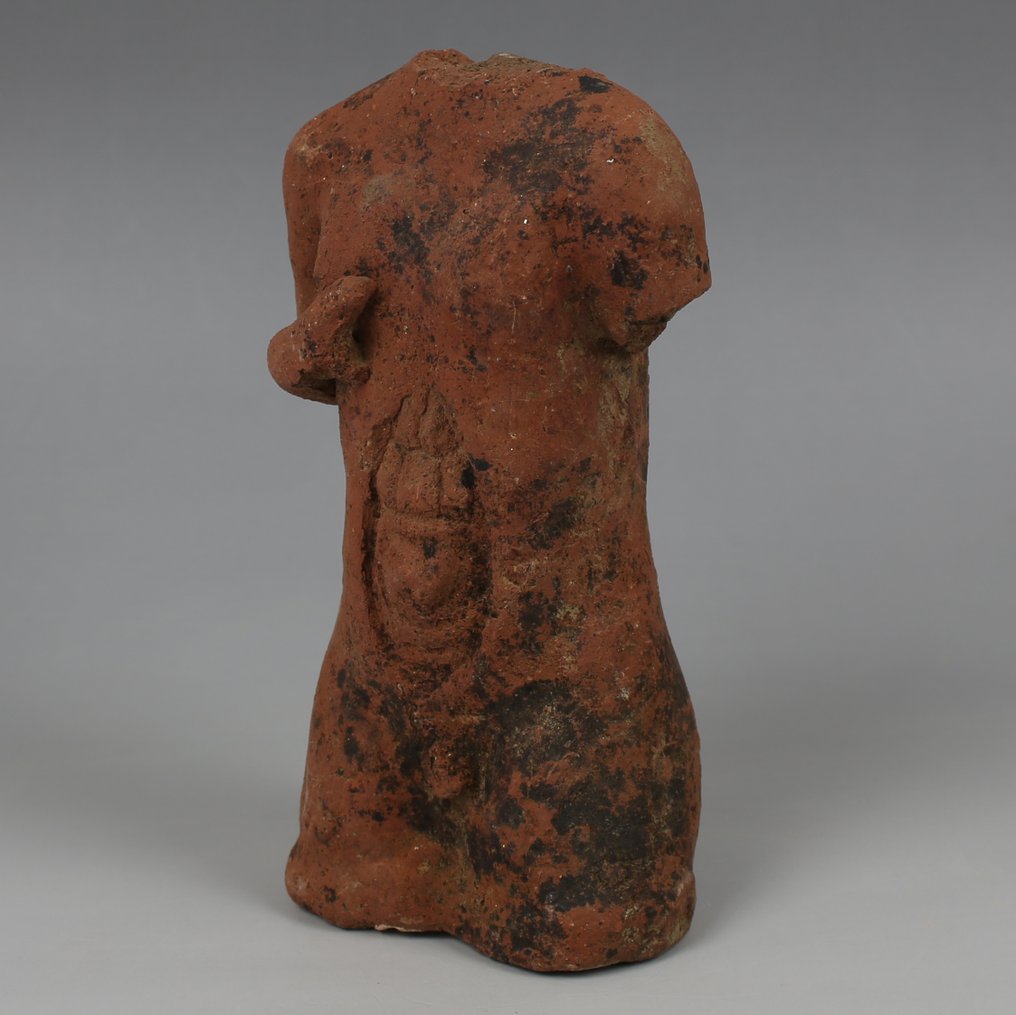
Etrusker Keramik Anatomisk offermodel af en torso.



Starter kl. 11:00
Startbud
€ 1
Føj til dine favoritter for at få en alarm når auktionen starter.

Ekspert
Udvalgt af Ruth Garrido Vila
Ledede Ifergan Collection Museum med speciale i fønikisk arkæologi.
Estimat € 1.000 - € 1.300
Catawikis køberbeskyttelse
Din betaling er sikker hos os, indtil du modtager din genstand.Se flere oplysninger
Trustpilot 4.4 | %{antal} anmeldelser
Bedømt som Fremragende på Trustpilot.
Beskrivelse fra sælger
ITEM: Anatomisk votivmodel af en overkrop
MATERIAL: Terracotta
CULTURE: Etruscan
PERIOD: 5th – 4th Century B.C
DIMENSIONS: 125 mm x 75 mm
CONDITION: Good condition
PROVENANCE: Ex Belgian private collection, Ex Spanish antiquities dealer (2022), Ex Belgian private collection, Brussels
Etruscan pottery reflects a dynamic blend of indigenous innovation and external influence, particularly from Greek and Near Eastern cultures. During the 7th century B.C., Etruscan potters developed the bucchero style—distinctive for its black, glossy surface achieved through a reducing firing technique. Bucchero vessels, often finely crafted and decorated with incised or relief patterns, served both everyday and ceremonial functions. Early examples were elegant and light, while later ones grew heavier and more elaborate, often mimicking metal prototypes.
By the 6th century B.C., the influence of Greek pottery became more pronounced, especially through the importation of Corinthian and Attic ceramics. Etruscan artisans began producing their own painted wares, imitating Greek black-figure and later red-figure techniques. These locally made vases, especially from workshops in places like Vulci and Cerveteri, frequently depict mythological scenes, banquets, and athletic contests, sometimes with uniquely Etruscan interpretations. Shapes such as amphorae, kraters, and kylikes were common, reflecting the importance of symposium culture.
In the 5th century B.C., Etruscan pottery production became increasingly regionalized and somewhat conservative compared to the innovations in Greek pottery. However, the continued production of impasto wares—coarse, hand-formed ceramics used for domestic purposes—demonstrates a parallel tradition alongside the finer, painted pieces.
Comes with Certificate of Authenticity and European Union export license
If you bid outside European Union and win the item, we must request a new export license to your country and the shipment will delay between 3 - 5 weeks.
#CollectorsFairMarch2026
Sælger's Historie
Din antikvar tilbyder gammel kunst og gamle mønter. Vores hovedmål er at tilbyde den højeste kvalitet til den bedste pris under respekt for og nøje overholde lovene om kulturarvsbeskyttelse og UNESCOs kulturarvsnormer. Derfor kommer alle de stykker, der udgives, fra private samlinger, hvor herkomsten kan kontrolleres eller internationale auktioner. Alle vores antikviteter og mønter er ledsaget af deres ægthedsbevis. Vi har en 90 dages returret uden tvivl. Hos Your Antiquarian er vi forpligtet til at hjælpe dårligt stillede grupper, og af denne grund doneres en del af hvert køb til velgørende organisationer for at hjælpe mennesker i nød.
Oversat af Google OversætITEM: Anatomisk votivmodel af en overkrop
MATERIAL: Terracotta
CULTURE: Etruscan
PERIOD: 5th – 4th Century B.C
DIMENSIONS: 125 mm x 75 mm
CONDITION: Good condition
PROVENANCE: Ex Belgian private collection, Ex Spanish antiquities dealer (2022), Ex Belgian private collection, Brussels
Etruscan pottery reflects a dynamic blend of indigenous innovation and external influence, particularly from Greek and Near Eastern cultures. During the 7th century B.C., Etruscan potters developed the bucchero style—distinctive for its black, glossy surface achieved through a reducing firing technique. Bucchero vessels, often finely crafted and decorated with incised or relief patterns, served both everyday and ceremonial functions. Early examples were elegant and light, while later ones grew heavier and more elaborate, often mimicking metal prototypes.
By the 6th century B.C., the influence of Greek pottery became more pronounced, especially through the importation of Corinthian and Attic ceramics. Etruscan artisans began producing their own painted wares, imitating Greek black-figure and later red-figure techniques. These locally made vases, especially from workshops in places like Vulci and Cerveteri, frequently depict mythological scenes, banquets, and athletic contests, sometimes with uniquely Etruscan interpretations. Shapes such as amphorae, kraters, and kylikes were common, reflecting the importance of symposium culture.
In the 5th century B.C., Etruscan pottery production became increasingly regionalized and somewhat conservative compared to the innovations in Greek pottery. However, the continued production of impasto wares—coarse, hand-formed ceramics used for domestic purposes—demonstrates a parallel tradition alongside the finer, painted pieces.
Comes with Certificate of Authenticity and European Union export license
If you bid outside European Union and win the item, we must request a new export license to your country and the shipment will delay between 3 - 5 weeks.
#CollectorsFairMarch2026
Sælger's Historie
Din antikvar tilbyder gammel kunst og gamle mønter. Vores hovedmål er at tilbyde den højeste kvalitet til den bedste pris under respekt for og nøje overholde lovene om kulturarvsbeskyttelse og UNESCOs kulturarvsnormer. Derfor kommer alle de stykker, der udgives, fra private samlinger, hvor herkomsten kan kontrolleres eller internationale auktioner. Alle vores antikviteter og mønter er ledsaget af deres ægthedsbevis. Vi har en 90 dages returret uden tvivl. Hos Your Antiquarian er vi forpligtet til at hjælpe dårligt stillede grupper, og af denne grund doneres en del af hvert køb til velgørende organisationer for at hjælpe mennesker i nød.
Oversat af Google OversætDetaljer
Kultur
Etrusker
Århundrede/ Tidsramme
5th – 4th Century B.C
Name of object
Anatomical votive model of a torso
Erhvervet fra
Privat samling
År erhvervet
2025
Materiale
Keramik
Land erhvervet fra
Belgien
Stand
God
Tidligere ejer erhvervet fra
Antikmarked
Tidligere ejer – år erhvervet
1980
Tidligere ejer – land erhvervet fra
Belgien
Jeg bekræfter, at jeg har erhvervet denne genstand lovligt, og at jeg har lov til at sælge det
Ja
Autenticitet
Original/officiel
Solgt af
Disclaimer
Sælgeren er blevet informeret af Catawiki om dokumentationskrav og garanterer følgende: - genstanden er lovligt erhvervet - sælgeren har ret til at sælge og/eller eksportere genstanden, alt efter hvad der er relevant - sælgeren vil give de nødvendige herkomstoplysninger og arrangere påkrævet dokumentation og tilladelser/licenser, som det er relevant og i henhold til lokal lovgivning - sælgeren vil underrette køberen om eventuelle forsinkelser i opnåelsen af tilladelser/licenser Ved at byde anerkender du, at importdokumentation kan være påkrævet afhængigt af dit bopælsland, og at opnåelse af tilladelser/licenser kan forårsage forsinkelser i leveringen af dit objekt.
Sælgeren er blevet informeret af Catawiki om dokumentationskrav og garanterer følgende: - genstanden er lovligt erhvervet - sælgeren har ret til at sælge og/eller eksportere genstanden, alt efter hvad der er relevant - sælgeren vil give de nødvendige herkomstoplysninger og arrangere påkrævet dokumentation og tilladelser/licenser, som det er relevant og i henhold til lokal lovgivning - sælgeren vil underrette køberen om eventuelle forsinkelser i opnåelsen af tilladelser/licenser Ved at byde anerkender du, at importdokumentation kan være påkrævet afhængigt af dit bopælsland, og at opnåelse af tilladelser/licenser kan forårsage forsinkelser i leveringen af dit objekt.
