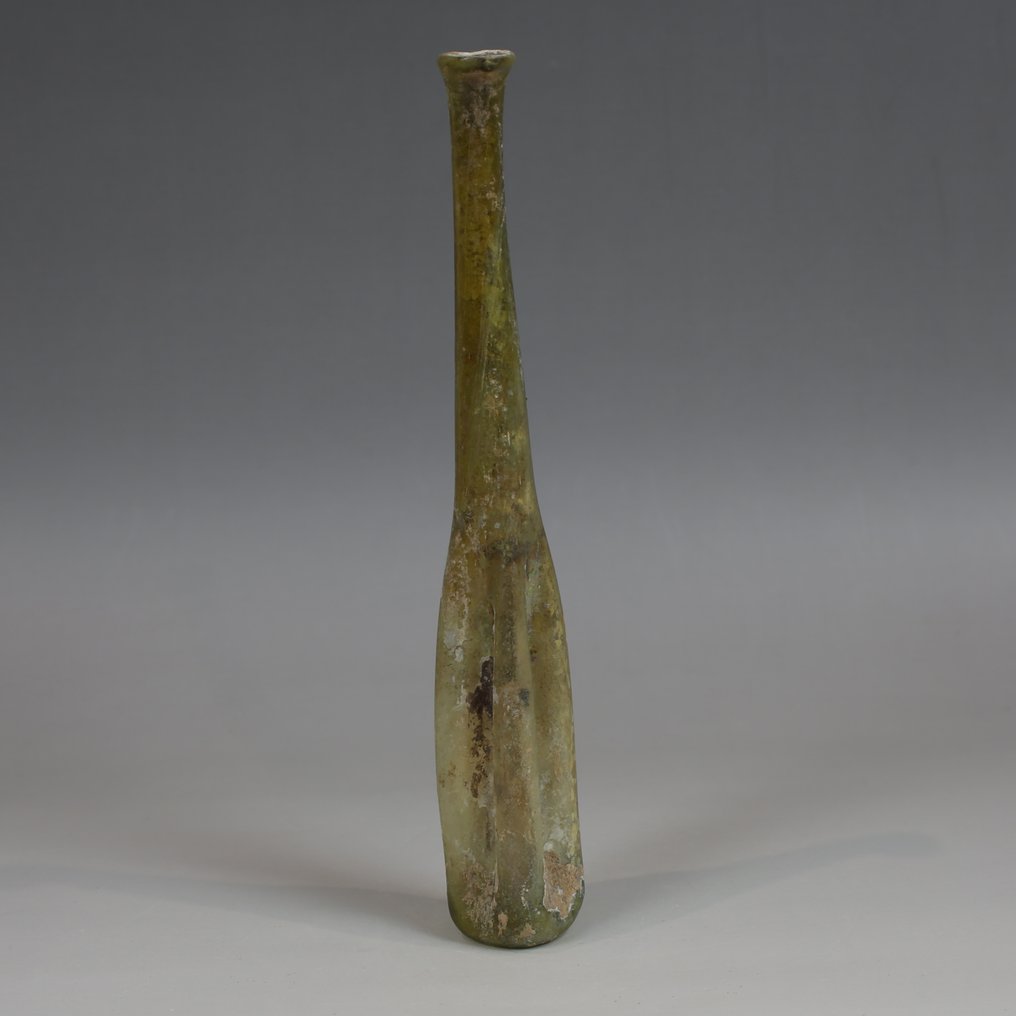
Romersk antik Glas Flask.


00
dage
09
timer
12
minutter
02
sekunder
Nuværende bud
€ 60
Mindstepris ikke opfyldt

Ekspert
Udvalgt af Ruth Garrido Vila
Ledede Ifergan Collection Museum med speciale i fønikisk arkæologi.
Estimat € 330 - € 400
12 andre mennesker holder øje med dette objekt
 Byder 6431 Byder 6431 | € 60 | |
|---|---|---|
 Byder 1839 Byder 1839 | € 1 |
Catawikis køberbeskyttelse
Din betaling er sikker hos os, indtil du modtager din genstand.Se flere oplysninger
Trustpilot 4.4 | %{antal} anmeldelser
Bedømt som Fremragende på Trustpilot.
Romersk glaskrukke, 165 × 21 mm, periode I–III e.Kr., i god stand, med ægthedscertifikat og eksportlicens, stammer fra en tysk privat samling.
AI-assisteret oversigt
Beskrivelse fra sælger
ITEM: Flask
MATERIAL: Glass
CULTURE: Roman
PERIOD: 1st - 3rd Century A.D
DIMENSIONS: 165 mm x 21 mm
CONDITION: Good condition
PROVENANCE: Ex German private collection, acquired before 2000s
Roman flasks were versatile and functional vessels used primarily for storing and transporting liquids such as oils, perfumes, and medicinal concoctions. These flasks, which were typically made from glass or ceramic, varied in size and shape, reflecting their diverse uses and the craftsmanship of the period. Glass flasks were particularly valued for their ability to contain and preserve aromatic oils and perfumes, which were essential in daily Roman life for personal grooming and religious rituals. Ceramic flasks, on the other hand, were often used for more practical purposes, such as storing cooking oils or vinegar.
The design of Roman flasks often included features that facilitated their use and storage. Many flasks had narrow necks to minimize spillage and maintain the quality of their contents. Some were equipped with handles or spouts to make pouring easier, while others had stoppers or lids to seal the contents securely. The artistic quality of these vessels varied from simple, utilitarian designs to more elaborate forms decorated with patterns or inscriptions. Inscriptions on flasks sometimes indicated the type of liquid contained or the name of the owner, adding a personalized touch to these everyday objects.
Roman flasks also provide valuable insights into trade and cultural exchanges within the Roman Empire. Glass production techniques, including the use of molds and blowing methods, were advanced during the Roman period, and Roman glassware was widely traded across the empire. The distribution of Roman flasks throughout various provinces reflects the extensive trade networks and the integration of different cultures within the empire. Additionally, the variety in flask designs and materials reveals the adaptability of Roman artisans to different regional tastes and technological innovations.
Comes with Certificate of Authenticity and Export license
If you bid outside the European Union and win the item, we will have to apply for an export licence for your country and shipping will take 3 to 5 weeks.
Sælger's Historie
Din antikvar tilbyder gammel kunst og gamle mønter. Vores hovedmål er at tilbyde den højeste kvalitet til den bedste pris under respekt for og nøje overholde lovene om kulturarvsbeskyttelse og UNESCOs kulturarvsnormer. Derfor kommer alle de stykker, der udgives, fra private samlinger, hvor herkomsten kan kontrolleres eller internationale auktioner. Alle vores antikviteter og mønter er ledsaget af deres ægthedsbevis. Vi har en 90 dages returret uden tvivl. Hos Your Antiquarian er vi forpligtet til at hjælpe dårligt stillede grupper, og af denne grund doneres en del af hvert køb til velgørende organisationer for at hjælpe mennesker i nød.
Oversat af Google OversætITEM: Flask
MATERIAL: Glass
CULTURE: Roman
PERIOD: 1st - 3rd Century A.D
DIMENSIONS: 165 mm x 21 mm
CONDITION: Good condition
PROVENANCE: Ex German private collection, acquired before 2000s
Roman flasks were versatile and functional vessels used primarily for storing and transporting liquids such as oils, perfumes, and medicinal concoctions. These flasks, which were typically made from glass or ceramic, varied in size and shape, reflecting their diverse uses and the craftsmanship of the period. Glass flasks were particularly valued for their ability to contain and preserve aromatic oils and perfumes, which were essential in daily Roman life for personal grooming and religious rituals. Ceramic flasks, on the other hand, were often used for more practical purposes, such as storing cooking oils or vinegar.
The design of Roman flasks often included features that facilitated their use and storage. Many flasks had narrow necks to minimize spillage and maintain the quality of their contents. Some were equipped with handles or spouts to make pouring easier, while others had stoppers or lids to seal the contents securely. The artistic quality of these vessels varied from simple, utilitarian designs to more elaborate forms decorated with patterns or inscriptions. Inscriptions on flasks sometimes indicated the type of liquid contained or the name of the owner, adding a personalized touch to these everyday objects.
Roman flasks also provide valuable insights into trade and cultural exchanges within the Roman Empire. Glass production techniques, including the use of molds and blowing methods, were advanced during the Roman period, and Roman glassware was widely traded across the empire. The distribution of Roman flasks throughout various provinces reflects the extensive trade networks and the integration of different cultures within the empire. Additionally, the variety in flask designs and materials reveals the adaptability of Roman artisans to different regional tastes and technological innovations.
Comes with Certificate of Authenticity and Export license
If you bid outside the European Union and win the item, we will have to apply for an export licence for your country and shipping will take 3 to 5 weeks.
Sælger's Historie
Din antikvar tilbyder gammel kunst og gamle mønter. Vores hovedmål er at tilbyde den højeste kvalitet til den bedste pris under respekt for og nøje overholde lovene om kulturarvsbeskyttelse og UNESCOs kulturarvsnormer. Derfor kommer alle de stykker, der udgives, fra private samlinger, hvor herkomsten kan kontrolleres eller internationale auktioner. Alle vores antikviteter og mønter er ledsaget af deres ægthedsbevis. Vi har en 90 dages returret uden tvivl. Hos Your Antiquarian er vi forpligtet til at hjælpe dårligt stillede grupper, og af denne grund doneres en del af hvert køb til velgørende organisationer for at hjælpe mennesker i nød.
Oversat af Google OversætDetaljer
Kultur
Romersk antik
Århundrede/ Tidsramme
1st - 3rd Century A.D
Name of object
Flask.
Erhvervet fra
Privat samling
År erhvervet
2025
Materiale
Glas
Land erhvervet fra
Tyskland
Stand
God
Tidligere ejer erhvervet fra
Antikmarked
Tidligere ejer – år erhvervet
2000
Tidligere ejer – land erhvervet fra
Tyskland
Jeg bekræfter, at jeg har erhvervet denne genstand lovligt, og at jeg har lov til at sælge det
Ja
Solgt af
Disclaimer
Sælgeren er blevet informeret af Catawiki om dokumentationskrav og garanterer følgende: - genstanden er lovligt erhvervet - sælgeren har ret til at sælge og/eller eksportere genstanden, alt efter hvad der er relevant - sælgeren vil give de nødvendige herkomstoplysninger og arrangere påkrævet dokumentation og tilladelser/licenser, som det er relevant og i henhold til lokal lovgivning - sælgeren vil underrette køberen om eventuelle forsinkelser i opnåelsen af tilladelser/licenser Ved at byde anerkender du, at importdokumentation kan være påkrævet afhængigt af dit bopælsland, og at opnåelse af tilladelser/licenser kan forårsage forsinkelser i leveringen af dit objekt.
Sælgeren er blevet informeret af Catawiki om dokumentationskrav og garanterer følgende: - genstanden er lovligt erhvervet - sælgeren har ret til at sælge og/eller eksportere genstanden, alt efter hvad der er relevant - sælgeren vil give de nødvendige herkomstoplysninger og arrangere påkrævet dokumentation og tilladelser/licenser, som det er relevant og i henhold til lokal lovgivning - sælgeren vil underrette køberen om eventuelle forsinkelser i opnåelsen af tilladelser/licenser Ved at byde anerkender du, at importdokumentation kan være påkrævet afhængigt af dit bopælsland, og at opnåelse af tilladelser/licenser kan forårsage forsinkelser i leveringen af dit objekt.
