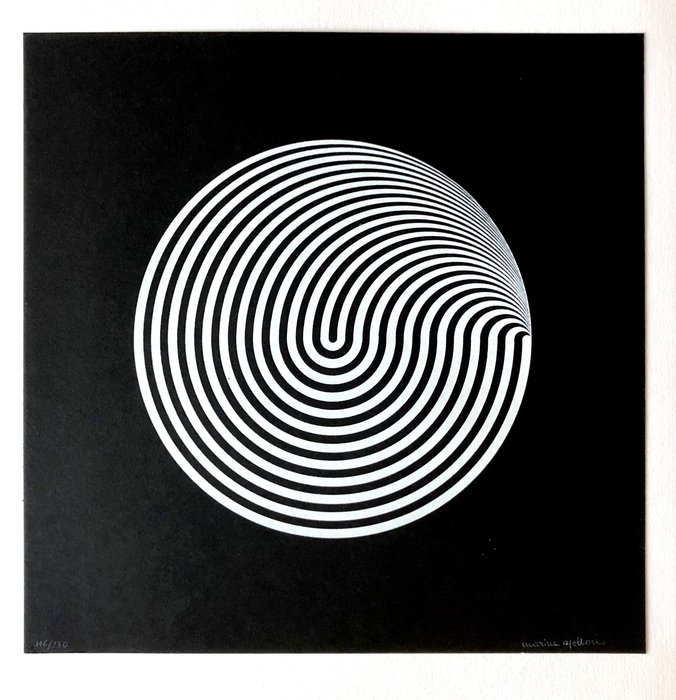
Marina Apollonio (1940) - Dinamica circolare 1966 (negative)


350 € | ||
|---|---|---|
305 € | ||
265 € | ||
Προστασία Αγοραστή Catawiki
Η πληρωμή σας είναι ασφαλής μαζί μας μέχρι να παραλάβετε το αντικείμενό σας.Προβολή λεπτομερειών
Trustpilot 4.4 | 137988 κριτικών
Βαθμολογήθηκε με Άριστα στο Trustpilot.
Μαρίνα Απολλωνίo, Dinamica circolare 1966 (negative), περιορισμένη εκτύπωση σε χαρτί που είναι προσαρτημένο σε χαρτόνι, 28 × 28 εκ., χειρόγραφα υπογεγραμμένη, σε άριστη κατάσταση, δημοσιεύθηκε το 1966 από Edition Panderma Basel ως μη αριθμημένο αντίτυπο από 230 αντίτυπα.
Περιγραφή από τον πωλητή
Marina Apollonio: "Dinamica circolare" (1966)
Medium: Mixed Media
Material: Paper - fixed on cardboard (31 x 31.5 cm)
Dimensions: 28 x 28 cm
Editor: Edition Panderma, Basel
Year: published 1966
Edition: This is an unnumbered copy of 230 editions
(65 hors commerce were unnumbered)
Signature: hand signed
Provenance:
Edition Panderma, Carl Laszlo Basel
Galerie von Bartha, Basel
Private Collection, Basel
Condition / Restauration:
Mint archival condition
Further Information:
A rare limited edition of the portable collection of post-war and contemporary art La Lune en Rodage III. This is an unnumbered copy of 230 editions (65 hors commerce were unnumbered) and part of the third serie of the La Lune en Rodage books. La Lune en Rodage was published in three volumes in 1960, 1965 and 1977 containing a total of approximately 180 art pieces which provide an account of the artistic avant-garde scene between the 1950s and 1970s. The art works were gathered by Carl Laslzo and included the greatest artists of the time who contributed with important pieces, often marking a turning point in their production and carriers: Enrico Castellani’s work for example is his first documented graphic work and Piero Manzoni's multiple Achrome is the only one produced by the artist.
Biography:
Marina Apollonio, daughter of the well-known art historian Umberto Apollonio, followed the precepts of Arte Programmata from a young age. She exhibited for the first time in 1965 together with Alviani, Biasi, Colombo, Dadamaino, Mari and Scheggi. Her Dinamica circolare series dates from 1964; the artist, who was part of Gruppo Enne, took part in the fourth edition of New Tendencies in Zagreb. Critics and international institutions unanimously recognised the theoretical implication of these works.
Ιστορία πωλητή
Marina Apollonio: "Dinamica circolare" (1966)
Medium: Mixed Media
Material: Paper - fixed on cardboard (31 x 31.5 cm)
Dimensions: 28 x 28 cm
Editor: Edition Panderma, Basel
Year: published 1966
Edition: This is an unnumbered copy of 230 editions
(65 hors commerce were unnumbered)
Signature: hand signed
Provenance:
Edition Panderma, Carl Laszlo Basel
Galerie von Bartha, Basel
Private Collection, Basel
Condition / Restauration:
Mint archival condition
Further Information:
A rare limited edition of the portable collection of post-war and contemporary art La Lune en Rodage III. This is an unnumbered copy of 230 editions (65 hors commerce were unnumbered) and part of the third serie of the La Lune en Rodage books. La Lune en Rodage was published in three volumes in 1960, 1965 and 1977 containing a total of approximately 180 art pieces which provide an account of the artistic avant-garde scene between the 1950s and 1970s. The art works were gathered by Carl Laslzo and included the greatest artists of the time who contributed with important pieces, often marking a turning point in their production and carriers: Enrico Castellani’s work for example is his first documented graphic work and Piero Manzoni's multiple Achrome is the only one produced by the artist.
Biography:
Marina Apollonio, daughter of the well-known art historian Umberto Apollonio, followed the precepts of Arte Programmata from a young age. She exhibited for the first time in 1965 together with Alviani, Biasi, Colombo, Dadamaino, Mari and Scheggi. Her Dinamica circolare series dates from 1964; the artist, who was part of Gruppo Enne, took part in the fourth edition of New Tendencies in Zagreb. Critics and international institutions unanimously recognised the theoretical implication of these works.