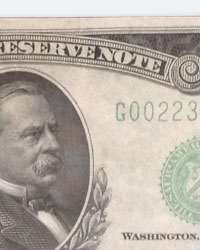
Ηνωμένες Πολιτείες Αμερικής. - 1 Dollar - 1899 - Fr.236 (χωρίς τιμή ασφαλείας)


07
ημέρες
23
ώρες
49
λεπτά
53
δευτερόλεπτα

 | 5 € | |
|---|---|---|
 | 4 € | |
Προστασία Αγοραστή Catawiki
Η πληρωμή σας είναι ασφαλής μαζί μας μέχρι να παραλάβετε το αντικείμενό σας.Προβολή λεπτομερειών
Trustpilot 4.4 | 139877 κριτικών
Βαθμολογήθηκε με Άριστα στο Trustpilot.
Ηνωμένες Πολιτείες Αμερικής, Silver Certificate ενός δολαρίου από το 1899 γνωστό ως Black Eagle, Fr.236, σειριακός αριθμός R29555625A, υπογραφές Speelman-White, μεγάλης μορφής, σε πολύ κυκλοφορία με πτυχώσεις και σκιάσεις, ευανάγνωστες οι εγγραφές.
Περίληψη με τη βοήθεια τεχνητής νοημοσύνης
Περιγραφή από τον πωλητή
Certificate Silver $1 του 1899 «Black Eagle» – Fr.236, Speelman–White, S/N R29555625A
United States One Dollar Silver Certificate, Series of 1899, commonly known as the “Black Eagle”, serial number R29555625A. This signature combination of Harley V. Speelman, Register of the Treasury, and Frank White, Treasurer of the United States, is catalogued as Friedberg Fr.236. The note carries the characteristic blue Treasury seal and blue serial numbers of the issue.
The face features the celebrated “Eagle of the Capitol” vignette, with a spread-winged American bald eagle and the United States Capitol visible in the background. Portraits of Abraham Lincoln and Ulysses S. Grant appear beneath the central vignette. The reverse is printed in dark green with elaborate large-size guilloché work, repeated ONE denominations, “UNITED STATES OF AMERICA” and “SILVER CERTIFICATE”. This is the classic large-size U.S. currency format associated with the Series of 1899 Black Eagle design.
The note retains clearly readable inscriptions, serial numbers, Treasury seal and signatures. The principal engraved details remain well defined despite extensive circulation, including the eagle, presidential portraits and the intricate reverse ornamentation. The Black Eagle design is one of the most recognisable United States large-size Silver Certificate types.
Condition: heavily circulated, with numerous strong horizontal and vertical folds, extensive secondary creasing and overall surface wrinkling. The paper shows pronounced age toning, handling dirt and brownish staining, particularly across the central fields and fold lines. The margins display wear, compression and light fraying, while the corners are softened and creased. Several old handling marks and small coloured/pencil-like marks are visible in the fields. The main fold intersections show substantial paper wear, but no large area of paper loss is visible in the supplied photographs. The note remains complete and the main printed design, blue seal and serial number retain good legibility.
Certificate Silver $1 του 1899 «Black Eagle» – Fr.236, Speelman–White, S/N R29555625A
United States One Dollar Silver Certificate, Series of 1899, commonly known as the “Black Eagle”, serial number R29555625A. This signature combination of Harley V. Speelman, Register of the Treasury, and Frank White, Treasurer of the United States, is catalogued as Friedberg Fr.236. The note carries the characteristic blue Treasury seal and blue serial numbers of the issue.
The face features the celebrated “Eagle of the Capitol” vignette, with a spread-winged American bald eagle and the United States Capitol visible in the background. Portraits of Abraham Lincoln and Ulysses S. Grant appear beneath the central vignette. The reverse is printed in dark green with elaborate large-size guilloché work, repeated ONE denominations, “UNITED STATES OF AMERICA” and “SILVER CERTIFICATE”. This is the classic large-size U.S. currency format associated with the Series of 1899 Black Eagle design.
The note retains clearly readable inscriptions, serial numbers, Treasury seal and signatures. The principal engraved details remain well defined despite extensive circulation, including the eagle, presidential portraits and the intricate reverse ornamentation. The Black Eagle design is one of the most recognisable United States large-size Silver Certificate types.
Condition: heavily circulated, with numerous strong horizontal and vertical folds, extensive secondary creasing and overall surface wrinkling. The paper shows pronounced age toning, handling dirt and brownish staining, particularly across the central fields and fold lines. The margins display wear, compression and light fraying, while the corners are softened and creased. Several old handling marks and small coloured/pencil-like marks are visible in the fields. The main fold intersections show substantial paper wear, but no large area of paper loss is visible in the supplied photographs. The note remains complete and the main printed design, blue seal and serial number retain good legibility.
Λεπτομέρειες
Εποχή
1400-1900
Κατάσταση
Ungraded
Over 200 years old
Όχι
Denomination
Dollar
Χώρα/επαρχία
Ηνωμένες Πολιτείες Αμερικής
Έτος / Περίοδος και Παραλλαγή
- 1899
Catalogue number
Fr.236
Ποσότητα x ονομαστική αξία
- 1
Αριθμός αντικειμένων
1
Απεικόνιση/θέμα
History
Πωλήθηκε από τον/-ην