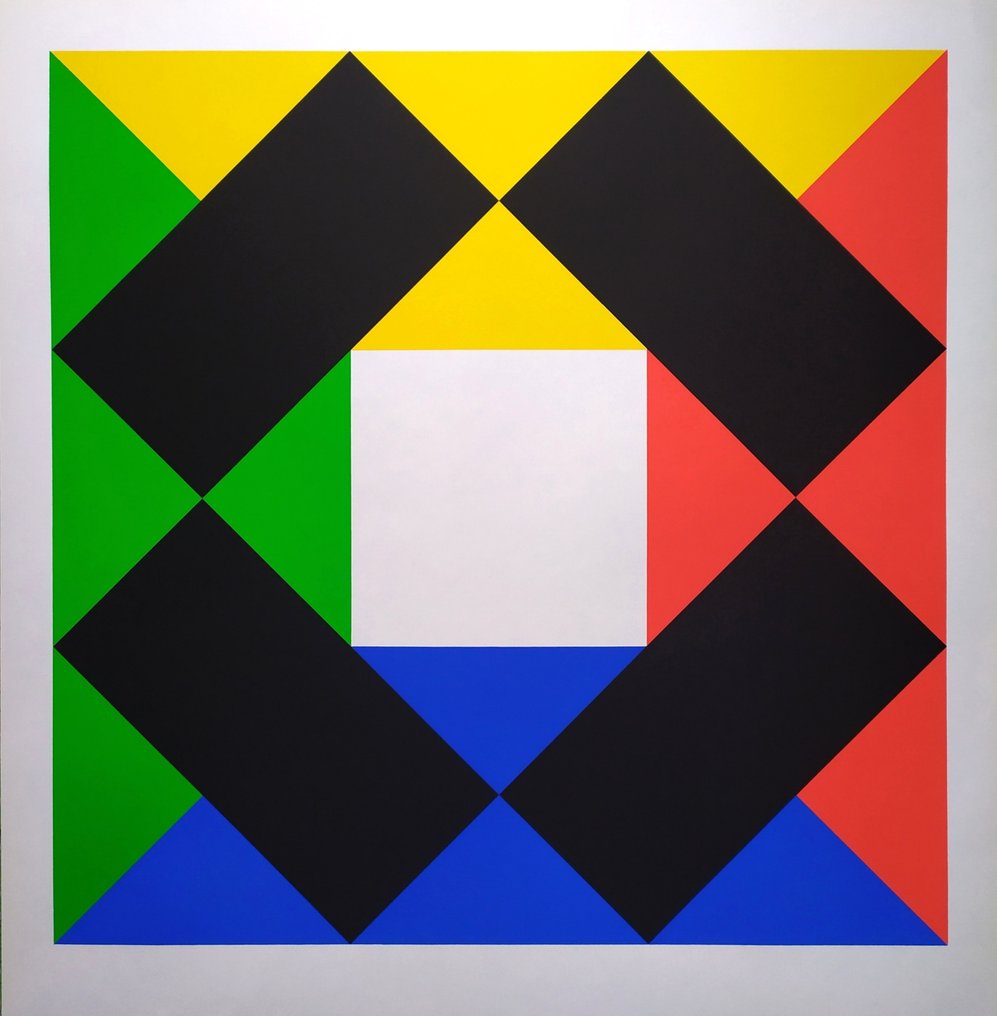
Max Bill (1908-1994) - "Komposition Mit Weißem Zentrum, 1972"



06
días
12
horas
57
minutos
08
segundos
Puja actual
€ 1
Sin precio de reserva

Experto
Seleccionado por Juan Antonio Rodríguez
Ocho años valorando carteles; tasador en Balclis, Barcelona.
Estimación € 150 - € 200
6 personas más están mirando este objeto
 Pujador 5585 Pujador 5585 | 1 € |
|---|
Protección del Comprador de Catawiki
Tu pago está protegido con nosotros hasta que recibas tu objeto.Ver detalles
Trustpilot 4.4 | 123418 valoraciones
Valoración Excelente en Trustpilot.
Descripción del vendedor
- Screenprint / Serigraph on fine veil paper, published in 1972 in the "Look At" edition of the Galerie Thomas (Munich).
- Size: 67x68,5cm.
- Discontinued item. Closed edition, available only in the secondary market (auctions, resellers, galleries, etc.)
- Condition: excellent. Never framed, never exposed.
- Max Bill (1908–1994) was a Swiss architect, painter, sculptor, and designer, widely recognized as one of the most important figures of Concrete Art. Trained at the Bauhaus in Dessau under teachers such as Wassily Kandinsky and Paul Klee, Bill developed a rigorous visual language that combined mathematics, geometry, and aesthetic clarity. His art is characterized by precise forms, vibrant color fields, and a pursuit of harmony through proportion and balance. Beyond painting, his career extended into architecture and industrial design, where he applied the same principles of clarity and function.
Bill’s works are highly valued in the international art market, particularly his paintings, prints, and sculptures that exemplify geometric abstraction. Collectors and institutions value his contribution as a bridge between Bauhaus modernism and postwar minimal and conceptual practices.
Komposition mit weißem Zentrum (1972) is a striking example of Bill’s geometric rigor. The composition presents a square divided into colorful triangular and rectangular sections red, yellow, green, blue, and black arranged around a stark white center. The work demonstrates Bill’s interest in balance and contrast, with the white void functioning as a focal point of calm amid the dynamic interplay of colors and shapes. It embodies his idea of art as “concrete,” free from representation, existing purely as an arrangement of forms and relationships.
Some artists of similar importance, Basquiat, Picasso, Hockney, Lichtenstein, Miro, Banksy, Brainwash, Delaunay, Nara, Soulages, Lagasse, Ramos, Rothko, Lautrec, Klimt, Matisse, Hirst, Chagall, Koons, Haring, Indiana, Mondrian, Groening, Richter, Monroe, Kusama, Murakami, Testa, Villemot, Oldenburg, Hopper, Ripolles, Wesselmann, Magritte, Jenk, Orlinski, Wille, Rizzi, Manara, Thiebaud, Herrera, Laurent, Klein, Coa, Dior, Vuitton, Kaws, Valentino, Cappiello, Kandinsky, Warhol, Buffa, Tura, Castle, Ponti, Knoll, Corbusier, rober, Johns, Starck, Breuer, Nelson, Mogensen, Ponti, Bertoia, Urquiola, Chillida. Magistretti, Gauguin, Monet, Cezanne, Van Gogh, Botero, Katz, Braque, among others.
El vendedor y su historia
Vendedor en Catawiki desde hace más de siete años.
Te invito a visitar mi perfil, allí encontrarás una lista completa de los diferentes lotes que se están subastando ahora. Haga clic en "Yuke".
¡Buena suerte en las subastas!
- Screenprint / Serigraph on fine veil paper, published in 1972 in the "Look At" edition of the Galerie Thomas (Munich).
- Size: 67x68,5cm.
- Discontinued item. Closed edition, available only in the secondary market (auctions, resellers, galleries, etc.)
- Condition: excellent. Never framed, never exposed.
- Max Bill (1908–1994) was a Swiss architect, painter, sculptor, and designer, widely recognized as one of the most important figures of Concrete Art. Trained at the Bauhaus in Dessau under teachers such as Wassily Kandinsky and Paul Klee, Bill developed a rigorous visual language that combined mathematics, geometry, and aesthetic clarity. His art is characterized by precise forms, vibrant color fields, and a pursuit of harmony through proportion and balance. Beyond painting, his career extended into architecture and industrial design, where he applied the same principles of clarity and function.
Bill’s works are highly valued in the international art market, particularly his paintings, prints, and sculptures that exemplify geometric abstraction. Collectors and institutions value his contribution as a bridge between Bauhaus modernism and postwar minimal and conceptual practices.
Komposition mit weißem Zentrum (1972) is a striking example of Bill’s geometric rigor. The composition presents a square divided into colorful triangular and rectangular sections red, yellow, green, blue, and black arranged around a stark white center. The work demonstrates Bill’s interest in balance and contrast, with the white void functioning as a focal point of calm amid the dynamic interplay of colors and shapes. It embodies his idea of art as “concrete,” free from representation, existing purely as an arrangement of forms and relationships.
Some artists of similar importance, Basquiat, Picasso, Hockney, Lichtenstein, Miro, Banksy, Brainwash, Delaunay, Nara, Soulages, Lagasse, Ramos, Rothko, Lautrec, Klimt, Matisse, Hirst, Chagall, Koons, Haring, Indiana, Mondrian, Groening, Richter, Monroe, Kusama, Murakami, Testa, Villemot, Oldenburg, Hopper, Ripolles, Wesselmann, Magritte, Jenk, Orlinski, Wille, Rizzi, Manara, Thiebaud, Herrera, Laurent, Klein, Coa, Dior, Vuitton, Kaws, Valentino, Cappiello, Kandinsky, Warhol, Buffa, Tura, Castle, Ponti, Knoll, Corbusier, rober, Johns, Starck, Breuer, Nelson, Mogensen, Ponti, Bertoia, Urquiola, Chillida. Magistretti, Gauguin, Monet, Cezanne, Van Gogh, Botero, Katz, Braque, among others.
El vendedor y su historia
Vendedor en Catawiki desde hace más de siete años.
Te invito a visitar mi perfil, allí encontrarás una lista completa de los diferentes lotes que se están subastando ahora. Haga clic en "Yuke".
¡Buena suerte en las subastas!
Datos
Artista
Max Bill (1908-1994)
Vendido por
Propietario o revendedor
Edición
Edición limitada
Título de la obra
"Komposition Mit Weißem Zentrum, 1972"
Técnica
Serigrafía
Firma
Sin firmar
País de origen
Alemania
Año
1972
Estado
En excelente estado
Color
Amarillo, Azul, Blanco, Negro, Rojo, Verde
Alto
67 cm
Ancho
68,5 cm
Periodo
1970-1980
Se vende con marco
No
Vendido por