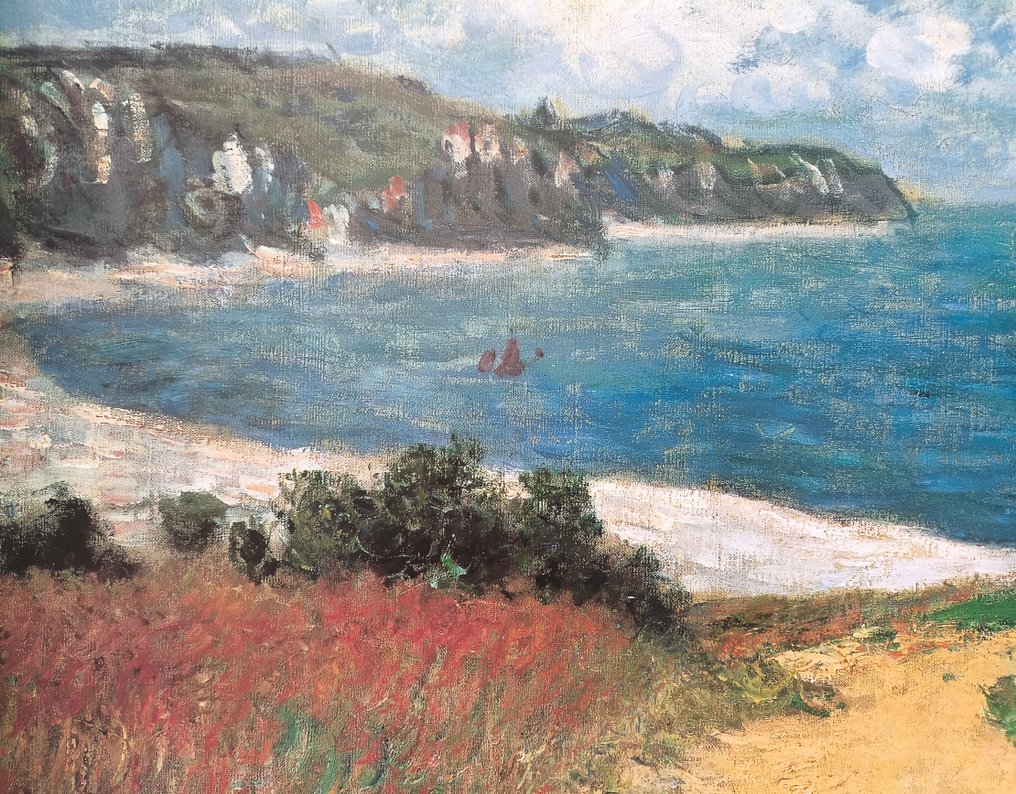
Claude Monet (1840–1926) (after) - "Path Through the Corn at Pourville, 1882"



06
días
00
horas
08
minutos
54
segundos
Puja actual
€ 10
Sin precio de reserva

Experto
Seleccionado por Juan Antonio Rodríguez
Ocho años valorando carteles; tasador en Balclis, Barcelona.
Estimación € 150 - € 200
8 personas más están mirando este objeto
 Pujador 4456 Pujador 4456 | 10 € | |
|---|---|---|
 Pujador 7644 Pujador 7644 | 1 € |
Protección del Comprador de Catawiki
Tu pago está protegido con nosotros hasta que recibas tu objeto.Ver detalles
Trustpilot 4.4 | 123536 valoraciones
Valoración Excelente en Trustpilot.
Descripción del vendedor
- Claude Monet (after), authorized offset print on heavyweight smooth satin paper (300gsm approx.). By Migneco graphics.
- Stamp on verso.
- Condition: excellent. Never framed, never exposed.
- Size: 60 x 80cm.
- Claude Monet (1840–1926) was a French painter and one of the founders and central figures of the Impressionist movement. His innovative approach to color, light, and atmosphere transformed modern art, emphasizing the transient effects of nature over traditional, detailed representation. Monet sought to capture the fleeting sensations of a moment, using quick, visible brushstrokes and a vibrant palette to express how light interacted with the landscape at different times of day and under varying weather conditions.
Monet’s dedication to painting “en plein air” (outdoors) became a defining aspect of Impressionism. His subjects ranged from serene gardens and water lilies to rural fields, rivers, and coastal views. Rather than focusing on line and form, Monet sought to evoke mood and perception an approach that profoundly influenced generations of artists.
Today, Monet’s paintings are among the most sought-after and valuable works in the art market. His canvases regularly achieve record prices at auction; for example, Meules (Haystacks) sold for over $110 million in 2019. Collectors and museums worldwide consider his works masterpieces that represent a turning point in Western art.
One of Monet’s notable works, Path Through the Corn at Pourville (1882), exemplifies his mastery of light and landscape. Painted during his stay in the small fishing village of Pourville-sur-Mer on the Normandy coast, the piece captures a winding sandy path leading to the sea, bordered by vibrant red and green vegetation under a brilliant blue sky. The composition conveys depth and openness, while the energetic brushwork and shimmering hues evoke the movement of wind and light across the fields and waves.
This piece reflects Monet’s fascination with the interplay between land, sea, and sky a hallmark of his coastal works from the early 1880s. It demonstrates his ability to transform a simple countryside view into a poetic study of light and color, making Path Through the Corn at Pourville a quintessential example of Impressionist beauty and harmony.
Some artists of similar importance, Basquiat, Hockney, Lichtenstein, Sorolla, Banksy, Brainwash, Delaunay, Nara, Soulages, Lagasse, Ramos, Rothko, Lautrec, Klimt, Matisse, Hirst, Chagall, Koons, Haring, Indiana, Mondrian, Groening, Richter, Monroe, Kusama, Murakami, Coa, Hopper, Ripolles, Wesselmann, Magritte, Jenk, Orlinski, Wille, Rizzi, Manara, Thiebaud, Herrera, Laurent, Klein, Dior, Vuitton, Kaws, Cappiello, Kandinsky, Warhol, Buffa, Tura, Castle, Katz, Braque, among others.
El vendedor y su historia
Vendedor en Catawiki desde hace más de siete años.
Te invito a visitar mi perfil, allí encontrarás una lista completa de los diferentes lotes que se están subastando ahora. Haga clic en "Yuke".
¡Buena suerte en las subastas!
- Claude Monet (after), authorized offset print on heavyweight smooth satin paper (300gsm approx.). By Migneco graphics.
- Stamp on verso.
- Condition: excellent. Never framed, never exposed.
- Size: 60 x 80cm.
- Claude Monet (1840–1926) was a French painter and one of the founders and central figures of the Impressionist movement. His innovative approach to color, light, and atmosphere transformed modern art, emphasizing the transient effects of nature over traditional, detailed representation. Monet sought to capture the fleeting sensations of a moment, using quick, visible brushstrokes and a vibrant palette to express how light interacted with the landscape at different times of day and under varying weather conditions.
Monet’s dedication to painting “en plein air” (outdoors) became a defining aspect of Impressionism. His subjects ranged from serene gardens and water lilies to rural fields, rivers, and coastal views. Rather than focusing on line and form, Monet sought to evoke mood and perception an approach that profoundly influenced generations of artists.
Today, Monet’s paintings are among the most sought-after and valuable works in the art market. His canvases regularly achieve record prices at auction; for example, Meules (Haystacks) sold for over $110 million in 2019. Collectors and museums worldwide consider his works masterpieces that represent a turning point in Western art.
One of Monet’s notable works, Path Through the Corn at Pourville (1882), exemplifies his mastery of light and landscape. Painted during his stay in the small fishing village of Pourville-sur-Mer on the Normandy coast, the piece captures a winding sandy path leading to the sea, bordered by vibrant red and green vegetation under a brilliant blue sky. The composition conveys depth and openness, while the energetic brushwork and shimmering hues evoke the movement of wind and light across the fields and waves.
This piece reflects Monet’s fascination with the interplay between land, sea, and sky a hallmark of his coastal works from the early 1880s. It demonstrates his ability to transform a simple countryside view into a poetic study of light and color, making Path Through the Corn at Pourville a quintessential example of Impressionist beauty and harmony.
Some artists of similar importance, Basquiat, Hockney, Lichtenstein, Sorolla, Banksy, Brainwash, Delaunay, Nara, Soulages, Lagasse, Ramos, Rothko, Lautrec, Klimt, Matisse, Hirst, Chagall, Koons, Haring, Indiana, Mondrian, Groening, Richter, Monroe, Kusama, Murakami, Coa, Hopper, Ripolles, Wesselmann, Magritte, Jenk, Orlinski, Wille, Rizzi, Manara, Thiebaud, Herrera, Laurent, Klein, Dior, Vuitton, Kaws, Cappiello, Kandinsky, Warhol, Buffa, Tura, Castle, Katz, Braque, among others.
El vendedor y su historia
Vendedor en Catawiki desde hace más de siete años.
Te invito a visitar mi perfil, allí encontrarás una lista completa de los diferentes lotes que se están subastando ahora. Haga clic en "Yuke".
¡Buena suerte en las subastas!
Datos
Artista
Claude Monet (1840–1926) (after)
Vendido por
Propietario o revendedor
Edición
Original
Título de la obra
"Path Through the Corn at Pourville, 1882"
Técnica
Impresión ófset
Firma
Firmado en plancha
País de origen
Italia
Estado
En excelente estado
Alto
60 cm
Ancho
80 cm
Representación/tema
Paisaje marino
Periodo
2000 - 2010
Se vende con marco
No
Vendido por