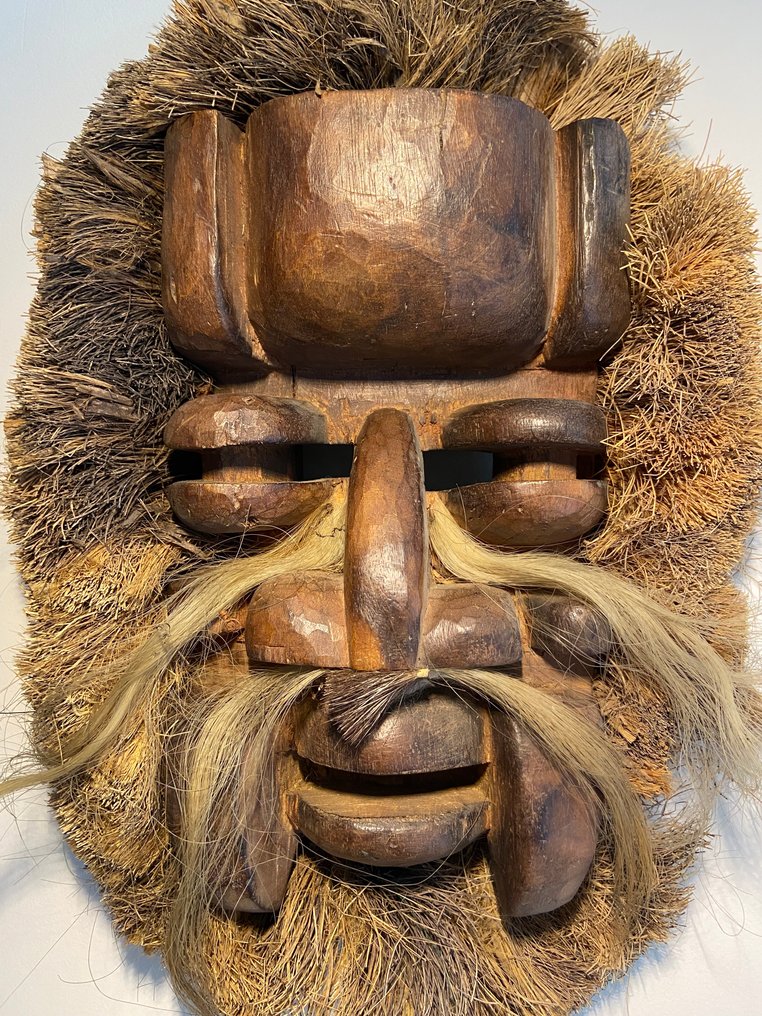
Máscara N'guéré-Wobé - N'Guéré-Wobé - Costa de Marfil



05
días
06
horas
28
minutos
17
segundos
Empezar a pujar
€ 1
Precio de reserva no alcanzado

Experto
Seleccionado por Dimitri André
Posee un título de posgrado en Estudios Africanos y 15 años de experiencia en Arte Africano.
Estimación € 280 - € 330
No hay ninguna puja
Protección del Comprador de Catawiki
Tu pago está protegido con nosotros hasta que recibas tu objeto.Ver detalles
Trustpilot 4.4 | 123641 valoraciones
Valoración Excelente en Trustpilot.
Máscara N'guéré-Wobé, máscara de madera y rafia de los N'Guéré-Wobé de Costa de Marfil, 38 cm de alto, procedencia Mundo Africano, Barcelona; Argiles Collection, Barcelona.
Resumen redactado con la ayuda de la IA
Descripción del vendedor
The N'Guéré-Wobé, also called Wé, which means “men who forgive easily,” inhabit the forests along the western border of Ivory Coast. They are divided into two different tribes, the N'guére, also known as Guéré, and the Wobé, who share many customs and beliefs. Confederations govern these tribes; they are led by a chief who is also a civil authority. The family unit plays an important role among the Wé. Each family is under the authority of an elder, revered for his wisdom and wealth, who organizes family life, marriages, conflicts, and religious life. Masks are part of the attributes of the Gla social control society. This institution is very similar to that of the Dan mask society. The members, who belong to certain lineages, meet far from the village in a sacred enclosure marked by a raffia curtain hanging at the entrance. This entrance leads to a courtyard where the Kpan is located, which houses the masks and objects needed for the ritual. The Wé use them to represent the powerful forest demon with a deformed face, exuberant and aggressive in form, conveying great dynamism. The masks, in which zoomorphic elements merge with human elements in an exasperating naturalism, have very prominent foreheads and eyebrows, swollen lips, a fleshy, flattened nose, and tubular or almond-shaped eyes. Some have iron or horn fangs attached, while others sometimes feature stylized cones or cylinders, arches, or half-spheres. The masks belonging to the so-called Grebo style—in the inner Cavally region, in Liberia, and in Ivory Coast—are influenced by the cubist style of the N'Guéré.
Provenance: Mundo Africano, Barcelona
Argiles Collection, Barcelona
The N'Guéré-Wobé, also called Wé, which means “men who forgive easily,” inhabit the forests along the western border of Ivory Coast. They are divided into two different tribes, the N'guére, also known as Guéré, and the Wobé, who share many customs and beliefs. Confederations govern these tribes; they are led by a chief who is also a civil authority. The family unit plays an important role among the Wé. Each family is under the authority of an elder, revered for his wisdom and wealth, who organizes family life, marriages, conflicts, and religious life. Masks are part of the attributes of the Gla social control society. This institution is very similar to that of the Dan mask society. The members, who belong to certain lineages, meet far from the village in a sacred enclosure marked by a raffia curtain hanging at the entrance. This entrance leads to a courtyard where the Kpan is located, which houses the masks and objects needed for the ritual. The Wé use them to represent the powerful forest demon with a deformed face, exuberant and aggressive in form, conveying great dynamism. The masks, in which zoomorphic elements merge with human elements in an exasperating naturalism, have very prominent foreheads and eyebrows, swollen lips, a fleshy, flattened nose, and tubular or almond-shaped eyes. Some have iron or horn fangs attached, while others sometimes feature stylized cones or cylinders, arches, or half-spheres. The masks belonging to the so-called Grebo style—in the inner Cavally region, in Liberia, and in Ivory Coast—are influenced by the cubist style of the N'Guéré.
Provenance: Mundo Africano, Barcelona
Argiles Collection, Barcelona
Datos
N.º de artículos
1
Grupo étnico/cultura
N'Guéré-Wobé
País de origen
Costa de Marfil
Periodo estimado
mediados del siglo XX
Material
Rafia, Madera
Sold with stand
No
Estado
En buen estado
Título de la obra de arte
Mask N'guéré-Wobé
Alto
38 cm
Procedencia
Colección privada
Vendido por
