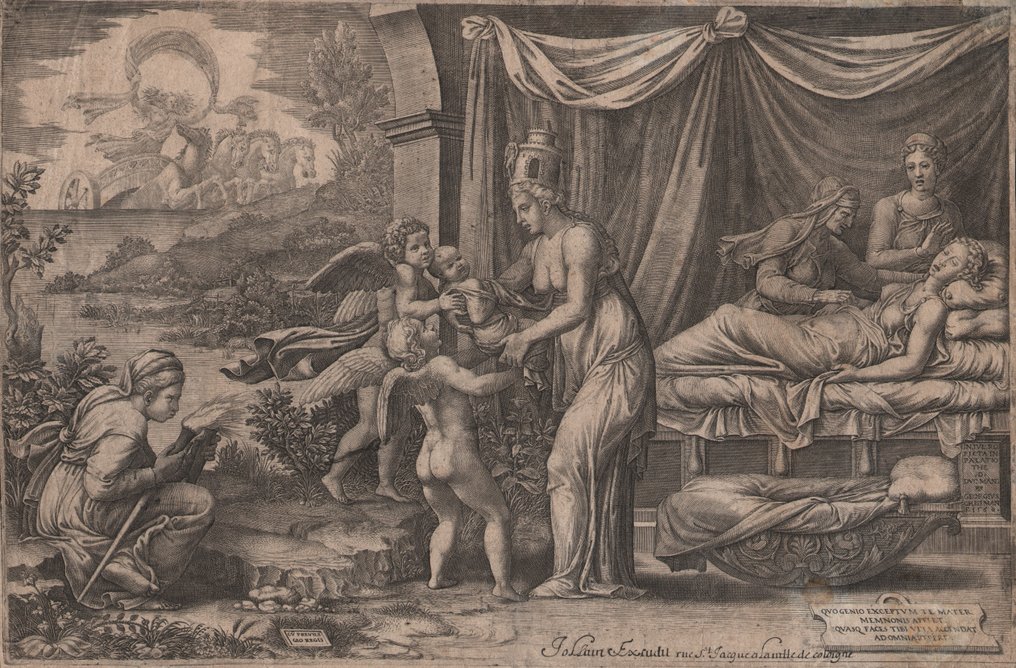
Giorgio Ghisi (1520 — 15 December 1582) - Allegory of Nativity


06
días
03
horas
25
minutos
54
segundos
Empezar a pujar
€ 1
Precio de reserva no alcanzado

Experto
Seleccionado por David Elberg
Pasó cinco años como experto en arte clásico y tres años como comisario-priseur.
Estimación € 450 - € 500
No hay ninguna puja
Protección del Comprador de Catawiki
Tu pago está protegido con nosotros hasta que recibas tu objeto.Ver detalles
Trustpilot 4.4 | 122713 valoraciones
Valoración Excelente en Trustpilot.
Giorgio Ghisi, Allegory of Nativity, 1568, grabado, 28,2 × 42,6 cm, Italia.
Resumen redactado con la ayuda de la IA
Descripción del vendedor
Description:
Allegory of birth, a woman in the bed at the right has just given birth, the infant is passed to two putti at the left, in the background Aurora arrives in her horse drawn carriage. Etching after G. ROMANO,
Dimensions:
28,20 x 42,60 cm
Literature:
Lewis&Lewis 26-4(5) Bartsch 57 Bellini (Ghisi) 38 The Illustrated Bartsch 57-2(2) . This print is based on a drawing made by Guilio Romano for a fresco in the Palazzo del T in Mantua. It shows one of the seven scenes in the Loggia del grotto, painted around 1531. It shows the powerful masterly evident of maturity Ghise reached in the 1560's. The scen shows, at the right, a woman who has just givne birth. Two female attendants minister to her from the far side of the bed., the older woman haolding her wrists. The mother seems to be deing or death. In te center, a woman wearing a tower-shaped crown hands the newborn to two genii. At the left, a woman holding two torches, signifying life, appears to be fueling the one in her right hand by blowing on it, perhaps having just lit it from the other. The other torch may represent the life of the mother. Bartsch, following Mariette, calls this figure a faite, although fates are usually shown spinning.
Medium:
Engraving
Circa:
1568
Notes:
All measurements are taken on the plate mark. All lot's are listed with several high resolution images, which is the best way to give a clear and objective idea of the general very good condition. Textual condition description is limited, so please examine the images carefully and ask for more info if needed.
Condition:
Good impression with full plate borders and small margins on bunch of grapes watermarked paper. The impression has good plate tone and is equally printed. Some stains and cracks have been treated and closed. Some paper loss filled in at top left corner.
Description:
Allegory of birth, a woman in the bed at the right has just given birth, the infant is passed to two putti at the left, in the background Aurora arrives in her horse drawn carriage. Etching after G. ROMANO,
Dimensions:
28,20 x 42,60 cm
Literature:
Lewis&Lewis 26-4(5) Bartsch 57 Bellini (Ghisi) 38 The Illustrated Bartsch 57-2(2) . This print is based on a drawing made by Guilio Romano for a fresco in the Palazzo del T in Mantua. It shows one of the seven scenes in the Loggia del grotto, painted around 1531. It shows the powerful masterly evident of maturity Ghise reached in the 1560's. The scen shows, at the right, a woman who has just givne birth. Two female attendants minister to her from the far side of the bed., the older woman haolding her wrists. The mother seems to be deing or death. In te center, a woman wearing a tower-shaped crown hands the newborn to two genii. At the left, a woman holding two torches, signifying life, appears to be fueling the one in her right hand by blowing on it, perhaps having just lit it from the other. The other torch may represent the life of the mother. Bartsch, following Mariette, calls this figure a faite, although fates are usually shown spinning.
Medium:
Engraving
Circa:
1568
Notes:
All measurements are taken on the plate mark. All lot's are listed with several high resolution images, which is the best way to give a clear and objective idea of the general very good condition. Textual condition description is limited, so please examine the images carefully and ask for more info if needed.
Condition:
Good impression with full plate borders and small margins on bunch of grapes watermarked paper. The impression has good plate tone and is equally printed. Some stains and cracks have been treated and closed. Some paper loss filled in at top left corner.
Datos
Artista
Giorgio Ghisi (1520 — 15 December 1582)
Título de la obra
Allegory of Nativity
Técnica
Grabado
Firma
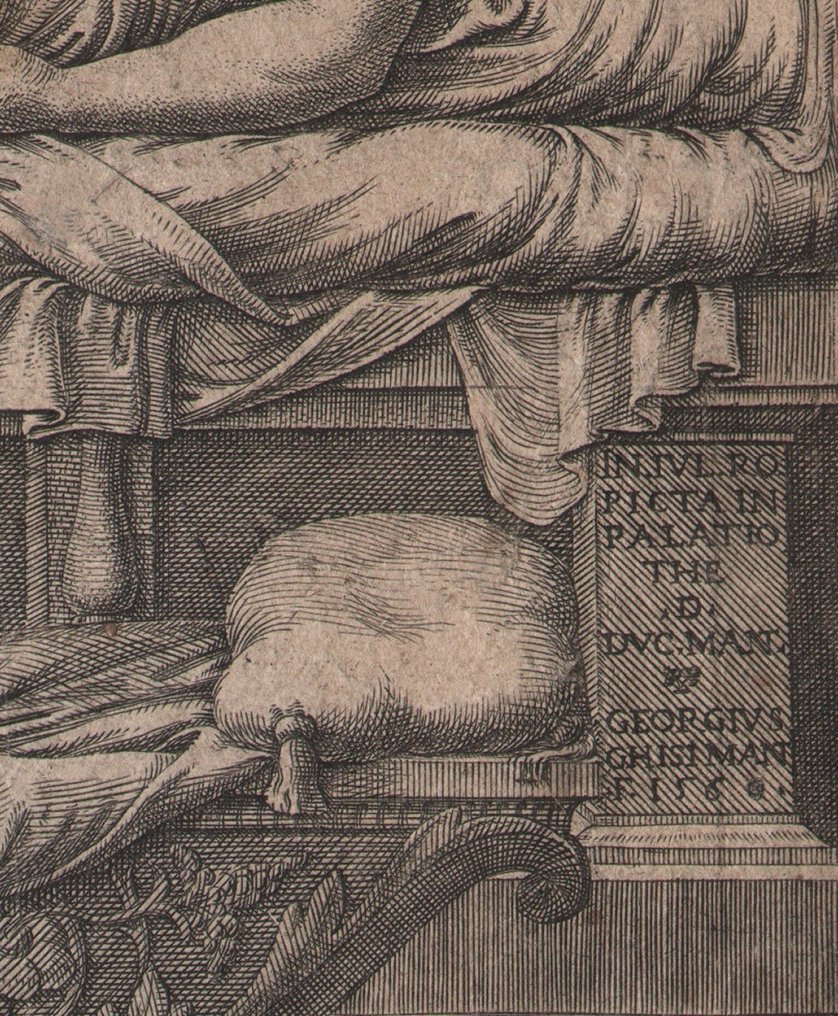
Firmado en plancha
País de origen
Italia
Año
1568
Estado
En buen estado
Alto
282 mm
Ancho
426 mm
Estilo
Renacimiento
Periodo
siglo XVI
Se vende con marco
No
Vendido por