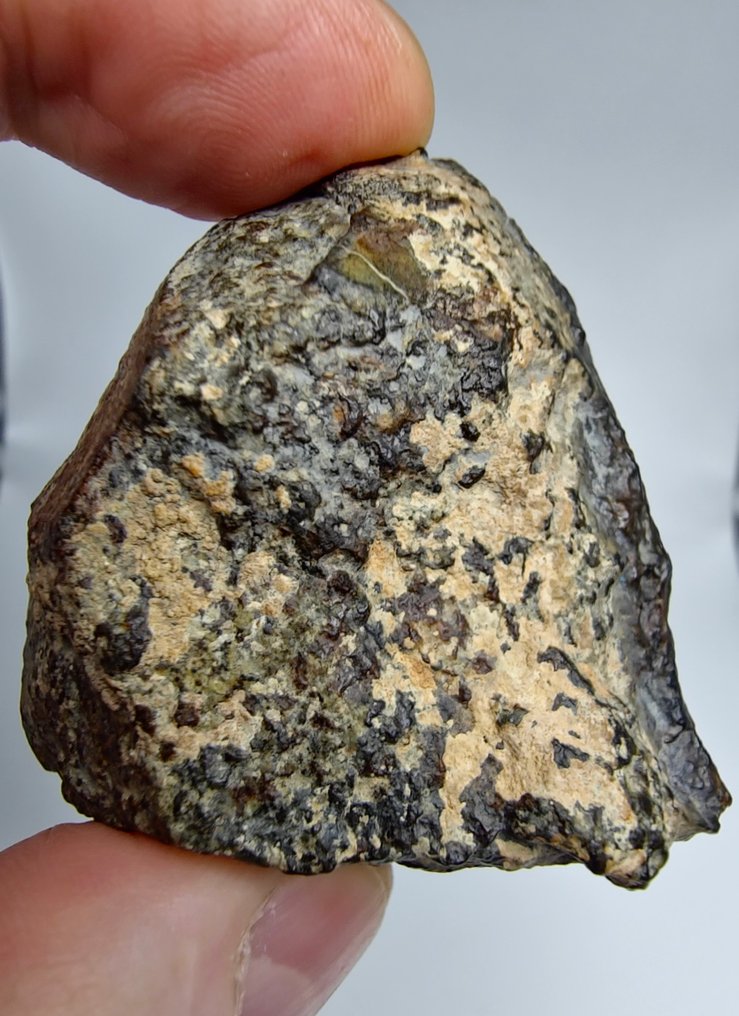
NWA 869 Meteorite, L3-6. The most famous chondrite. - 66.77 g




01
día
18
horas
25
minutos
53
segundos
Puja actual
€ 55
Sin precio de reserva

Experto
Seleccionado por Francesco Moser
Más de 20 años coleccionando meteoritos; excurador y restaurador de museo.
Estimación € 110 - € 160
17 personas más están mirando este objeto
 Pujador 2169 Pujador 2169 | 55 € | |
|---|---|---|
 Pujador 4223 Pujador 4223 | 50 € | |
| Pujador 2169 | 45 € | |
Protección del Comprador de Catawiki
Tu pago está protegido con nosotros hasta que recibas tu objeto.Ver detalles
Trustpilot 4.4 | 121899 valoraciones
Valoración Excelente en Trustpilot.
Meteorito NWA 869, brecha de rególito L3-6, peso 66,77 g, procedente de Northwest Africa, con certificado de autenticidad.
Resumen redactado con la ayuda de la IA
Descripción del vendedor
Northwest Africa 869
Find: 2000 or 2001
Physical characteristics: Most samples are individual meteorites but some fragments (mostly >1 kg) also occur. In most cases the fusion crust has been polished or ablated by wind erosion. Many samples are more severely affected and show faces with deep wind erosion features. Fracture faces, formed by ground collision, show a typical gray-green color and sometimes visible brecciation (light and/or dark clasts). Due to the coarseness of this breccia, there are some stones that consist of only a single lithology.
Petrography: This chondritic breccia consists of about 75 vol% matrix with unequilibrated and equilibrated L-chondrite clasts (up to 5.5 cm), some of which display shock-darkening. Impact melt-rock clasts, themselves either clast-free or clast-poor, also occur and are strongly depleted in Fe,Ni metal and sulfide.
Geochemistry: Northwest Africa 869 is a regolith breccia, containing solar noble gases and preirradiated lithologies. Olivine in lithic clasts: Fa0.2-49.2; olivine in matrix: Fa10.3-29.3; low-Ca pyroxene in lithic clasts: Fs2.1-35.9; low-Ca pyroxene in matrix: Fs7.0-23.9. Bulk oxygen isotopes: δ17O = 3.52; δ18O = 4.67; Δ17O = 1.09 per mil. Terrestrial age: 4.4 ± 0.7 ka. Preatmospheric meteoroid size and mass: 225 ± 25 cm, 120-230 T.
Classification: Because NWA 869 contains unequilibrated clasts, its classification is revised to L3-6.
This lot comes with certificate of authenticity.
Thanks for your interest.
Northwest Africa 869
Find: 2000 or 2001
Physical characteristics: Most samples are individual meteorites but some fragments (mostly >1 kg) also occur. In most cases the fusion crust has been polished or ablated by wind erosion. Many samples are more severely affected and show faces with deep wind erosion features. Fracture faces, formed by ground collision, show a typical gray-green color and sometimes visible brecciation (light and/or dark clasts). Due to the coarseness of this breccia, there are some stones that consist of only a single lithology.
Petrography: This chondritic breccia consists of about 75 vol% matrix with unequilibrated and equilibrated L-chondrite clasts (up to 5.5 cm), some of which display shock-darkening. Impact melt-rock clasts, themselves either clast-free or clast-poor, also occur and are strongly depleted in Fe,Ni metal and sulfide.
Geochemistry: Northwest Africa 869 is a regolith breccia, containing solar noble gases and preirradiated lithologies. Olivine in lithic clasts: Fa0.2-49.2; olivine in matrix: Fa10.3-29.3; low-Ca pyroxene in lithic clasts: Fs2.1-35.9; low-Ca pyroxene in matrix: Fs7.0-23.9. Bulk oxygen isotopes: δ17O = 3.52; δ18O = 4.67; Δ17O = 1.09 per mil. Terrestrial age: 4.4 ± 0.7 ka. Preatmospheric meteoroid size and mass: 225 ± 25 cm, 120-230 T.
Classification: Because NWA 869 contains unequilibrated clasts, its classification is revised to L3-6.
This lot comes with certificate of authenticity.
Thanks for your interest.
Datos
Nombre del meteorito
NWA 869 Meteorite, L3-6
Tipos de meteoritos
The most famous chondrite.
Suplemento
Do not reserve price.
Peso
66,77 g
País de origen
NWA
Vendido por