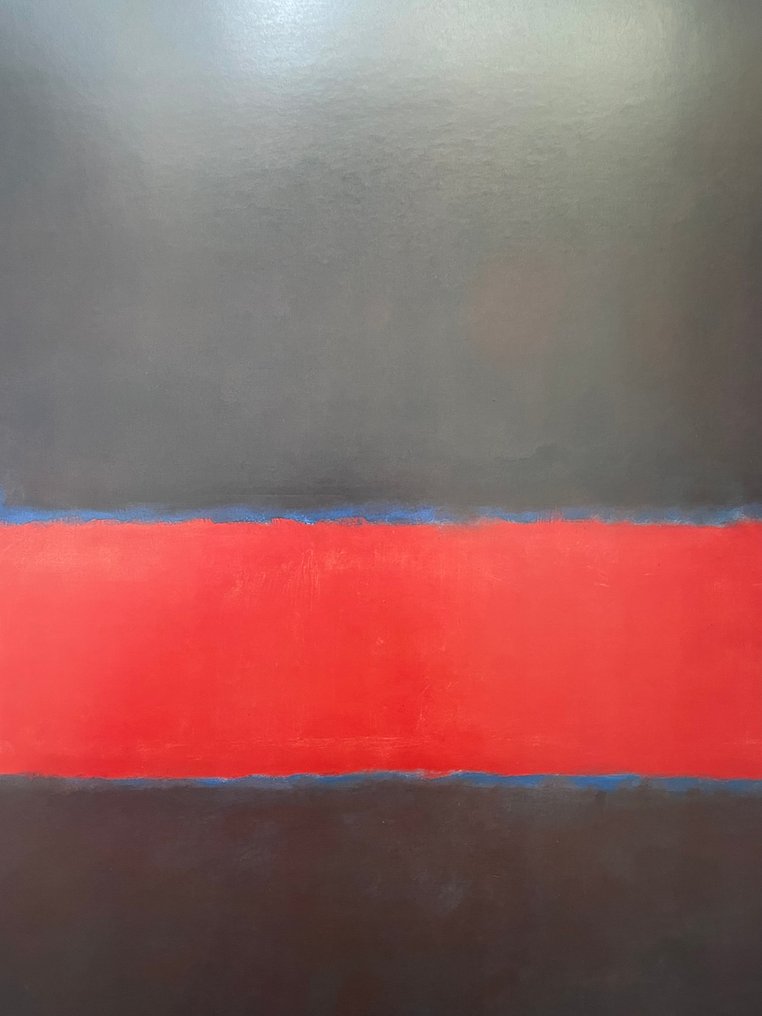
Mark Rothko (after) - Maroon on Blue - Offset lithography - VG licensed print - 2004




05
päivät
04
tuntia
44
minuuttia
34
sekuntia
Aloitustarjous
€ 1
Pohjahintaa ei saavutettu

asiantuntija
Valinnut Juan Antonio Rodríguez
Kahdeksan vuoden kokemus Balclis Barcelonassa, julisteiden arvioija.
Arvio € 150 - € 200
Tarjouksia ei ole tehty
Catawikin ostaja turva
Maksusi pidetään turvassa, kunnes saat esineesi. Näytä tiedot
Trustpilot 4.4 | 132931 arvostelua
Arvosteltu erinomaiseksi Trustpilot.
Myyjän antama kuvaus
Offset Lithography after Mark Rothko (*)
Reproduction of the work “Maroon on Blue” created by Rothko in 1957,
Printed on thick Fine Art 200 g cardboard
Published by VG Bild-Kunst, Bonn in 2004.
Authorized print with copyright by Kate Rothko-Prizel & Christopher Rothko.
Large format.
- Sheet dimensions: 80 x 60 cm
- Year: 2004
- Condition: Excellent (this work has never been framed or exhibited, always kept in a professional art folder, and therefore remains in perfect condition).
- Provenance: Private collection.
The work will be carefully handled and packed in a reinforced cardboard package. The shipment will be tracked with a tracking number.
The shipping will also include transport insurance up to the final value of the work with full reimbursement in case of loss or damage, at no cost to the buyer.
(*) Mark Rothko was, along with Pollock, the leading representative of American abstraction. With his painting he sought to achieve an ambitious utopia: to express the most basic universal emotions. And for many he achieved it.
Markus Rothkovitz was born in Russia. From a evidently Jewish family, he emigrated to Oregon in 1910, probably fleeing antisemitism for which so many minds escaped.
He studied art in the 1920s but considered himself self-taught. He cultivated figurative expressionism before World War II and soaked up the spirit of the vanguards he saw in MoMA-organized exhibitions.
After the war he began researching color field painting, gradually abandoning all figurative reference, and in the 1950s, with abstract expressionism already established, he began the personal abstraction that would define his painting ever since.
Rothko’s paintings, huge, show wide rectangular fields of color with undefined boundaries between them. They are blurry colors, floating suspended on the canvas, stimulating mystical sensations that are quite interesting.
From there, Mark Rothko would become an institution of American art. Protected by Peggy Guggenheim, his successes would be notable. But at the end of the 1960s, amid a depressive crisis, and after painting his series of works with black acrylic, he would ultimately take his own life.
Myyjän tarina
Kääntänyt Google TranslateOffset Lithography after Mark Rothko (*)
Reproduction of the work “Maroon on Blue” created by Rothko in 1957,
Printed on thick Fine Art 200 g cardboard
Published by VG Bild-Kunst, Bonn in 2004.
Authorized print with copyright by Kate Rothko-Prizel & Christopher Rothko.
Large format.
- Sheet dimensions: 80 x 60 cm
- Year: 2004
- Condition: Excellent (this work has never been framed or exhibited, always kept in a professional art folder, and therefore remains in perfect condition).
- Provenance: Private collection.
The work will be carefully handled and packed in a reinforced cardboard package. The shipment will be tracked with a tracking number.
The shipping will also include transport insurance up to the final value of the work with full reimbursement in case of loss or damage, at no cost to the buyer.
(*) Mark Rothko was, along with Pollock, the leading representative of American abstraction. With his painting he sought to achieve an ambitious utopia: to express the most basic universal emotions. And for many he achieved it.
Markus Rothkovitz was born in Russia. From a evidently Jewish family, he emigrated to Oregon in 1910, probably fleeing antisemitism for which so many minds escaped.
He studied art in the 1920s but considered himself self-taught. He cultivated figurative expressionism before World War II and soaked up the spirit of the vanguards he saw in MoMA-organized exhibitions.
After the war he began researching color field painting, gradually abandoning all figurative reference, and in the 1950s, with abstract expressionism already established, he began the personal abstraction that would define his painting ever since.
Rothko’s paintings, huge, show wide rectangular fields of color with undefined boundaries between them. They are blurry colors, floating suspended on the canvas, stimulating mystical sensations that are quite interesting.
From there, Mark Rothko would become an institution of American art. Protected by Peggy Guggenheim, his successes would be notable. But at the end of the 1960s, amid a depressive crisis, and after painting his series of works with black acrylic, he would ultimately take his own life.
Myyjän tarina
Kääntänyt Google TranslateTiedot
Aikakausi
1900-2000
Designer/artist
Mark Rothko (after)
Poster title
Maroon on Blue - Offset lithography - VG licensed print - 2004
Aihe
Taide
Alkuperämaa
Saksa
Kunto
A (erinomainen - täydellinen kunto)
Leveys
80 cm
Leveys
60 cm
Myynyt käyttäjä