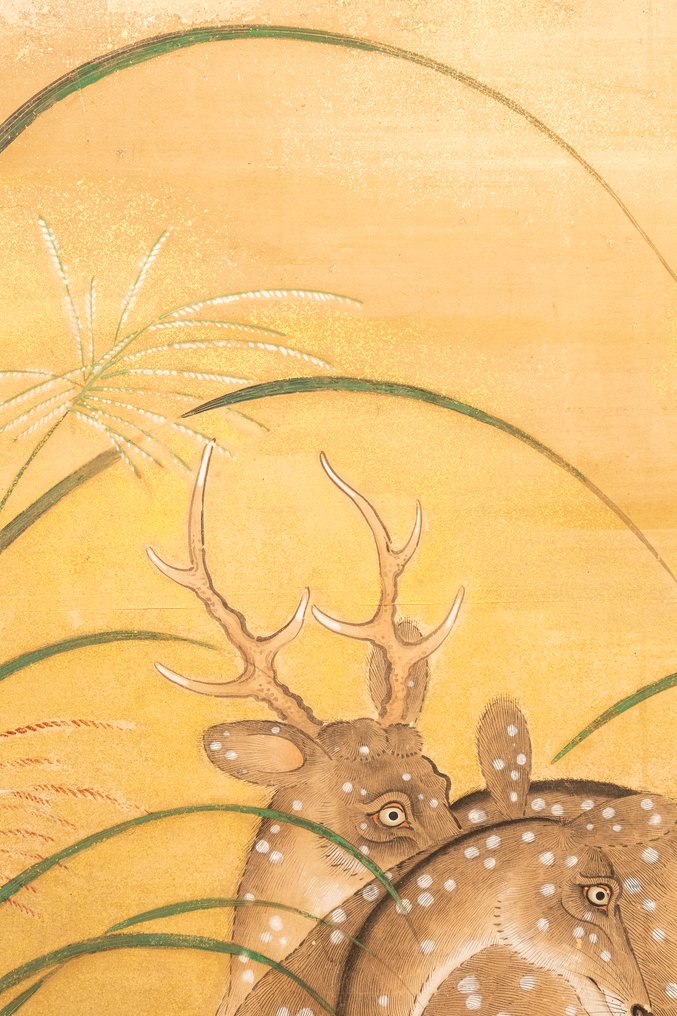
Paravento Byōbu - Carta, Legno, A two-panel Japanese folding screen depicting deer on a gold dust ground - Signed Shūkei (Sōkei) - Giappone - Edo (early 19th century)


05
giorni
15
ore
27
minuti
23
secondi
Offerta attuale
€ 1
Prezzo di riserva non raggiunto

Esperto
Selezionato da Giovanni Bottero
Ha una laurea magistrale in Storia dell'Arte Giapponese e oltre 10 anni di esperienza.
Stima € 4.000 - € 4.400
14 persone stanno guardando questo oggetto
 Offerente 9167 Offerente 9167 | 1 € |
|---|
Tutela degli acquirenti Catawiki
Il tuo pagamento è al sicuro con noi finché non ricevi il tuo oggetto.Mostra dettagli
Trustpilot 4.4 | 123779 recensioni
Valutato Eccellente su Trustpilot.
Due pannel di byobu giapponese, dipinto su carta con polvere d’oro, raffigurante una coppia di cervi tra erba alta; firmato Shūkei (Sōkei) della scuola Kanō, periodo Edo (c. 1800–1850), dimensioni 176 × 178 cm, spessore 2 cm, in buone condizioni con segni del tempo, corredato di certificato di autenticità rilasciato dalla Mastromauro Japanese Art Gallery di Milano.
Riepilogo creato con l’aiuto dell’IA
Descrizione del venditore
A Japanese two-panel folding screen painted on paper with applications of gold powder, depicting a pair of deer emerging among tall grasses swaying in the wind. The two animals are rendered with great care and stand out against a background of paper enriched with gold powder.
The screen is signed Shūkei (Sōkei), a painter active within the Kanō school, and bears the honorific title Hōgen, traditionally conferred upon artists of high rank.
Provenance: private US collection previously purchased from Naga Antiques (New York) as showed on the label placed on the back of the screen.
The Kanō school of painting was one of the most important and long-lasting artistic traditions in Japan. It was composed primarily of male members of the Kanō family, alongside particularly talented pupils who were sometimes granted permission to adopt the family surname.
For generations, the Kanō school was commissioned to produce large decorative cycles for temples, castles, and palaces in Japan’s major capitals, becoming the official painting style of the aristocratic elites.
The screen can also be easily mounted on a wall or used as a room divider.
Byōbu (屏風), literally “wind protection screens,” are traditional Japanese folding screens originally created to divide spaces and today appreciated above all as striking wall-mounted paintings.
---The byobu is in good condition, with wear, stains, some losses and imperfections to the paper across the surface and along the panel joints, consistent with age. Please refer to the pictures for further details.
The item will be carefully packed and shipped via DHL or FedEx, accompanied by the original certificate of authenticity issued by Mastromauro Japanese art gallery based in Milan, Italy.
468
Il venditore si racconta
Mastromauro Arte Giapponese, con sede a Milano, è specializzata in arte giapponese, con particolare attenzione ai periodi Edo (1603–1868) e Meiji (1868–1912), pur mantenendo uno sguardo aperto anche su opere più contemporanee.
Qui su Catawiki offrono una parte della loro collezione in ogni asta settimanale.
A Japanese two-panel folding screen painted on paper with applications of gold powder, depicting a pair of deer emerging among tall grasses swaying in the wind. The two animals are rendered with great care and stand out against a background of paper enriched with gold powder.
The screen is signed Shūkei (Sōkei), a painter active within the Kanō school, and bears the honorific title Hōgen, traditionally conferred upon artists of high rank.
Provenance: private US collection previously purchased from Naga Antiques (New York) as showed on the label placed on the back of the screen.
The Kanō school of painting was one of the most important and long-lasting artistic traditions in Japan. It was composed primarily of male members of the Kanō family, alongside particularly talented pupils who were sometimes granted permission to adopt the family surname.
For generations, the Kanō school was commissioned to produce large decorative cycles for temples, castles, and palaces in Japan’s major capitals, becoming the official painting style of the aristocratic elites.
The screen can also be easily mounted on a wall or used as a room divider.
Byōbu (屏風), literally “wind protection screens,” are traditional Japanese folding screens originally created to divide spaces and today appreciated above all as striking wall-mounted paintings.
---The byobu is in good condition, with wear, stains, some losses and imperfections to the paper across the surface and along the panel joints, consistent with age. Please refer to the pictures for further details.
The item will be carefully packed and shipped via DHL or FedEx, accompanied by the original certificate of authenticity issued by Mastromauro Japanese art gallery based in Milan, Italy.
468
Il venditore si racconta
Mastromauro Arte Giapponese, con sede a Milano, è specializzata in arte giapponese, con particolare attenzione ai periodi Edo (1603–1868) e Meiji (1868–1912), pur mantenendo uno sguardo aperto anche su opere più contemporanee.
Qui su Catawiki offrono una parte della loro collezione in ogni asta settimanale.
Dettagli
Epoca
1400-1900
Paese d’origine
Giappone
Materiale
A two-panel Japanese folding screen depicting deer on a gold dust ground., Carta, Legno
Stile/Periodo dinastico
Edo (early 19th century)
Artista
Signed Shūkei (Sōkei)
Condizione
In buone condizioni - usato, con piccoli segni dell’età e macchie.
Altezza
176 cm
Larghezza
178 cm
Profondità
2 cm
Periodo stimato
1800-1850
Venduto da
