Vannuccio BIRINGUCCIO - PIROTECHNIA- The first printed work on metallurgy - 1559




03
giorni
07
ore
58
minuti
43
secondi
Offerta attuale
€ 1.400
Prezzo di riserva non raggiunto

Esperto
Selezionato da Volker Riepenhausen
Specialista in letteratura di viaggio e stampe rare prima del 1600, con 28 anni di esperienza.
Stima € 1.900 - € 2.800
25 persone stanno guardando questo oggetto
 Offerente 0806 Offerente 0806 | 1.400 € | |
|---|---|---|
| Offerente 8962 | 1.100 € | |
| Offerente 0806 | 1.000 € | |
Tutela degli acquirenti Catawiki
Il tuo pagamento è al sicuro con noi finché non ricevi il tuo oggetto.Mostra dettagli
Trustpilot 4.4 | 121899 recensioni
Valutato Eccellente su Trustpilot.
PIROTECHNIA- Il primo lavoro stampato sulla metallurgia di Vannuccio BIRINGUCCIO.
Riepilogo creato con l’aiuto dell’IA
Descrizione del venditore
(METALLURGY; MINING; CHEMISTRY; PYROTHECNICS; ART; MILITARIA; ILLUSTRATED) Vannoccio BIRINGUCCIO (1480 c.-1539 c.)
Pirotechnia del s. Vannuccio Biringuccio senese, nella quale si tratta non solo della diversità delle minere, ma ancho di quanto si ricerca alla pratica di esse. E di quanto s’appartiene all’arte della fusione, o getto, de metalli. Far campane, arteglierie, fuochi artificiali, & altre diverse cose utilissime. Nuovamente corretta, et ristampata. Con la tavola delle cose notabili. In Venetia, Appresso Gironimo Giglio, e compagni, 1559.
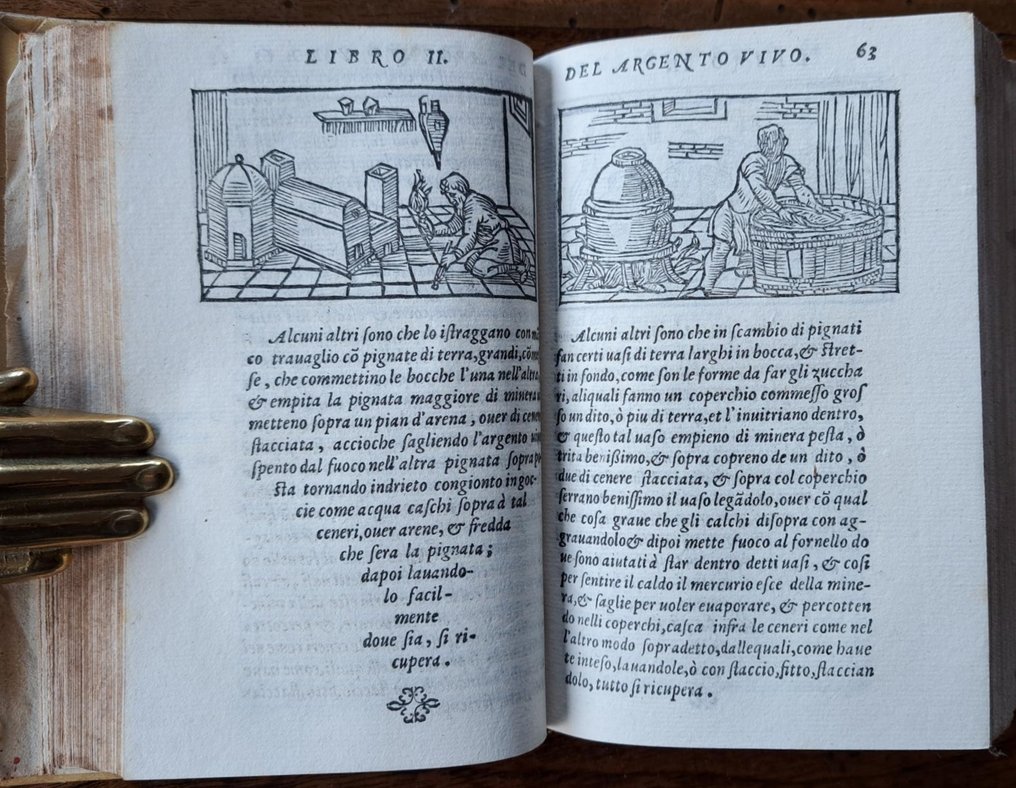
§ Small 8vo (143x93); 345, [7] leaves; woodcut head-pieces and initials, 76 large (70x40) woodcut illustrations in strong impression. Contemporary vellum, hand-written title on spine. Fine copy on crisp paper, a little short-cut.
Fourth edition, the first one in pocket size, uncommon. First published, posthumously, in 1540 in Venice, it was followed by four Italian editions (1550, 1558, the present one of 1559 and 1658), three ub French (1556, 1572 and 1627) and possibly two in Latin (1672 and 1658) (Mieli, p. 93). Divided in ten books, the work is extremely vast and comprehensive; it covers mineralogy and chemistry, metallurgy and smelting, firearms technology and art. The first two books mainly deal with the deposits of the six classic metals (gold, silver, copper, lead, tin and iron), of other elements (such as mercury, sulphur etc.) and of various gems. Numerous references to metallurgy and industry are also present as well as information of interest from a chemical, geographical and geological point of view. Books III, IV and V describe the preparation of metals from their minerals, the separation of various metals from each other, particularly gold and silver, and the nature of various alloys. In the sixth book, the art of casting is discussed, especially with reference to the reparation of artillery; several topics of considerable importance for the history of the art of war are also present. After dealing mainly with forms in the sixth book, in the seventh book the author focuses more specifically on the practice of casting, and in the eighth more specifically its application to the art. In the ninth book various minor arts, are considered, as well as alchemy in general, the art of distillation, the various arts of the goldsmith, the blacksmith, the tinsmith, etc; the minting of coins were minted and the making of mirrors are also described. Finally, the tenth and last book, returning in part to a subject of utmost importance for the art of war, deals with the preparation of powder for artillery, mines, and projectiles, and, last but not least, is mentioned the peaceful use of such instruments, that is, the use of fireworks in public celebrations. “... one can easily appreciate the vast and extremely interesting field covered by our scientist. In fact, a significant part of the scientific technique and thought of the first half of the sixteenth century is presented in this work. ... If we analyse this work in detail and compare the text with earlier writings and knowledge, we can easily see that the merit of this Sienese scholar is not limited to the dissemination of knowledge known at the time, but extends to the fact that he made significant progress in chemistry, mineralogy, metallurgy, etc. ... However, the work De la Pirotechnia is even more important. It embodies and expresses a new spirit, namely the spirit of the Renaissance ...” (Mieli p. 95, translated). “De la pirotechnia contrasts strikingly with the obscure alchemical writings of the time. The book is replete with lavish woodcuts illustrating the equipment and processes then in use and includes clear, practical instructions for mining, smelting, and metalworking. It became a standard reference and remains valuable as a source of information on the state of technology during the 15th and 16th centuries.” (Britannica). “Pirotechnia is the oldest printed work covering the entire scientific universe of metallurgy.” (Zanibelli, translated, p. 8). “The driving force behind his work did not come from documentary research but from practical application and observation; he had travelled throughout Europe to learn various metalworking techniques. In Pirotechnia, we see the passion and dedication of the Sienese author in conveying to the reader the effectiveness of a practical approach to the subject. The chemical knowledge of the time did not allow for certain theoretical conclusions to be reached, hence Biringuccio's conviction that practice was the key to the success of the manufacturing process. We must give Vannoccio credit for being the first to provide detailed and practical descriptions of many metallurgical processes, even though he never considered himself their inventor. The value of Pirotechnia stems from its rich documentation of practical chemistry and fundamental processes in metalworking.” (Zanibelli, translated, p. 13).
Britannica (https://www.britannica.com/biography/Vannoccio-Biringuccio); ALDO MIELI Vannoccio Bringuccio e il metodo sperimentale In: Isis, 2, (1914), pp. 90-99; G. ZANIBELLI Vannoccio Biringuccio e la Pirotechnia (1540). Il senese, spesso dimenticato, che inventò la scienza moderna. (no date) https://www.academia.edu/7357018/Vannoccio_Biringuccio_e_la_Pirotechnia_1540_Il_senese_spesso_dimenticato_che_invent%C3%B2_la_scienza_moderna
(METALLURGY; MINING; CHEMISTRY; PYROTHECNICS; ART; MILITARIA; ILLUSTRATED) Vannoccio BIRINGUCCIO (1480 c.-1539 c.)
Pirotechnia del s. Vannuccio Biringuccio senese, nella quale si tratta non solo della diversità delle minere, ma ancho di quanto si ricerca alla pratica di esse. E di quanto s’appartiene all’arte della fusione, o getto, de metalli. Far campane, arteglierie, fuochi artificiali, & altre diverse cose utilissime. Nuovamente corretta, et ristampata. Con la tavola delle cose notabili. In Venetia, Appresso Gironimo Giglio, e compagni, 1559.
§ Small 8vo (143x93); 345, [7] leaves; woodcut head-pieces and initials, 76 large (70x40) woodcut illustrations in strong impression. Contemporary vellum, hand-written title on spine. Fine copy on crisp paper, a little short-cut.
Fourth edition, the first one in pocket size, uncommon. First published, posthumously, in 1540 in Venice, it was followed by four Italian editions (1550, 1558, the present one of 1559 and 1658), three ub French (1556, 1572 and 1627) and possibly two in Latin (1672 and 1658) (Mieli, p. 93). Divided in ten books, the work is extremely vast and comprehensive; it covers mineralogy and chemistry, metallurgy and smelting, firearms technology and art. The first two books mainly deal with the deposits of the six classic metals (gold, silver, copper, lead, tin and iron), of other elements (such as mercury, sulphur etc.) and of various gems. Numerous references to metallurgy and industry are also present as well as information of interest from a chemical, geographical and geological point of view. Books III, IV and V describe the preparation of metals from their minerals, the separation of various metals from each other, particularly gold and silver, and the nature of various alloys. In the sixth book, the art of casting is discussed, especially with reference to the reparation of artillery; several topics of considerable importance for the history of the art of war are also present. After dealing mainly with forms in the sixth book, in the seventh book the author focuses more specifically on the practice of casting, and in the eighth more specifically its application to the art. In the ninth book various minor arts, are considered, as well as alchemy in general, the art of distillation, the various arts of the goldsmith, the blacksmith, the tinsmith, etc; the minting of coins were minted and the making of mirrors are also described. Finally, the tenth and last book, returning in part to a subject of utmost importance for the art of war, deals with the preparation of powder for artillery, mines, and projectiles, and, last but not least, is mentioned the peaceful use of such instruments, that is, the use of fireworks in public celebrations. “... one can easily appreciate the vast and extremely interesting field covered by our scientist. In fact, a significant part of the scientific technique and thought of the first half of the sixteenth century is presented in this work. ... If we analyse this work in detail and compare the text with earlier writings and knowledge, we can easily see that the merit of this Sienese scholar is not limited to the dissemination of knowledge known at the time, but extends to the fact that he made significant progress in chemistry, mineralogy, metallurgy, etc. ... However, the work De la Pirotechnia is even more important. It embodies and expresses a new spirit, namely the spirit of the Renaissance ...” (Mieli p. 95, translated). “De la pirotechnia contrasts strikingly with the obscure alchemical writings of the time. The book is replete with lavish woodcuts illustrating the equipment and processes then in use and includes clear, practical instructions for mining, smelting, and metalworking. It became a standard reference and remains valuable as a source of information on the state of technology during the 15th and 16th centuries.” (Britannica). “Pirotechnia is the oldest printed work covering the entire scientific universe of metallurgy.” (Zanibelli, translated, p. 8). “The driving force behind his work did not come from documentary research but from practical application and observation; he had travelled throughout Europe to learn various metalworking techniques. In Pirotechnia, we see the passion and dedication of the Sienese author in conveying to the reader the effectiveness of a practical approach to the subject. The chemical knowledge of the time did not allow for certain theoretical conclusions to be reached, hence Biringuccio's conviction that practice was the key to the success of the manufacturing process. We must give Vannoccio credit for being the first to provide detailed and practical descriptions of many metallurgical processes, even though he never considered himself their inventor. The value of Pirotechnia stems from its rich documentation of practical chemistry and fundamental processes in metalworking.” (Zanibelli, translated, p. 13).
Britannica (https://www.britannica.com/biography/Vannoccio-Biringuccio); ALDO MIELI Vannoccio Bringuccio e il metodo sperimentale In: Isis, 2, (1914), pp. 90-99; G. ZANIBELLI Vannoccio Biringuccio e la Pirotechnia (1540). Il senese, spesso dimenticato, che inventò la scienza moderna. (no date) https://www.academia.edu/7357018/Vannoccio_Biringuccio_e_la_Pirotechnia_1540_Il_senese_spesso_dimenticato_che_invent%C3%B2_la_scienza_moderna
Dettagli
Numero di Libri
1
Soggetto
Chimica, Illustrati, Incunabuli e prime stampe, Scienza
Titolo del Libro
PIROTECHNIA- The first printed work on metallurgy
Autore/ Illustratore
Vannuccio BIRINGUCCIO
Condizione
Ottime
Anno di pubblicazione dell’oggetto più vecchio
1559
Altezza
145 mm
Edizione
1° edizione in questo formato
Larghezza
93 mm
Lingua
Italiano
Lingua originale
Sì
Editore
Gironimo Giglio
Legatura
Pergamena
Numero di pagine
704
Venduto da
