Nr. 100153885

Solgt
August Neresheimer & Co. - C. 1890, Hanau for Swedish Market - Tekanne - .835 sølv - 793 g
Siste bud
€ 1.001
2 dager siden

August Neresheimer & Co. - C. 1890, Hanau for Swedish Market - Tekanne - .835 sølv - 793 g

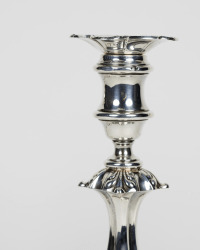
This ornate silver teapot, crafted by the renowned Hanau firm of B. Neresheimer & Söhne (often associated with August and Ludwig Neresheimer as key partners), exemplifies the Rococo revival style popular in late 19th-century German silverware. Established in 1890, the Neresheimer workshop specialized in high-quality pieces inspired by historical designs, frequently incorporating elaborate repoussé work and pseudo-hallmarks that evoked antique European silver traditions. This particular example, dating to around 1890, was produced for export to the Swedish market, as indicated by the presence of Swedish silver import hallmarks alongside German marks, or just model numbers or pseudo marks. Weight 793g The teapot stands 23 cm tall, with a body diameter of 12 cm and an overall width (including spout and handle) of 24 cm. Its form is characteristically bulbous and lobed, shaped like a stylized pumpkin or melon, with vertical fluting that adds texture and depth. The body is richly decorated with chased and repoussé floral motifs—prominent roses encircled by scrolling leaves and tendrils—creating a lush, asymmetrical garden-like effect typical of Rococo aesthetics. These embellishments are repeated on the curved gooseneck spout, which features acanthus leaf accents at its base and a molded floral detail near the tip for added elegance and functionality in pouring. The piece rests on three cabriole feet, each terminating in a scrolled pad with leaf motifs, providing stability while enhancing the overall baroque flair. The C-scroll handle is ergonomically arched, with a thumbpiece for secure grip, and includes insulating rings (likely ivory, bone, or a similar heat-resistant material) to prevent burns when handling hot contents. The hinged, domed lid mirrors the body's scalloped lobes and is topped by a finial resembling a budding flower or artichoke, complete with detailed petals and leaves for a naturalistic touch. On the base, the hallmarks include the "835" fineness mark, denoting 83.5% pure silver (a standard Continental European purity, slightly above the Swedish minimum of 830/1000). Additional marks Swedish import indicators. "S" in an oval or related symbol confirming silver content for import. Swedish import controls for foreign silver were formalized around the turn of the century, but pieces like this often bear combined marks reflecting export practices.

Nr. 100153885

Solgt
August Neresheimer & Co. - C. 1890, Hanau for Swedish Market - Tekanne - .835 sølv - 793 g

August Neresheimer & Co. - C. 1890, Hanau for Swedish Market - Tekanne - .835 sølv - 793 g

This ornate silver teapot, crafted by the renowned Hanau firm of B. Neresheimer & Söhne (often associated with August and Ludwig Neresheimer as key partners), exemplifies the Rococo revival style popular in late 19th-century German silverware. Established in 1890, the Neresheimer workshop specialized in high-quality pieces inspired by historical designs, frequently incorporating elaborate repoussé work and pseudo-hallmarks that evoked antique European silver traditions. This particular example, dating to around 1890, was produced for export to the Swedish market, as indicated by the presence of Swedish silver import hallmarks alongside German marks, or just model numbers or pseudo marks.

Weight 793g

The teapot stands 23 cm tall, with a body diameter of 12 cm and an overall width (including spout and handle) of 24 cm. Its form is characteristically bulbous and lobed, shaped like a stylized pumpkin or melon, with vertical fluting that adds texture and depth. The body is richly decorated with chased and repoussé floral motifs—prominent roses encircled by scrolling leaves and tendrils—creating a lush, asymmetrical garden-like effect typical of Rococo aesthetics. These embellishments are repeated on the curved gooseneck spout, which features acanthus leaf accents at its base and a molded floral detail near the tip for added elegance and functionality in pouring.
The piece rests on three cabriole feet, each terminating in a scrolled pad with leaf motifs, providing stability while enhancing the overall baroque flair. The C-scroll handle is ergonomically arched, with a thumbpiece for secure grip, and includes insulating rings (likely ivory, bone, or a similar heat-resistant material) to prevent burns when handling hot contents. The hinged, domed lid mirrors the body's scalloped lobes and is topped by a finial resembling a budding flower or artichoke, complete with detailed petals and leaves for a naturalistic touch.
On the base, the hallmarks include the "835" fineness mark, denoting 83.5% pure silver (a standard Continental European purity, slightly above the Swedish minimum of 830/1000).
Additional marks Swedish import indicators. "S" in an oval or related symbol confirming silver content for import. Swedish import controls for foreign silver were formalized around the turn of the century, but pieces like this often bear combined marks reflecting export practices.

Siste bud
€ 1.001
Chiara Scotto Pasanisi dei Foscarini
Ekspert
Estimat  € 550 - € 700

Lignende objekter

For deg

Sølv- og gulldekor

Legg inn et søkevarsel
Angi et søkevarsel for å bli varslet når nye treff er tilgjengelige.

Dette objektet ble vist i


Hvordan kjøpe på Catawiki

Les mer om vår kjøperbeskyttelse

      1. Oppdag noe spesielt

      Bla gjennom tusenvis av spesielle objekter valgt av eksperter. Se bilder, detaljer og estimert verdi av hvert spesialobjekt. 

      2. Legg inn det høyeste budet

      Finn noe du liker, og legg inn det øverste budet. Du kan følge auksjonen til slutten eller la systemet vårt gjøre budgivningen for deg. Alt du trenger å gjøre er å angi et bud for det maksimale beløpet du vil betale. 

      3. Å gjøre en sikker betaling

      Betal for dine spesielle objekter og vi holder betalingen sikker til objektet ditt kommer trygt og godt frem. Vi bruker et pålitelig betalingssystem for å håndtere alle transaksjoner. 

Har du noe lignende å selge?

Enten du er ny på nettauksjoner eller profesjonell selger, kan vi hjelpe deg med å tjene mer for dine spesielle gjenstander.

Selg objektet ditt