Nr. 100195460

Ikke lenger tilgjengelig
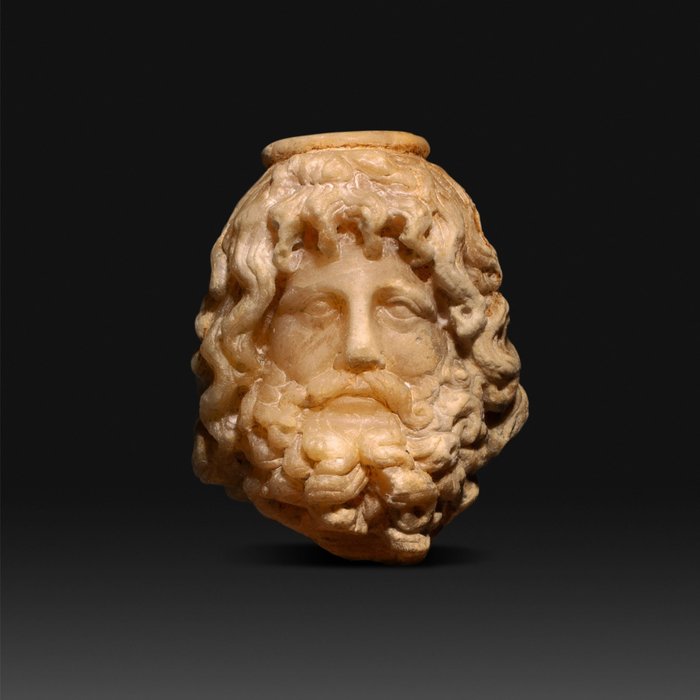
Romersk antikk Alabst Serapis-hode. 1. - 2. århundre e.Kr. 9,5 cm høyde. Spansk eksportlisens
Budgivning avsluttet
23 t. siden

Romersk antikk Alabst Serapis-hode. 1. - 2. århundre e.Kr. 9,5 cm høyde. Spansk eksportlisens

Serapis Head. Ancient Roman, 1st - 2nd century AD. Alabaster. Height 9.5 cm and 20 cm with the stand. PROVENANCE: Private collection, France. Acquired by family inheritance. 1970. CONDITION: In a good state of preservation. DESCRIPTION: A beautiful head that belonged to a bust or sculpture, sculpted in translucent alabaster, of the syncretic Egyptian-Roman deity Serapis. It was probably intended to be placed on a private altar or as decoration in a room of a Roman domus. Similar examples have been found in both Egypt and Rome, as well as in other cities on the Italian peninsula. Its sculptural style suggests that it may well have been made in Egypt. This deity is depicted in its most common form: an adult male with long hair and beard. The essential attribute that distinguished the images of Serapis from those of other similar gods is the calathus or modius, the sacred basket of the mysteries, symbol of abundance, which would have been made piece by piece. It unites the concepts of agricultural fertility, life and death; it was used in the art of Ancient Egypt and in the Greco-Roman world. It resembles the bun that was worn on the head to carry something heavy. Its name was given by scholars because of its resemblance to the Roman modius, an utensil used as a unit of measurement for grain capacity. Ptolemy I, the first Greek ruler of Egypt after the death of Alexander the Great, declared Serapis to be the patron saint of Alexandria and the official god of Egypt and Greece, thus linking the two peoples. Ptolemy's intention was probably to find a deity who would command the respect and veneration of the Hellenes and the intensely traditionalist Egyptians alike. It is unlikely that the Greeks would have accepted a zoocephalous deity, in the Egyptian manner, whereas the Egyptians would have been more willing to accept any aspect for this god. A typical Greek icon was therefore chosen, which was proclaimed to be the anthropomorphic equivalent of a much revered Egyptian divinity, the ox Apis, assimilated to Osiris. Serapis is thus a syncretic divinity in which cultic practices of different origins are synthesised in a new image. Notes: The piece includes authenticity certificate. The piece includes Spanish Export License (Passport for European Union) - If the piece is destined outside the European Union a substitution of the export permit should be requested. This process could take between 1 and 2 months. #MasterpiecesW39

Nr. 100195460

Ikke lenger tilgjengelig
Romersk antikk Alabst Serapis-hode. 1. - 2. århundre e.Kr. 9,5 cm høyde. Spansk eksportlisens

Romersk antikk Alabst Serapis-hode. 1. - 2. århundre e.Kr. 9,5 cm høyde. Spansk eksportlisens

Serapis Head.

Ancient Roman, 1st - 2nd century AD.

Alabaster.

Height 9.5 cm and 20 cm with the stand.

PROVENANCE: Private collection, France. Acquired by family inheritance. 1970.

CONDITION: In a good state of preservation.

DESCRIPTION:

A beautiful head that belonged to a bust or sculpture, sculpted in translucent alabaster, of the syncretic Egyptian-Roman deity Serapis. It was probably intended to be placed on a private altar or as decoration in a room of a Roman domus. Similar examples have been found in both Egypt and Rome, as well as in other cities on the Italian peninsula. Its sculptural style suggests that it may well have been made in Egypt.

This deity is depicted in its most common form: an adult male with long hair and beard. The essential attribute that distinguished the images of Serapis from those of other similar gods is the calathus or modius, the sacred basket of the mysteries, symbol of abundance, which would have been made piece by piece. It unites the concepts of agricultural fertility, life and death; it was used in the art of Ancient Egypt and in the Greco-Roman world. It resembles the bun that was worn on the head to carry something heavy. Its name was given by scholars because of its resemblance to the Roman modius, an utensil used as a unit of measurement for grain capacity.

Ptolemy I, the first Greek ruler of Egypt after the death of Alexander the Great, declared Serapis to be the patron saint of Alexandria and the official god of Egypt and Greece, thus linking the two peoples. Ptolemy's intention was probably to find a deity who would command the respect and veneration of the Hellenes and the intensely traditionalist Egyptians alike. It is unlikely that the Greeks would have accepted a zoocephalous deity, in the Egyptian manner, whereas the Egyptians would have been more willing to accept any aspect for this god. A typical Greek icon was therefore chosen, which was proclaimed to be the anthropomorphic equivalent of a much revered Egyptian divinity, the ox Apis, assimilated to Osiris. Serapis is thus a syncretic divinity in which cultic practices of different origins are synthesised in a new image.


Notes:

The piece includes authenticity certificate.
The piece includes Spanish Export License (Passport for European Union) - If the piece is destined outside the European Union a substitution of the export permit should be requested. This process could take between 1 and 2 months.
#MasterpiecesW39


Budgivning avsluttet
Ruth Garrido Vila
Ekspert
Estimat  € 12.000 - € 15.000

Lignende objekter

For deg

Arkeologi

Legg inn et søkevarsel
Angi et søkevarsel for å bli varslet når nye treff er tilgjengelige.

Dette objektet ble vist i


Hvordan kjøpe på Catawiki

Les mer om vår kjøperbeskyttelse

      1. Oppdag noe spesielt

      Bla gjennom tusenvis av spesielle objekter valgt av eksperter. Se bilder, detaljer og estimert verdi av hvert spesialobjekt. 

      2. Legg inn det høyeste budet

      Finn noe du liker, og legg inn det øverste budet. Du kan følge auksjonen til slutten eller la systemet vårt gjøre budgivningen for deg. Alt du trenger å gjøre er å angi et bud for det maksimale beløpet du vil betale. 

      3. Å gjøre en sikker betaling

      Betal for dine spesielle objekter og vi holder betalingen sikker til objektet ditt kommer trygt og godt frem. Vi bruker et pålitelig betalingssystem for å håndtere alle transaksjoner. 

Har du noe lignende å selge?

Enten du er ny på nettauksjoner eller profesjonell selger, kan vi hjelpe deg med å tjene mer for dine spesielle gjenstander.

Selg objektet ditt
