Nr. 100195413

Ikke længere tilgængelig
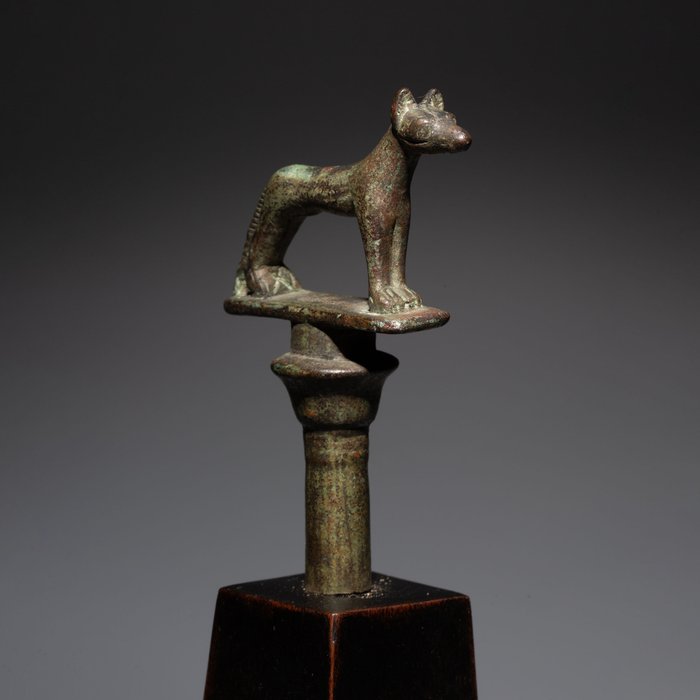
Oldtidens Egypten Bronze God Wepwawet - Upuaut scepter terminal. Sen Periode, 626 - 323 f.Kr. 17,5 cm H.
Lukket for budgivning
2 dage siden

Oldtidens Egypten Bronze God Wepwawet - Upuaut scepter terminal. Sen Periode, 626 - 323 f.Kr. 17,5 cm H.

God Wepwawet - Upuaut scepter terminal CULTURE: Ancient Egypt PERIOD: Late Period, 626 - 323 BC MATERIAL: Solid Bronze DIMENSIONS: Height 17,5 cm . Height 9,5 cm without stand. PROVENANCE: Collection of Guy Delbès (1928 - 2019), Paris. Private collection, Barcelona. CONDITION: Intact. DESCRIPTION: Terminal of the upper area of a baton or scepter with the effigy of a canid. The piece has a simple finish, with geometric shapes, inspired by columns, especially a typology characteristic of ancient Egypt such as lotiform columns, influenced by the shapes of the lotus flower. On the small capital with a camping structure, a circular podium raises the flat rectangular base where rests in a slender and elegant form, a dog or jackal in a standing position, is the image of the god Wepwawet. Wepwawet "the one who opens the roads", deity of the Duat (Beyond), funerary god and of the war in the Egyptian mythology. Wepwawet was represented in the form of a black dog or jackal with a white head, on an ensign, with one or two uraeus emerging from the sides of the paws. His warrior attributes were a mace and a bow. The Greeks interpreted him as a wolf, from which comes the name of Lycopolis, his city. It is likely that Wepwawet was originally a symbol of the pharaoh, attempting to associate himself with lupine attributes, later deifying himself as a mascot to accompany the pharaoh. Likewise, Wepwawet was said to accompany the pharaoh on hunts, in which capacity it was titled "(one with a) sharp arrow more powerful than the gods alone." In time, the connection with war, and thus with death, led Wepwawet to be seen as the one who opened the gates through and across the Duat to the spirits of the dead. With this and the similarity of the jackal to the wolf, Wepwawet became associated with Anubis, a deity who was worshipped in Asiut, eventually considering himself his son. Viscous as a jackal, he was also said to be the son of Set. Therefore, Wepwawet is often confused with Anubis. This deity appears in the temple of Seti I at Abydos. PARALLELS: Fig. 1 God Upuaut. Ancient Egypt, Lower Epoch, 664 - 323 B.C., bronze. Norwich Castle, Norfolk, inv. 1894.76.725. Fig. 2 God Upuaut. Ancient Egypt, Late Antiquity, 664 - 323 BC, bronze. Christie's London, Antiquities, April 26, 2012, lot 47. Notes: - The piece includes authenticity certificate. - The piece includes Spanish Export License. - The seller guarantees that he acquired this piece according to all national and international laws related to the ownership of cultural property. Provenance statement seen by Catawiki.

Nr. 100195413

Ikke længere tilgængelig
Oldtidens Egypten Bronze God Wepwawet - Upuaut scepter terminal. Sen Periode, 626 - 323 f.Kr. 17,5 cm H.

Oldtidens Egypten Bronze God Wepwawet - Upuaut scepter terminal. Sen Periode, 626 - 323 f.Kr. 17,5 cm H.

God Wepwawet - Upuaut scepter terminal

CULTURE: Ancient Egypt

PERIOD: Late Period, 626 - 323 BC

MATERIAL: Solid Bronze

DIMENSIONS: Height 17,5 cm . Height 9,5 cm without stand.

PROVENANCE: Collection of Guy Delbès (1928 - 2019), Paris. Private collection, Barcelona.

CONDITION: Intact.

DESCRIPTION:

Terminal of the upper area of a baton or scepter with the effigy of a canid. The piece has a simple finish, with geometric shapes, inspired by columns, especially a typology characteristic of ancient Egypt such as lotiform columns, influenced by the shapes of the lotus flower. On the small capital with a camping structure, a circular podium raises the flat rectangular base where rests in a slender and elegant form, a dog or jackal in a standing position, is the image of the god Wepwawet.

Wepwawet "the one who opens the roads", deity of the Duat (Beyond), funerary god and of the war in the Egyptian mythology. Wepwawet was represented in the form of a black dog or jackal with a white head, on an ensign, with one or two uraeus emerging from the sides of the paws. His warrior attributes were a mace and a bow. The Greeks interpreted him as a wolf, from which comes the name of Lycopolis, his city.

It is likely that Wepwawet was originally a symbol of the pharaoh, attempting to associate himself with lupine attributes, later deifying himself as a mascot to accompany the pharaoh. Likewise, Wepwawet was said to accompany the pharaoh on hunts, in which capacity it was titled "(one with a) sharp arrow more powerful than the gods alone."

In time, the connection with war, and thus with death, led Wepwawet to be seen as the one who opened the gates through and across the Duat to the spirits of the dead. With this and the similarity of the jackal to the wolf, Wepwawet became associated with Anubis, a deity who was worshipped in Asiut, eventually considering himself his son. Viscous as a jackal, he was also said to be the son of Set. Therefore, Wepwawet is often confused with Anubis. This deity appears in the temple of Seti I at Abydos.

PARALLELS:

Fig. 1 God Upuaut. Ancient Egypt, Lower Epoch, 664 - 323 B.C., bronze. Norwich Castle, Norfolk, inv. 1894.76.725.

Fig. 2 God Upuaut. Ancient Egypt, Late Antiquity, 664 - 323 BC, bronze. Christie's London, Antiquities, April 26, 2012, lot 47.


Notes:
- The piece includes authenticity certificate.
- The piece includes Spanish Export License.
- The seller guarantees that he acquired this piece according to all national and international laws related to the ownership of cultural property. Provenance statement seen by Catawiki.

Lukket for budgivning
Ruth Garrido Vila
Ekspert
Estimat  € 13.000 - € 15.000

Lignende genstande

Til dig i

Arkæologi

Indstil en søgealarm
Indstil en søgealarm for at få besked, når nye matches er tilgængelige.

Denne genstand blev vist i


Sådan køber du hos Catawiki

Få mere at vide om vores Køberbeskyttelse

      1. Opdag noget særligt

      Gennemse tusindvis af specielle genstande udvalgt af eksperter. Se fotos, detaljer og estimeret værdi af hver specielle genstand. 

      2. Afgiv det højeste bud

      Find noget, du er vild med, og afgiv det højeste bud. Du kan følge auktionen til dørs eller lade vores system byde for dig. Alt, du skal gøre, er at indstille et bud på det maksimale beløb, du vil betale. 

      3. Foretag en sikker betaling

      Betal for din specielle genstand, så opbevarer vi din betaling i sikkerhed, indtil den ankommer i god behold. Vi bruger et betroet betalingssystem til håndtering af alle transaktioner. 

Har du noget lignende at sælge?

Uanset om du er nybegynder på onlineauktioner eller sælger professionelt, kan vi hjælpe dig med at tjene mere på dine specielle genstande.

Sælg din genstand
