Nr. 100751667

Solgt
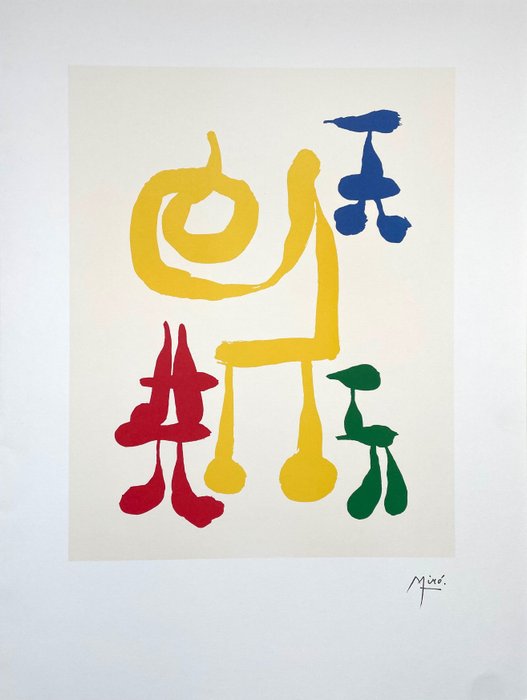
Joan Miro (1893-1983) - Parler Seul - licensed lithographic print - COA
Endelige bud
€ 80
Há 1 semana

Joan Miro (1893-1983) - Parler Seul - licensed lithographic print - COA

Joan Miró's lithograph (*) This work reproduces one of the illustrations originally created by Miró to illustrate the poetry book 'Parler Seul' (Talking to oneself), written by Tristan Tzara in 1947. Edited by Maeght Editeur in the year 2004. Made on high-weight cotton vellum paper. (170g) Stamped on a plate. Publisher's and Miró Succession's seal on the back of the page. Includes Certificate of Authenticity (COA). Specifications Support dimensions: 60 x 45 cm Image dimensions: 42 x 33 cm Year 2004 - Edition: 1000ex. - References: Cramer 17. Rauch 165 Condition: Excellent (this artwork has never been framed or exhibited, and has always been stored in a professional art folder, so it is in perfect condition). The work will be carefully handled and packaged in a reinforced flat cardboard box. The shipment will be certified with a tracking number. The shipment will also include full insurance for the final value of the work with full reimbursement in case of loss or damage, at no cost to the buyer. Joan Miró (1893-1983) was born in Barcelona, where he grew up and began his artistic studies. He attended the La Llotja Academy against the wishes of his parents, who wanted him to work in a more traditional way. Later, he studied at the Escola d'Art of Francesc Galí and met the Fauves and Cubists. His emotional landscapes, which will shape him as a person and artist, are essentially Mont-roig, Paris, Mallorca, and later New York and Japan. Mont-roig, a small town in the Baix Camp comarca, will be the counterpoint to the intellectual agitation he experiences in Paris, where he moved in the twenties alongside surrealist poets and the most creative artists of his time. There, he came to know Arp, Magritte, Brancusi, and Giacometti, and exhibited alongside Dalí, Tanguy, Meret Oppenheim, and Max Ernst in various exhibitions on Dadaism and Surrealism. The stimulus of Abstract Expressionism was discovered in New York in the 1940s. Later, in 1956, during the midst of World War II, Joan Miró left his exile in France and settled in Palma de Mallorca, a place of refuge and work, where his friend Josep Lluís Sert designed the studio he had always dreamed of. There, he focused on sculpture and ceramics work until his death in 1983. The attachment to the landscape of Mont-roig first and Mallorca later will be decisive in his work. The connection with the land and the interest in everyday objects and the natural environment will be the backdrop of some of his technical and formal investigations. Miró shuns academicism, constantly seeking a global and pure work, not affiliated with any particular movement. Rooted in forms and public manifestations, it is through the plastic act that Joan Miró shows his rebellion and a great sensitivity to the political and social events surrounding him. This contrast of forces will lead him to create a unique and highly personal language that positions him as one of the most influential artists of the 20th century. (') 'Parler Seul' represents a particularly effective collaboration between artist and author. Miró's brilliantly spontaneous and amorphous images, drawn directly on the stone with very few preparatory sketches, possess the inventive vigor of Tzara's random verses. The original edition was produced by Maeght Editeur and consists of 72 original lithographs by Miró, 49 of which are in color, with 18 being hors-texte. (*) Joan Miró (1893-1983) was born in Barcelona, where he grew up and began his artistic studies. He attended the La Llotja academy against his parents' wishes, who wanted him to work in a more traditional manner. Later, he studied at the Escola d'Art of Francesc Galí and became acquainted with the Fauves and the Cubists. His emotional landscapes, which will shape him as a person and artist, are essentially Mont-roig, Paris, Mallorca, and later New York and Japan. Mont-roig, a small town in the Baix Camp comarca, will be the counterpoint to the intellectual agitation he experiences in Paris, where he moved in the twenties alongside surrealist poets and the most creative artists of his time. There, he came to know Arp, Magritte, Brancusi, and Giacometti, and exhibited alongside Dalí, Tanguy, Meret Oppenheim, and Max Ernst in various exhibitions on Dadaism and Surrealism. The stimulus of Abstract Expressionism was discovered in New York in the 1940s. Later, in 1956, during the midst of World War II, Joan Miró left his exile in France and settled in Palma de Mallorca, a place of refuge and work, where his friend Josep Lluís Sert designed the studio he had always dreamed of. There, he focused on sculpture and ceramics work until his death in 1983. The attachment to the landscape of Mont-roig first and Mallorca later will be decisive in his work. The connection with the land and the interest in everyday objects and the natural environment will be the backdrop of some of his technical and formal investigations. Miró shuns academicism, constantly seeking a global and pure work, not affiliated with any particular movement. Rooted in forms and public manifestations, it is through the plastic act that Joan Miró shows his rebellion and a great sensitivity to the political and social events surrounding him. This contrast of forces will lead him to create a unique and highly personal language that positions him as one of the most influential artists of the 20th century. (') 'Parler Seul' represents a particularly effective collaboration between artist and author. Miró's brilliantly spontaneous and amorphous images, drawn directly on the stone with very few preparatory sketches, possess the inventive vigor of Tzara's random verses. The original edition was edited by Maeght Editeur and consists of 72 original lithographs by Miró, 49 of them in color, of which 18 are hors-texte. Tags: Picasso, Dalí, Pollock, Miró, Beuys, Warhol, Giacometti, Hodgkin, Moore, Malevich, Mondrian, O’Keefe, Matisse, Kandinsky, Bacon, Klimt, Hooper, Rothko, Chirico, Duchamp, Chagall, Braque, Picabia, Kooning, Ernst, Paul Klee, Modigliani, Calder, Delaunay. Kiefer, Kusama, Murakami, Koons, Basquiat, Nauman, Sherman, Bourgeois, Polke, Ruff, Ruscha, Holzer, Abramović, Freud, Mendieta, Tuymans, Kruger, Hockney, Saville, Fanzhi, Oehlen, Richter, Scully, Stella, Schütte, Xiaodong, Judd, Peyton, Richard Serra, LeWitt, Kippenberger, Baldessari, Doig, González-Torres, Salvador Dalí, Joan Miró, Magritte, Max Ernst, Leonora Carrington, Dorothea Tanning, Roberto Matta, Man Ray, Varo, Oppenheim, Key Sage, André Masson, Paul Delvaux, Giorgio de Chirico, Marcel Duchamp, Marc Chagall, Paul Klee, Hans Bellmer, Zhang Xiaogang, Savinio, Alexander Calder, Dora Maar, Vitra, Poolsen, Jacobsen, Hans Wegner, Charles Eames, Perriand, Philippe Starck, Marcel Breuer, Knoll, Juhl, Verner Panton, Le Corbusier, Mies van der Rohe, Nelson, Mogensen, Eames, Gio Ponti, Knoll, Isamu Noguchi, Bertoia, Alvar Aalto, Urquiola, Eileen Gray, Pesce, Magistretti, Louis Vuitton, Gucci, Chanel, Burberry, Hermès, Prada, Dior, Armani, Cartier, Dolce & Gabbana, Versace, Balenciaga, Ralph Lauren, Rolex, Fendi, Givenchy, Tiffany, Alexander McQueen, Yves Saint Laurent, Valentino, Bvlgari, Adami, Alberti, Alcaraz, Alfaro, Baldaccini, Baldeweg, Barceló, Barjola, Canogar, Cabellut, Caruncho, Ceesepe, Chillida, Chirino, Clavé, Condé, Cruz-Díez, Dalí, Dokoupil, Equipo Crónica, Gudmundur, Feito, Genovés, Goya, Gordillo, Guinovart, Hernández Pijuan, Iglesias, Lacalle, Joan Miró, Misterpiro, Mompó, Palazuelo, Pérez-Villalta, Picasso, Plensa, Rafols-Casamada, Reche, Redondela, Saura, Soto, Sicilia, Tàpies, Teixidor, Quetglas, Úrculo, Uslé, Varela, Valdés, Villalba, Yturralde.

Nr. 100751667

Solgt
Joan Miro (1893-1983) - Parler Seul - licensed lithographic print - COA

Joan Miro (1893-1983) - Parler Seul - licensed lithographic print - COA

Joan Miró's lithograph (*)
This work reproduces one of the illustrations originally created by Miró to illustrate the poetry book 'Parler Seul' (Talking to oneself), written by Tristan Tzara in 1947.
Edited by Maeght Editeur in the year 2004.
Made on high-weight cotton vellum paper. (170g)
Stamped on a plate.
Publisher's and Miró Succession's seal on the back of the page.
Includes Certificate of Authenticity (COA).

Specifications

Support dimensions: 60 x 45 cm
Image dimensions: 42 x 33 cm
Year 2004
- Edition: 1000ex.
- References: Cramer 17. Rauch 165
Condition: Excellent (this artwork has never been framed or exhibited, and has always been stored in a professional art folder, so it is in perfect condition).

The work will be carefully handled and packaged in a reinforced flat cardboard box. The shipment will be certified with a tracking number.

The shipment will also include full insurance for the final value of the work with full reimbursement in case of loss or damage, at no cost to the buyer.

Joan Miró (1893-1983) was born in Barcelona, where he grew up and began his artistic studies. He attended the La Llotja Academy against the wishes of his parents, who wanted him to work in a more traditional way. Later, he studied at the Escola d'Art of Francesc Galí and met the Fauves and Cubists.
His emotional landscapes, which will shape him as a person and artist, are essentially Mont-roig, Paris, Mallorca, and later New York and Japan. Mont-roig, a small town in the Baix Camp comarca, will be the counterpoint to the intellectual agitation he experiences in Paris, where he moved in the twenties alongside surrealist poets and the most creative artists of his time. There, he came to know Arp, Magritte, Brancusi, and Giacometti, and exhibited alongside Dalí, Tanguy, Meret Oppenheim, and Max Ernst in various exhibitions on Dadaism and Surrealism.
The stimulus of Abstract Expressionism was discovered in New York in the 1940s. Later, in 1956, during the midst of World War II, Joan Miró left his exile in France and settled in Palma de Mallorca, a place of refuge and work, where his friend Josep Lluís Sert designed the studio he had always dreamed of. There, he focused on sculpture and ceramics work until his death in 1983.
The attachment to the landscape of Mont-roig first and Mallorca later will be decisive in his work. The connection with the land and the interest in everyday objects and the natural environment will be the backdrop of some of his technical and formal investigations. Miró shuns academicism, constantly seeking a global and pure work, not affiliated with any particular movement. Rooted in forms and public manifestations, it is through the plastic act that Joan Miró shows his rebellion and a great sensitivity to the political and social events surrounding him. This contrast of forces will lead him to create a unique and highly personal language that positions him as one of the most influential artists of the 20th century.

(') 'Parler Seul' represents a particularly effective collaboration between artist and author. Miró's brilliantly spontaneous and amorphous images, drawn directly on the stone with very few preparatory sketches, possess the inventive vigor of Tzara's random verses.
The original edition was produced by Maeght Editeur and consists of 72 original lithographs by Miró, 49 of which are in color, with 18 being hors-texte. (*) Joan Miró (1893-1983) was born in Barcelona, where he grew up and began his artistic studies. He attended the La Llotja academy against his parents' wishes, who wanted him to work in a more traditional manner. Later, he studied at the Escola d'Art of Francesc Galí and became acquainted with the Fauves and the Cubists.
His emotional landscapes, which will shape him as a person and artist, are essentially Mont-roig, Paris, Mallorca, and later New York and Japan. Mont-roig, a small town in the Baix Camp comarca, will be the counterpoint to the intellectual agitation he experiences in Paris, where he moved in the twenties alongside surrealist poets and the most creative artists of his time. There, he came to know Arp, Magritte, Brancusi, and Giacometti, and exhibited alongside Dalí, Tanguy, Meret Oppenheim, and Max Ernst in various exhibitions on Dadaism and Surrealism.
The stimulus of Abstract Expressionism was discovered in New York in the 1940s. Later, in 1956, during the midst of World War II, Joan Miró left his exile in France and settled in Palma de Mallorca, a place of refuge and work, where his friend Josep Lluís Sert designed the studio he had always dreamed of. There, he focused on sculpture and ceramics work until his death in 1983.
The attachment to the landscape of Mont-roig first and Mallorca later will be decisive in his work. The connection with the land and the interest in everyday objects and the natural environment will be the backdrop of some of his technical and formal investigations. Miró shuns academicism, constantly seeking a global and pure work, not affiliated with any particular movement. Rooted in forms and public manifestations, it is through the plastic act that Joan Miró shows his rebellion and a great sensitivity to the political and social events surrounding him. This contrast of forces will lead him to create a unique and highly personal language that positions him as one of the most influential artists of the 20th century.

(') 'Parler Seul' represents a particularly effective collaboration between artist and author. Miró's brilliantly spontaneous and amorphous images, drawn directly on the stone with very few preparatory sketches, possess the inventive vigor of Tzara's random verses.
The original edition was edited by Maeght Editeur and consists of 72 original lithographs by Miró, 49 of them in color, of which 18 are hors-texte.


Tags:
Picasso, Dalí, Pollock, Miró, Beuys, Warhol, Giacometti, Hodgkin, Moore, Malevich, Mondrian, O’Keefe, Matisse, Kandinsky, Bacon, Klimt, Hooper, Rothko, Chirico, Duchamp, Chagall, Braque, Picabia, Kooning, Ernst, Paul Klee, Modigliani, Calder, Delaunay.
Kiefer, Kusama, Murakami, Koons, Basquiat, Nauman, Sherman, Bourgeois, Polke, Ruff, Ruscha, Holzer, Abramović, Freud, Mendieta, Tuymans, Kruger, Hockney, Saville, Fanzhi, Oehlen, Richter, Scully, Stella, Schütte, Xiaodong, Judd, Peyton, Richard Serra, LeWitt, Kippenberger, Baldessari, Doig, González-Torres, Salvador Dalí, Joan Miró, Magritte, Max Ernst, Leonora Carrington, Dorothea Tanning, Roberto Matta, Man Ray, Varo, Oppenheim, Key Sage, André Masson, Paul Delvaux, Giorgio de Chirico, Marcel Duchamp, Marc Chagall, Paul Klee, Hans Bellmer, Zhang Xiaogang, Savinio, Alexander Calder, Dora Maar, Vitra, Poolsen, Jacobsen, Hans Wegner, Charles Eames, Perriand, Philippe Starck, Marcel Breuer, Knoll, Juhl, Verner Panton, Le Corbusier, Mies van der Rohe, Nelson, Mogensen, Eames, Gio Ponti, Knoll, Isamu Noguchi, Bertoia, Alvar Aalto, Urquiola, Eileen Gray, Pesce, Magistretti, Louis Vuitton, Gucci, Chanel, Burberry, Hermès, Prada, Dior, Armani, Cartier, Dolce & Gabbana, Versace, Balenciaga, Ralph Lauren, Rolex, Fendi, Givenchy, Tiffany, Alexander McQueen, Yves Saint Laurent, Valentino, Bvlgari, Adami, Alberti, Alcaraz, Alfaro, Baldaccini, Baldeweg, Barceló, Barjola, Canogar, Cabellut, Caruncho, Ceesepe, Chillida, Chirino, Clavé, Condé, Cruz-Díez, Dalí, Dokoupil, Equipo Crónica, Gudmundur, Feito, Genovés, Goya, Gordillo, Guinovart, Hernández Pijuan, Iglesias, Lacalle, Joan Miró, Misterpiro, Mompó, Palazuelo, Pérez-Villalta, Picasso, Plensa, Rafols-Casamada, Reche, Redondela, Saura, Soto, Sicilia, Tàpies, Teixidor, Quetglas, Úrculo, Uslé, Varela, Valdés, Villalba, Yturralde.

Endelige bud
€ 80
Juan Antonio Rodríguez
Ekspert
Estimat  € 150 - € 200

Lignende genstande

Til dig i

Plakater og vægdekorationer

Indstil en søgealarm
Indstil en søgealarm for at få besked, når nye matches er tilgængelige.

Denne genstand blev vist i


Sådan køber du hos Catawiki

Få mere at vide om vores Køberbeskyttelse

      1. Opdag noget særligt

      Gennemse tusindvis af specielle genstande udvalgt af eksperter. Se fotos, detaljer og estimeret værdi af hver specielle genstand. 

      2. Afgiv det højeste bud

      Find noget, du er vild med, og afgiv det højeste bud. Du kan følge auktionen til dørs eller lade vores system byde for dig. Alt, du skal gøre, er at indstille et bud på det maksimale beløb, du vil betale. 

      3. Foretag en sikker betaling

      Betal for din specielle genstand, så opbevarer vi din betaling i sikkerhed, indtil den ankommer i god behold. Vi bruger et betroet betalingssystem til håndtering af alle transaktioner. 

Har du noget lignende at sælge?

Uanset om du er nybegynder på onlineauktioner eller sælger professionelt, kan vi hjælpe dig med at tjene mere på dine specielle genstande.

Sælg din genstand