Nr. 99623728

Solgt
En træskulptur - Akan - Ghana  (Ingen mindstepris)
Endelige bud
€ 95
Há 1 semana

En træskulptur - Akan - Ghana (Ingen mindstepris)

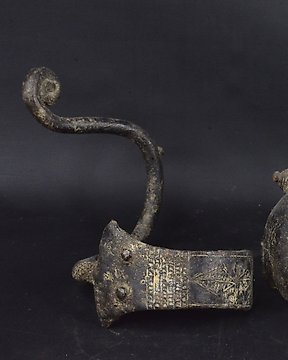
An Akan neck rest of Ghana or Ivory Coast, fine, brownish patina with geometric patterns on the sides and a bird's head as handle. Akan neckrests, primarily produced by the Akan peoples of southern Ghana and eastern Côte d’Ivoire, functioned both practically and symbolically. Practically, they served as supports for the head during sleep, keeping elaborate hairstyles intact and providing comfort on hard sleeping surfaces. The curved wooden form allowed the neck to rest without compressing the hair, reflecting the cultural importance of personal grooming and aesthetic presentation. Symbolically, neckrests carried social and spiritual significance. They were often carved with anthropomorphic or zoomorphic motifs, connecting the owner to protective spirits, ancestors, or emblematic animals. Some neckrests functioned as status symbols, signaling the wealth, rank, or identity of the owner, and could be included in funerary contexts to accompany the deceased. In addition, the carvings sometimes encoded proverbs, historical narratives, or ethical values, transforming an everyday object into a medium of cultural memory and moral instruction. In Akan visual culture, the interplay of functionality and symbolism in neckrests illustrates a broader principle: utilitarian objects frequently served as vehicles for social communication, spiritual protection, and artistic expression. "I believe that the import of all art objects from Africa—whether copies or originals—should be prohibited to protect Africa." Quote: Prof. Dr. Viola König, former director of the Ethnological Museum of Berlin, now HUMBOLDTFORUM Legal Framework Under the 1970 UNESCO Convention in combination with the Kulturgutschutz Gesetz (KGSG) any claim for the restitution of cultural property becomes time-barred three years after the competent authorities of the State of origin obtain knowledge of the object’s location and the identity of its possessor. All bronzes and terracotta items offered have been publicly exhibited in Wolfgang Jaenicke Gallery since 2001. Organisations such as DIGITAL BENIN and academic institutions such as the Technical University of Berlin, which have been intensively involved in restitution-reseaches (translocation-project) over the past seven years, are aware of our work, have inspected large parts of our collection and have visited us in our dependance in Lomé, Togo, among other places, to learn about the international Art trade on site. Furthermore, the National Commission for Museums and Monuments (NCMM) in Abuja, Nigeria, has been informed about our collection. In no case in the past have there been restitution claims against private institutions such as the Wolfgang Jaenicke Gallery Our Gallery addresses these structural challenges through a policy of maximum transparency and documentation. Should any questions or uncertainties arise, we invite you to contact us. Each matter will be reviewed diligently using all available resources. CAB25785

Nr. 99623728

Solgt
En træskulptur - Akan - Ghana  (Ingen mindstepris)

En træskulptur - Akan - Ghana (Ingen mindstepris)

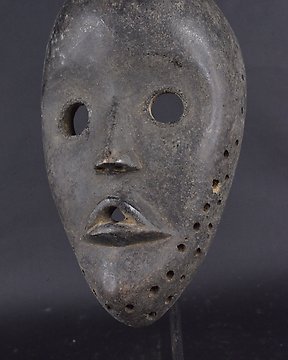
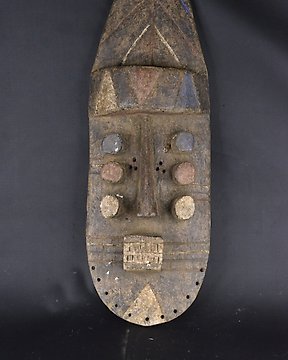
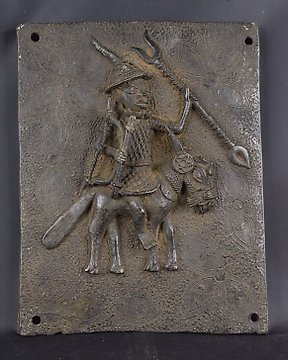
An Akan neck rest of Ghana or Ivory Coast, fine, brownish patina with geometric patterns on the sides and a bird's head as handle.

Akan neckrests, primarily produced by the Akan peoples of southern Ghana and eastern Côte d’Ivoire, functioned both practically and symbolically. Practically, they served as supports for the head during sleep, keeping elaborate hairstyles intact and providing comfort on hard sleeping surfaces. The curved wooden form allowed the neck to rest without compressing the hair, reflecting the cultural importance of personal grooming and aesthetic presentation.

Symbolically, neckrests carried social and spiritual significance. They were often carved with anthropomorphic or zoomorphic motifs, connecting the owner to protective spirits, ancestors, or emblematic animals. Some neckrests functioned as status symbols, signaling the wealth, rank, or identity of the owner, and could be included in funerary contexts to accompany the deceased. In addition, the carvings sometimes encoded proverbs, historical narratives, or ethical values, transforming an everyday object into a medium of cultural memory and moral instruction.

In Akan visual culture, the interplay of functionality and symbolism in neckrests illustrates a broader principle: utilitarian objects frequently served as vehicles for social communication, spiritual protection, and artistic expression.

"I believe that the import of all art objects from Africa—whether copies or originals—should be prohibited to protect Africa." Quote: Prof. Dr. Viola König, former director of the Ethnological Museum of Berlin, now HUMBOLDTFORUM

Legal Framework

Under the 1970 UNESCO Convention in combination with the Kulturgutschutz Gesetz (KGSG) any claim for the restitution of cultural property becomes time-barred three years after the competent authorities of the State of origin obtain knowledge of the object’s location and the identity of its possessor.
All bronzes and terracotta items offered have been publicly exhibited in Wolfgang Jaenicke Gallery since 2001. Organisations such as DIGITAL BENIN and academic institutions such as the Technical University of Berlin, which have been intensively involved in restitution-reseaches (translocation-project) over the past seven years, are aware of our work, have inspected large parts of our collection and have visited us in our dependance in Lomé, Togo, among other places, to learn about the international Art trade on site. Furthermore, the National Commission for Museums and Monuments (NCMM) in Abuja, Nigeria, has been informed about our collection. In no case in the past have there been restitution claims against private institutions such as the Wolfgang Jaenicke Gallery

Our Gallery addresses these structural challenges through a policy of maximum transparency and documentation. Should any questions or uncertainties arise, we invite you to contact us. Each matter will be reviewed diligently using all available resources.

CAB25785

Endelige bud
€ 95
Dimitri André
Ekspert
Estimat  € 280 - € 330

Lignende genstande

Til dig i

Afrikansk kunst og stammekunst

Indstil en søgealarm
Indstil en søgealarm for at få besked, når nye matches er tilgængelige.

Denne genstand blev vist i


Sådan køber du hos Catawiki

Få mere at vide om vores Køberbeskyttelse

      1. Opdag noget særligt

      Gennemse tusindvis af specielle genstande udvalgt af eksperter. Se fotos, detaljer og estimeret værdi af hver specielle genstand. 

      2. Afgiv det højeste bud

      Find noget, du er vild med, og afgiv det højeste bud. Du kan følge auktionen til dørs eller lade vores system byde for dig. Alt, du skal gøre, er at indstille et bud på det maksimale beløb, du vil betale. 

      3. Foretag en sikker betaling

      Betal for din specielle genstand, så opbevarer vi din betaling i sikkerhed, indtil den ankommer i god behold. Vi bruger et betroet betalingssystem til håndtering af alle transaktioner. 

Har du noget lignende at sælge?

Uanset om du er nybegynder på onlineauktioner eller sælger professionelt, kan vi hjælpe dig med at tjene mere på dine specielle genstande.

Sælg din genstand