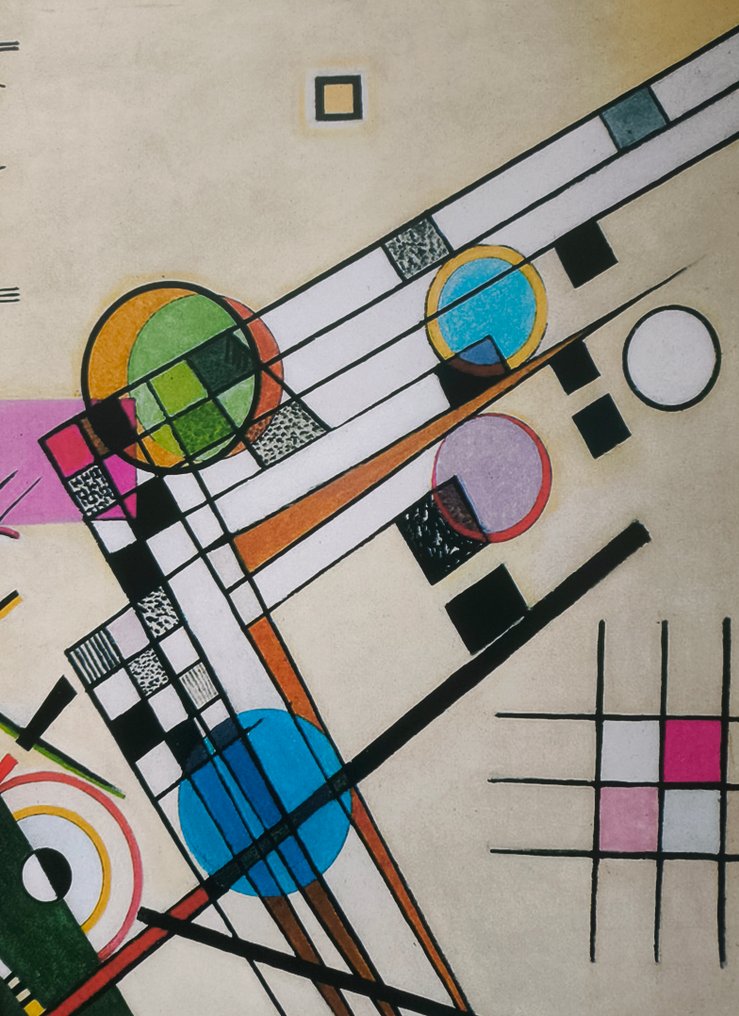
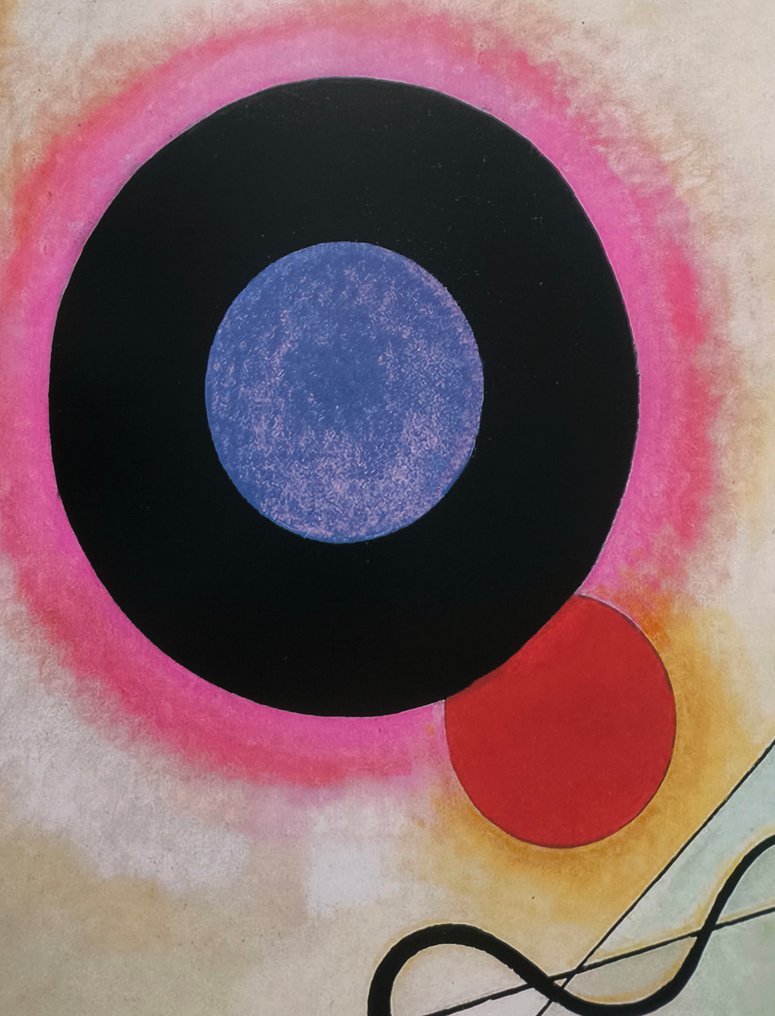
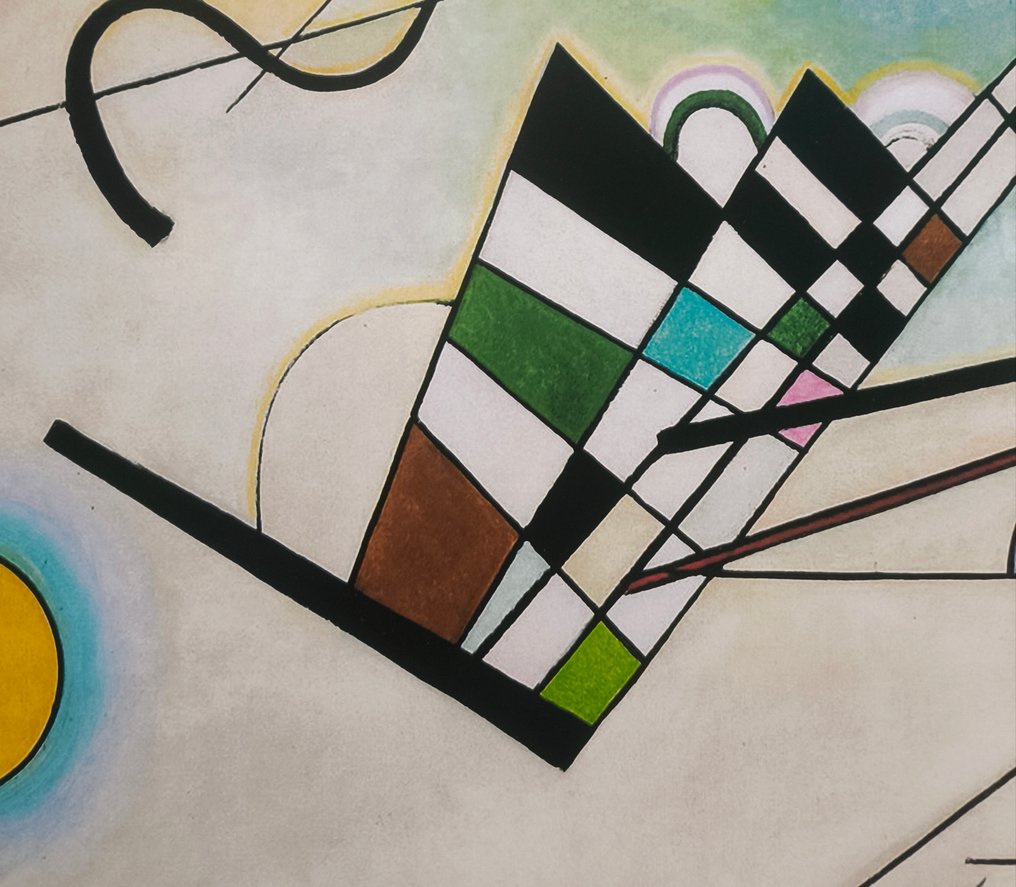
Wassily Kandinsky (1866–1944) (after) - "Composition VIII, 1923"


Abre el 26 mayo
Empezar a pujar
€ 1
Añádelo a tus favoritos para recibir una alerta cuando empiece la subasta.

Experto
Seleccionado por Juan Antonio Rodríguez
Ocho años valorando carteles; tasador en Balclis, Barcelona.
Estimación € 150 - € 200
Protección del Comprador de Catawiki
Tu pago está protegido con nosotros hasta que recibas tu objeto.Ver detalles
Trustpilot 4.4 | 133613 valoraciones
Valoración Excelente en Trustpilot.
Descripción del vendedor
- Wassily Kandinsky (after), "Composition VIII, 1923". Authorized offset print on heavyweight smooth satin paper (approx. 300gsm, refers to paper thickness/density).
- Signed in the plate.
- Stamp on verso.
- Condition: excellent. Never framed, never exposed.
- Size: 60 x 80cm.
- A masterwork of geometric abstraction and one of the defining images of the Bauhaus period, Composition VIII embodies Wassily Kandinsky’s revolutionary vision of painting as a universal language of form, colour and spiritual harmony. Created in 1923 during his teaching years at the Bauhaus alongside Paul Klee, László Moholy-Nagy and Josef Albers, this composition marks the transition from the expressive dynamism of his earlier works to a precise, architectural structure that would profoundly influence modern and contemporary abstraction.
Circles, diagonals, grids and chromatic planes interact like a visual symphony, echoing Kandinsky’s theory of synaesthesia in which colour and form correspond to musical sound a concept that resonates with the rhythmic structures later explored by Piet Mondrian, the optical clarity of Victor Vasarely and the minimal geometry of Ellsworth Kelly. The floating black lines and calibrated colour accents create a dynamic equilibrium between movement and control, anticipating the visual language of Constructivism and the systematic abstraction that would shape post-war art.
The central dominance of the circle which Kandinsky described as “the synthesis of the greatest oppositions” becomes a cosmic and spiritual symbol, aligning this work with the metaphysical aspirations of Kazimir Malevich and the formal purity later pursued by Mark Rothko and Barnett Newman. At the same time, the playful interaction of shapes preserves the poetic freedom that connects Kandinsky to Joan Miró and the lyrical abstraction of the mid-twentieth century.
Today, Composition VIII, housed in the Solomon R. Guggenheim Museum in New York, stands as an icon of twentieth-century modernism and a cornerstone for collectors of blue-chip masters. Its visual clarity, intellectual depth and timeless decorative power make it highly sought after in the international market and in contemporary interior design contexts, where works by Kandinsky coexist with those of Pablo Picasso, Henri Matisse, Gustav Klimt and Andy Warhol as essential references in curated fine art collections.
El vendedor y su historia
Vendedor en Catawiki desde hace más de ocho años.
Te invito a visitar mi perfil, allí encontrarás una lista completa de los diferentes lotes que se están subastando ahora. Haga clic en "Yuke".
¡Buena suerte en las subastas!
- Wassily Kandinsky (after), "Composition VIII, 1923". Authorized offset print on heavyweight smooth satin paper (approx. 300gsm, refers to paper thickness/density).
- Signed in the plate.
- Stamp on verso.
- Condition: excellent. Never framed, never exposed.
- Size: 60 x 80cm.
- A masterwork of geometric abstraction and one of the defining images of the Bauhaus period, Composition VIII embodies Wassily Kandinsky’s revolutionary vision of painting as a universal language of form, colour and spiritual harmony. Created in 1923 during his teaching years at the Bauhaus alongside Paul Klee, László Moholy-Nagy and Josef Albers, this composition marks the transition from the expressive dynamism of his earlier works to a precise, architectural structure that would profoundly influence modern and contemporary abstraction.
Circles, diagonals, grids and chromatic planes interact like a visual symphony, echoing Kandinsky’s theory of synaesthesia in which colour and form correspond to musical sound a concept that resonates with the rhythmic structures later explored by Piet Mondrian, the optical clarity of Victor Vasarely and the minimal geometry of Ellsworth Kelly. The floating black lines and calibrated colour accents create a dynamic equilibrium between movement and control, anticipating the visual language of Constructivism and the systematic abstraction that would shape post-war art.
The central dominance of the circle which Kandinsky described as “the synthesis of the greatest oppositions” becomes a cosmic and spiritual symbol, aligning this work with the metaphysical aspirations of Kazimir Malevich and the formal purity later pursued by Mark Rothko and Barnett Newman. At the same time, the playful interaction of shapes preserves the poetic freedom that connects Kandinsky to Joan Miró and the lyrical abstraction of the mid-twentieth century.
Today, Composition VIII, housed in the Solomon R. Guggenheim Museum in New York, stands as an icon of twentieth-century modernism and a cornerstone for collectors of blue-chip masters. Its visual clarity, intellectual depth and timeless decorative power make it highly sought after in the international market and in contemporary interior design contexts, where works by Kandinsky coexist with those of Pablo Picasso, Henri Matisse, Gustav Klimt and Andy Warhol as essential references in curated fine art collections.
El vendedor y su historia
Vendedor en Catawiki desde hace más de ocho años.
Te invito a visitar mi perfil, allí encontrarás una lista completa de los diferentes lotes que se están subastando ahora. Haga clic en "Yuke".
¡Buena suerte en las subastas!
Datos
Artista
Wassily Kandinsky (1866–1944) (after)
Vendido por
Propietario o revendedor
Edición
Original
Título de la obra
"Composition VIII, 1923"
Técnica
Impresión ófset
Firma
Firmado en plancha
País de origen
Italia
Estado
En excelente estado
Color
Amarillo, Azul, Negro, Rosa, Verde
Alto
60 cm
Ancho
80 cm
Estilo
Abstracto
Periodo
2000 - 2010
Se vende con marco
No
Vendido por