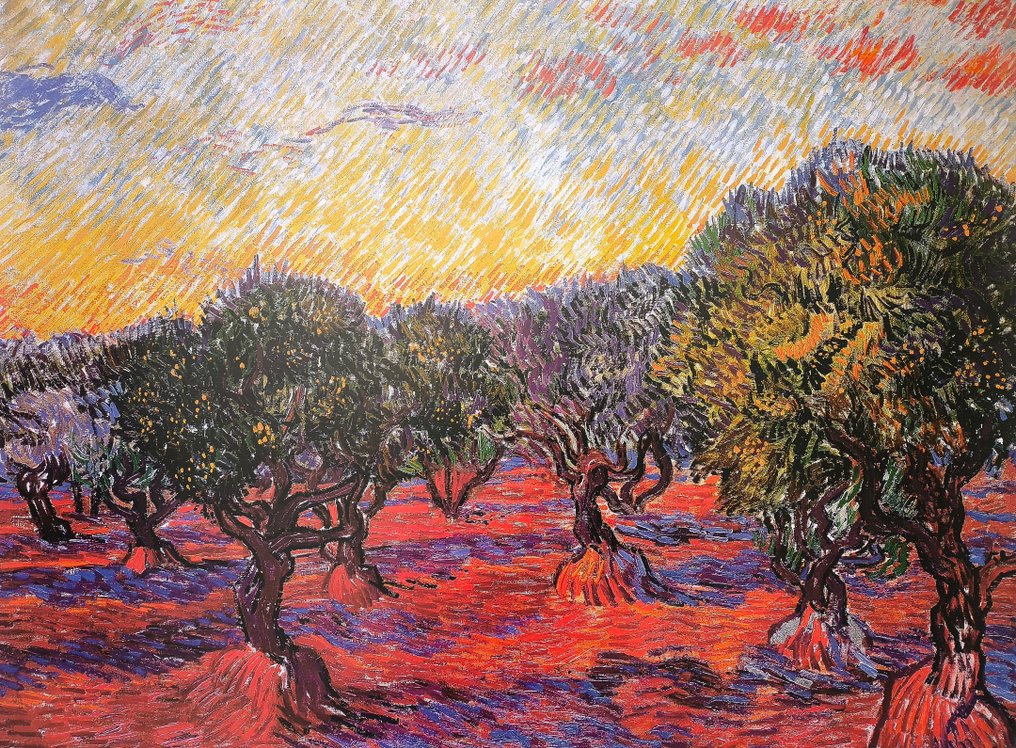
Vincent van Gogh (1853–1890) (after) - "Oliveraie"



Abre el 02 junio
Empezar a pujar
€ 1
Añádelo a tus favoritos para recibir una alerta cuando empiece la subasta.

Experto
Seleccionado por Juan Antonio Rodríguez
Ocho años valorando carteles; tasador en Balclis, Barcelona.
Estimación € 150 - € 200
Protección del Comprador de Catawiki
Tu pago está protegido con nosotros hasta que recibas tu objeto.Ver detalles
Trustpilot 4.4 | 134111 valoraciones
Valoración Excelente en Trustpilot.
Descripción del vendedor
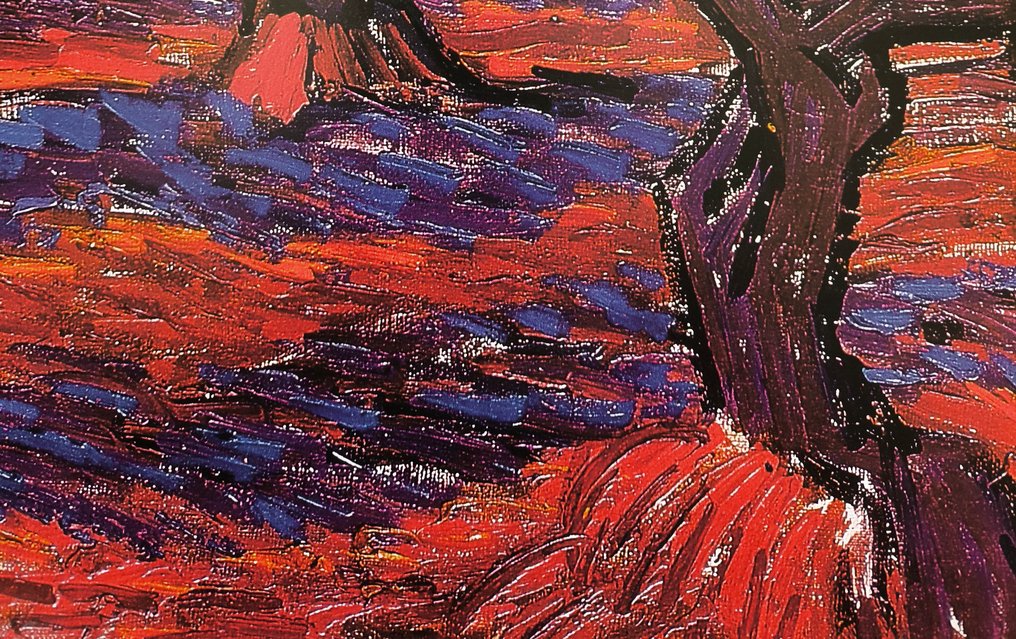
- Vincent van Gogh (after), authorized offset print on heavyweight smooth satin paper (approx.300gsm, refers to paper thickness/density).
- Stamp on verso.
- Condition: excellent. Never framed, never exposed.
- Size: 60 x 80cm.
- Vincent van Gogh (1853–1890), one of the most influential painters in the history of Post-Impressionism, created Oliveraie (Olive Grove) in 1889 during his stay in Saint-Rémy-de-Provence, a period in which he produced some of his most expressive and recognizable landscapes. Van Gogh’s bold brushwork, intense colors, and emotional approach to nature profoundly influenced artists such as Paul Gauguin, Henri Matisse, Edvard Munch, Wassily Kandinsky, and later modern masters including Marc Chagall, Chaïm Soutine, Francis Bacon, and even contemporary expressionist painters.
In Oliveraie, Van Gogh depicts the olive trees of southern France using vibrant complementary colors, dynamic strokes, and rhythmic lines that transform the landscape into a powerful emotional experience. The red and violet ground, the twisted trunks, and the luminous sky show the artist’s desire to go beyond realistic representation, anticipating the development of Expressionism and modern abstraction. These olive grove paintings belong to the same creative period as works like The Starry Night, Irises, and Wheatfield with Cypresses, which place Van Gogh among the most admired artists alongside Monet, Renoir, Cézanne, Seurat, Picasso, and Klimt.
Van Gogh painted several versions of olive groves, fascinated by their symbolic meaning and their connection to Mediterranean light, spirituality, and nature. His technique of thick, directional brushstrokes influenced generations of artists and helped shape the evolution of 20th-century art, linking his work to movements such as Fauvism, Expressionism, and modern figurative painting, and inspiring later creators including Kandinsky, Miró, Dalí, Warhol, and contemporary abstract painters.
Because of its intense color, energetic composition, and unmistakable style, Oliveraie (1889) is especially appreciated by collectors of Impressionism, Post-Impressionism, modern art, and decorative landscape prints, and it fits perfectly in contemporary interiors and design spaces where works inspired by Van Gogh, Monet, Picasso, Matisse, Kandinsky, and modern expressionist masters are valued for their timeless beauty and strong decorative presence.
Artists of similar importance: Basquiat, Kandinsky, Hockney, Lichtenstein, Miro, Banksy, Brainwash, Delaunay, Nara, Soulages, Lagasse, Ramos, Warhol, Lautrec, Klimt, Matisse, Hirst, Chagall, Koons, Haring, Indiana, Groening, Richter, Monroe, Herrera, Laurent, Klein, Coa, Dior, Vuitton, Kusama, Murakami, Testa, Villemot, Hopper, Ripolles, Wesselmann, Magritte, Orlinski, Rizzi, Manara, Kaws, Valentino, Cappiello, Rothko, Dalí, among others.
El vendedor y su historia
Vendedor en Catawiki desde hace más de ocho años.
Te invito a visitar mi perfil, allí encontrarás una lista completa de los diferentes lotes que se están subastando ahora. Haga clic en "Yuke".
¡Buena suerte en las subastas!
- Vincent van Gogh (after), authorized offset print on heavyweight smooth satin paper (approx.300gsm, refers to paper thickness/density).
- Stamp on verso.
- Condition: excellent. Never framed, never exposed.
- Size: 60 x 80cm.
- Vincent van Gogh (1853–1890), one of the most influential painters in the history of Post-Impressionism, created Oliveraie (Olive Grove) in 1889 during his stay in Saint-Rémy-de-Provence, a period in which he produced some of his most expressive and recognizable landscapes. Van Gogh’s bold brushwork, intense colors, and emotional approach to nature profoundly influenced artists such as Paul Gauguin, Henri Matisse, Edvard Munch, Wassily Kandinsky, and later modern masters including Marc Chagall, Chaïm Soutine, Francis Bacon, and even contemporary expressionist painters.
In Oliveraie, Van Gogh depicts the olive trees of southern France using vibrant complementary colors, dynamic strokes, and rhythmic lines that transform the landscape into a powerful emotional experience. The red and violet ground, the twisted trunks, and the luminous sky show the artist’s desire to go beyond realistic representation, anticipating the development of Expressionism and modern abstraction. These olive grove paintings belong to the same creative period as works like The Starry Night, Irises, and Wheatfield with Cypresses, which place Van Gogh among the most admired artists alongside Monet, Renoir, Cézanne, Seurat, Picasso, and Klimt.
Van Gogh painted several versions of olive groves, fascinated by their symbolic meaning and their connection to Mediterranean light, spirituality, and nature. His technique of thick, directional brushstrokes influenced generations of artists and helped shape the evolution of 20th-century art, linking his work to movements such as Fauvism, Expressionism, and modern figurative painting, and inspiring later creators including Kandinsky, Miró, Dalí, Warhol, and contemporary abstract painters.
Because of its intense color, energetic composition, and unmistakable style, Oliveraie (1889) is especially appreciated by collectors of Impressionism, Post-Impressionism, modern art, and decorative landscape prints, and it fits perfectly in contemporary interiors and design spaces where works inspired by Van Gogh, Monet, Picasso, Matisse, Kandinsky, and modern expressionist masters are valued for their timeless beauty and strong decorative presence.
Artists of similar importance: Basquiat, Kandinsky, Hockney, Lichtenstein, Miro, Banksy, Brainwash, Delaunay, Nara, Soulages, Lagasse, Ramos, Warhol, Lautrec, Klimt, Matisse, Hirst, Chagall, Koons, Haring, Indiana, Groening, Richter, Monroe, Herrera, Laurent, Klein, Coa, Dior, Vuitton, Kusama, Murakami, Testa, Villemot, Hopper, Ripolles, Wesselmann, Magritte, Orlinski, Rizzi, Manara, Kaws, Valentino, Cappiello, Rothko, Dalí, among others.
El vendedor y su historia
Vendedor en Catawiki desde hace más de ocho años.
Te invito a visitar mi perfil, allí encontrarás una lista completa de los diferentes lotes que se están subastando ahora. Haga clic en "Yuke".
¡Buena suerte en las subastas!
Datos
Artista
Vincent van Gogh (1853–1890) (after)
Vendido por
Propietario o revendedor
Edición
Original
Título de la obra
"Oliveraie"
Técnica
Impresión ófset
Firma
Sin firmar
País de origen
Italia
Estado
En excelente estado
Alto
60 cm
Ancho
80 cm
Representación/tema
Naturaleza
Estilo
Impresionismo
Periodo
2000 - 2010
Se vende con marco
No
Vendido por