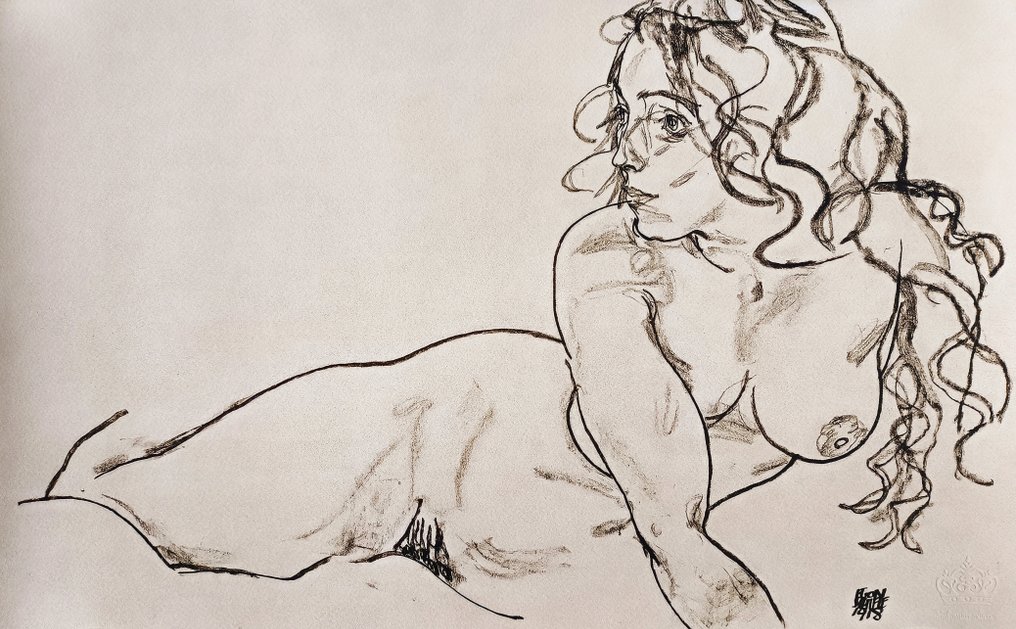
Egon Schiele (1890-1918) (after) - Nude Portrait


00
días
23
horas
26
minutos
36
segundos

 | 20 € | |
|---|---|---|
 | 3 € | |
 | 2 € | |
Protección del Comprador de Catawiki
Tu pago está protegido con nosotros hasta que recibas tu objeto.Ver detalles
Trustpilot 4.4 | 137810 valoraciones
Valoración Excelente en Trustpilot.
Descripción del vendedor
- Egon Schiele (after), giclée print on heavyweight textured matte paper (approx. 300gsm, refers to paper thickness/density).
- Plate signed.
- Embossing stamp.
- Stamp on verso.
- Size: 36 x 56,5 cm.
- Condition: excellent. Never framed, never exposed.
- Egon Schiele (1890–1918) is one of the most distinctive figures of early 20th-century art and a central representative of Austrian Expressionism, closely linked to the legacy of Gustav Klimt and the Vienna Secession. His work marked a radical departure from academic tradition, emphasizing raw emotion, psychological intensity, and the expressive power of line. Today, Schiele’s works are highly valued by collectors of Klimt, Kokoschka, Munch, and later artists associated with modern figuration, as well as by those who follow the market for Picasso, Hockney, Richter, and contemporary art.
This Nude Portrait is a powerful example of Schiele’s unmistakable style, in which the human figure is rendered with sharp, nervous lines and a striking sense of immediacy. The composition focuses on the body as a vehicle of expression rather than ideal beauty, presenting the figure in a pose that feels both intimate and confrontational. The economy of means, combined with the intensity of the line, reflects Schiele’s mastery of drawing and his ability to convey emotion with minimal elements, a quality that places him among the most influential draughtsmen of modern art.
Schiele’s nudes are considered among the most important explorations of the human figure in 20th-century art, challenging traditional representations and opening the way for a more direct and psychological approach to the body. His works remain essential references and are especially appreciated for those interested in Expressionism, modern drawing, and figurative art, fields that also attract buyers of works related to Klimt, Munch, Modigliani, and other artists who redefined the representation of the human form.
The combination of expressive line, emotional depth, and raw immediacy makes this image particularly appealing for those follow the market for Klimt, Picasso, Warhol, Hockney, Richter, Lagasse, Banksy and contemporary art, where powerful figurative compositions continue to generate strong and consistent demand.
El vendedor y su historia
Vendedor en Catawiki desde hace más de ocho años.
Te invito a visitar mi perfil, allí encontrarás una lista completa de los diferentes lotes que se están subastando ahora. Haga clic en "Yuke".
¡Buena suerte en las subastas!
- Egon Schiele (after), giclée print on heavyweight textured matte paper (approx. 300gsm, refers to paper thickness/density).
- Plate signed.
- Embossing stamp.
- Stamp on verso.
- Size: 36 x 56,5 cm.
- Condition: excellent. Never framed, never exposed.
- Egon Schiele (1890–1918) is one of the most distinctive figures of early 20th-century art and a central representative of Austrian Expressionism, closely linked to the legacy of Gustav Klimt and the Vienna Secession. His work marked a radical departure from academic tradition, emphasizing raw emotion, psychological intensity, and the expressive power of line. Today, Schiele’s works are highly valued by collectors of Klimt, Kokoschka, Munch, and later artists associated with modern figuration, as well as by those who follow the market for Picasso, Hockney, Richter, and contemporary art.
This Nude Portrait is a powerful example of Schiele’s unmistakable style, in which the human figure is rendered with sharp, nervous lines and a striking sense of immediacy. The composition focuses on the body as a vehicle of expression rather than ideal beauty, presenting the figure in a pose that feels both intimate and confrontational. The economy of means, combined with the intensity of the line, reflects Schiele’s mastery of drawing and his ability to convey emotion with minimal elements, a quality that places him among the most influential draughtsmen of modern art.
Schiele’s nudes are considered among the most important explorations of the human figure in 20th-century art, challenging traditional representations and opening the way for a more direct and psychological approach to the body. His works remain essential references and are especially appreciated for those interested in Expressionism, modern drawing, and figurative art, fields that also attract buyers of works related to Klimt, Munch, Modigliani, and other artists who redefined the representation of the human form.
The combination of expressive line, emotional depth, and raw immediacy makes this image particularly appealing for those follow the market for Klimt, Picasso, Warhol, Hockney, Richter, Lagasse, Banksy and contemporary art, where powerful figurative compositions continue to generate strong and consistent demand.
El vendedor y su historia
Vendedor en Catawiki desde hace más de ocho años.
Te invito a visitar mi perfil, allí encontrarás una lista completa de los diferentes lotes que se están subastando ahora. Haga clic en "Yuke".
¡Buena suerte en las subastas!
Datos
Artista
Egon Schiele (1890-1918) (after)
Vendido por
Propietario o revendedor
Edición
Original
Título de la obra
Nude Portrait
Técnica
Giclée
Firma
Firmado en plancha
País de origen
Alemania
Estado
En excelente estado
Alto
36 cm
Ancho
56,5 cm
Representación/tema
Desnudo
Periodo
2000 - 2010
Se vende con marco
No
Vendido por