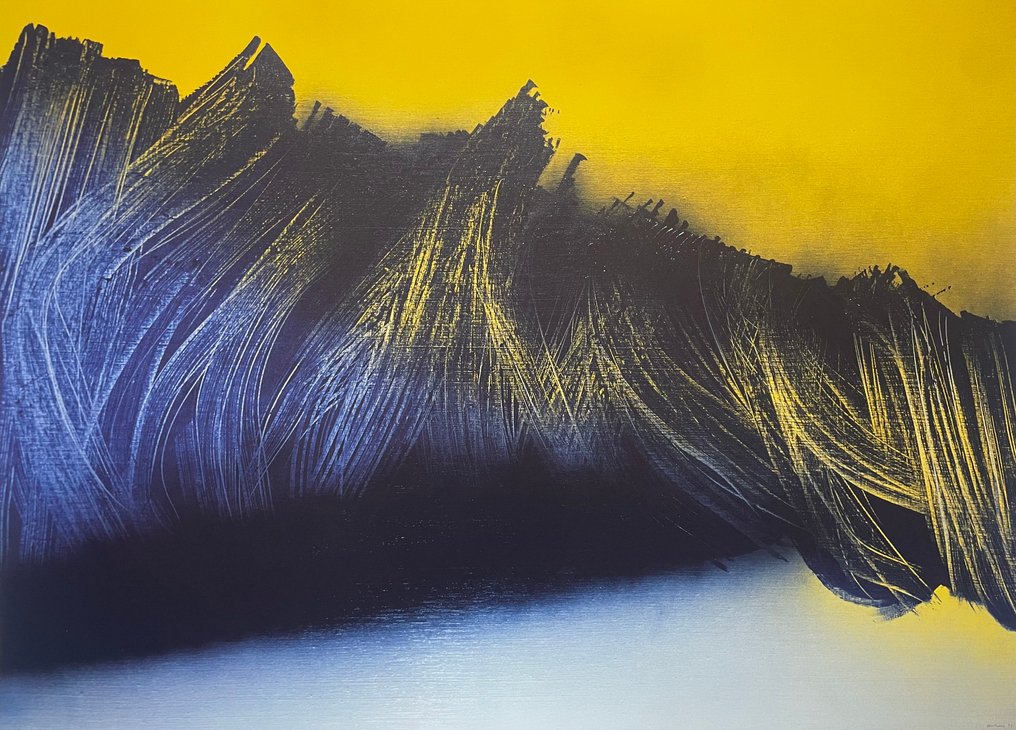
Hans Hartung - T1971-R30 - Offset lithography - Licensed print 2008 - COA



05
jours
19
heures
48
minutes
20
secondes
Offre actuelle
€ 35
Prix de réserve non atteint

Expert
Sélectionné par Juan Antonio Rodríguez
Huit ans d'expérience en expertise d'affiches chez Balclis, Barcelone.
Estimation € 150 - € 200
3 autres personnes s’intéressent cet objet
 | 35 € | |
|---|---|---|
| 1 € |
Protection des acheteurs Catawiki
Votre paiement est en sécurité chez nous jusqu’à la réception de votre objet.Voir les informations
Trustpilot 4.4 | 135391 d’avis
Noté Excellent sur Trustpilot.
Description fournie par le vendeur
Offset lithography by Hans Hartung (*).
Reproduction of the work “T1971-R30”, made by Hartung in 1971.
Produced on high-quality vellum paper (220g).
Published by Arte-Paris.
Legal print authorized by the Hartung-Bergman Foundation
Signed on the plate by the artist.
Specifications:
Dimensions: 65 x 85 cm
Year: 2008
Condition: Excellent (this work has never been framed or exhibited, and has always been kept in a professional art folder, and is therefore offered in perfect condition).
Provenance: Private Collection.
The work will be carefully handled and packed in reinforced cardboard packaging. The shipment will be certified with a tracking number.
The shipment will also include transport insurance for the final value of the work with full reimbursement in case of loss or damage, at no cost to the buyer.
(*) Hans Hartung is an important German painter who became a French national, known for his abstract works with black calligraphic strokes on colored backgrounds.
He was born in Leipzig into a family of physicists. His grandfather was also a self-taught painter and composer. Between 1915 and 1926 he studied classical languages at Dresden Gymnasium and philosophy and art history at the university and at the Leipzig Academy of Fine Arts. Later he entered the Dresden Academy of Fine Arts.
During the summer of 1926 he traveled by bicycle through France, Italy and Spain. In 1931 he first exhibited in Dresden. In 1937, at a collective exhibition at the Jeu de Paume, Paris (France), he met the great Spanish sculptor Julio González, who would have a profound influence on him. González provided all kinds of help and encouraged him to undertake his own artistic path.
During the prewar period Hartung settled in Paris to avoid the Nazi regime, and he exhibited in several galleries. In 1938 he participated in an anti-Nazi exhibition at the New Burlington Galleries in London (Great Britain).
In 1939, he was imprisoned in Spain and subsequently enlisted in the Foreign Legion in North Africa. In 1944 he was seriously injured during the siege of Belfort and lost a leg. After the war he became a French citizen and in 1947 held an important solo exhibition in Paris.
From the beginning he remained distant from the Bauhaus movement, which he regarded as a mere passing fashion. His paintings, purely abstract, reflect his view on the representation of reality: free and pure expression must transcend reality. The rapid brushwork was a fundamental feature of his working method.
Speed in the creative process was, in his own words, a spiritual necessity. He received several awards, including the Guggenheim Prize in 1956 and in 1960 the Grand International Prize of the Venice Biennale."
À propos du vendeur
EsKobARTE sélectionne soigneusement des œuvres et des affiches d'artistes reconnus et émergents du monde entier, pour les proposer ici à des prix abordables.*** OBRAS AUTHENTIQUES *** Nous ne vendons que des œuvres et affiches authentiques et des tirages légalement autorisés*** SOMOS PROFESIONALES ***
Vous pouvez enchérir sur vos objets en toute confiance. Plus de 1000 avis positifs de nos clients attestent de notre expérience et de notre professionnalisme sur Catawiki*** ENVÍOS PROTÉGIDOS, CERTIFICADOS Y ASEGURADOS ***
Tous nos objets sont soigneusement emballés dans des emballages en carton écologiques. Nous travaillons avec les meilleures entreprises de transport (UPS-DPD-DHL-FEDEX) pour garantir le meilleur service et le suivi. De plus, nos envois incluent une assurance contre les dommages ou la perte, sans frais pour l'acheteur.*** SI ADQUIERE MÁS DE UN OBJETO, COMBINAMOS EL ENVÍO ***
Même si les objets proviennent de ventes aux enchères différentes, vous ne paierez les frais de port que pour un seul objet.*** ¿ALGUNA DUDA? CONTACTE CON NOSOTROS ***
Vous pouvez utiliser le chat pour nous parler, nous vous accueillerons avec grand plaisir dans les plus brefs délais.*** ¡ GRACIAS Y SUERTE CON SUS PUJAS ! ***
Traduit par Google TraductionOffset lithography by Hans Hartung (*).
Reproduction of the work “T1971-R30”, made by Hartung in 1971.
Produced on high-quality vellum paper (220g).
Published by Arte-Paris.
Legal print authorized by the Hartung-Bergman Foundation
Signed on the plate by the artist.
Specifications:
Dimensions: 65 x 85 cm
Year: 2008
Condition: Excellent (this work has never been framed or exhibited, and has always been kept in a professional art folder, and is therefore offered in perfect condition).
Provenance: Private Collection.
The work will be carefully handled and packed in reinforced cardboard packaging. The shipment will be certified with a tracking number.
The shipment will also include transport insurance for the final value of the work with full reimbursement in case of loss or damage, at no cost to the buyer.
(*) Hans Hartung is an important German painter who became a French national, known for his abstract works with black calligraphic strokes on colored backgrounds.
He was born in Leipzig into a family of physicists. His grandfather was also a self-taught painter and composer. Between 1915 and 1926 he studied classical languages at Dresden Gymnasium and philosophy and art history at the university and at the Leipzig Academy of Fine Arts. Later he entered the Dresden Academy of Fine Arts.
During the summer of 1926 he traveled by bicycle through France, Italy and Spain. In 1931 he first exhibited in Dresden. In 1937, at a collective exhibition at the Jeu de Paume, Paris (France), he met the great Spanish sculptor Julio González, who would have a profound influence on him. González provided all kinds of help and encouraged him to undertake his own artistic path.
During the prewar period Hartung settled in Paris to avoid the Nazi regime, and he exhibited in several galleries. In 1938 he participated in an anti-Nazi exhibition at the New Burlington Galleries in London (Great Britain).
In 1939, he was imprisoned in Spain and subsequently enlisted in the Foreign Legion in North Africa. In 1944 he was seriously injured during the siege of Belfort and lost a leg. After the war he became a French citizen and in 1947 held an important solo exhibition in Paris.
From the beginning he remained distant from the Bauhaus movement, which he regarded as a mere passing fashion. His paintings, purely abstract, reflect his view on the representation of reality: free and pure expression must transcend reality. The rapid brushwork was a fundamental feature of his working method.
Speed in the creative process was, in his own words, a spiritual necessity. He received several awards, including the Guggenheim Prize in 1956 and in 1960 the Grand International Prize of the Venice Biennale."
À propos du vendeur
EsKobARTE sélectionne soigneusement des œuvres et des affiches d'artistes reconnus et émergents du monde entier, pour les proposer ici à des prix abordables.*** OBRAS AUTHENTIQUES *** Nous ne vendons que des œuvres et affiches authentiques et des tirages légalement autorisés*** SOMOS PROFESIONALES ***
Vous pouvez enchérir sur vos objets en toute confiance. Plus de 1000 avis positifs de nos clients attestent de notre expérience et de notre professionnalisme sur Catawiki*** ENVÍOS PROTÉGIDOS, CERTIFICADOS Y ASEGURADOS ***
Tous nos objets sont soigneusement emballés dans des emballages en carton écologiques. Nous travaillons avec les meilleures entreprises de transport (UPS-DPD-DHL-FEDEX) pour garantir le meilleur service et le suivi. De plus, nos envois incluent une assurance contre les dommages ou la perte, sans frais pour l'acheteur.*** SI ADQUIERE MÁS DE UN OBJETO, COMBINAMOS EL ENVÍO ***
Même si les objets proviennent de ventes aux enchères différentes, vous ne paierez les frais de port que pour un seul objet.*** ¿ALGUNA DUDA? CONTACTE CON NOSOTROS ***
Vous pouvez utiliser le chat pour nous parler, nous vous accueillerons avec grand plaisir dans les plus brefs délais.*** ¡ GRACIAS Y SUERTE CON SUS PUJAS ! ***
Traduit par Google TraductionDétails
Époque
1900-2000
Designer/artist
Hans Hartung
Titre de l’affiche
T1971-R30 - Offset lithography - Licensed print 2008 - COA
Sujet
Art
Pays d’origine
Allemagne
Condition
A (excellent - état neuf)
Hauteur
85 cm
Largeur
65 cm
Vendu par