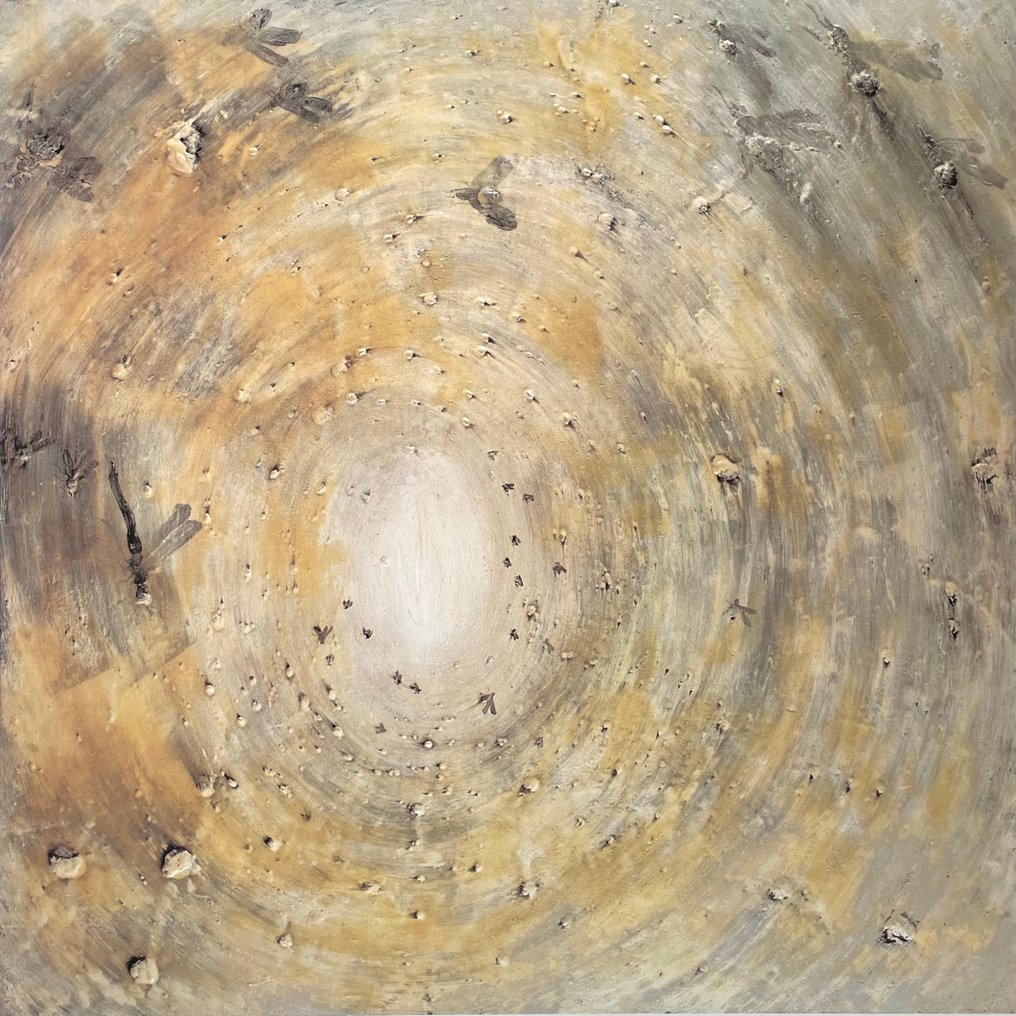
Miquel Barceló (after) - Constelació Nº4 - Offset Lithograph - 68x68 - Licensed print


02
jours
07
heures
38
minutes
05
secondes
Offre actuelle
€ 2
Prix de réserve non atteint

Expert
Sélectionné par Juan Antonio Rodríguez
Huit ans d'expérience en expertise d'affiches chez Balclis, Barcelone.
Estimation € 150 - € 200
 | 2 € | |
|---|---|---|
| 1 € |
Protection des acheteurs Catawiki
Votre paiement est en sécurité chez nous jusqu’à la réception de votre objet.Voir les informations
Trustpilot 4.4 | 144916 d’avis
Noté Excellent sur Trustpilot.
Description fournie par le vendeur
Offset lithography after Miquel Barceló (*)
Reproduction of the work “Constelació Nº4” (**), mixed media of pigments and latex on canvas created by Barceló in 1989
Printed on thick high-quality Art Fine paper (200g)
Published by Mueso d’Art Espanyol Contemporani de Palma de Mallorca.
Authorized print with copyright and legal serial number.
Large Format.
- Sheet dimensions: 68 x 68 cm
- Condition: Excellent (this work has never been framed or exhibited, always kept in a professional art folder, thus in perfect condition).
The work will be carefully handled and packed in reinforced cardboard packaging. The shipment will be traceable with a tracking number.
The shipment will also include transport insurance for the final value of the work with full reimbursement in case of loss or damage, at no cost to the buyer.
(*) Miquel Barceló’s early interest in art comes largely from his mother, a painter in the Mallorca landscape tradition; his first dazzlement occurred when he traveled to Paris in 1974 and discovered the painting of Paul Klee, Jean Dubuffet, and the art brut works in general, which would have a lasting impact on him.
That same year he began attending drawing and modeling classes at the Palma de Mallorca School of Decorative Arts, and shortly after he entered the Sant Jordi School of Fine Arts in Barcelona, although he hardly attended classes during the first months; instead, his self-taught education was decisive: he read voraciously all kinds of works and gradually explored the paintings of Lucio Fontana, Mark Rothko, Jackson Pollock and Willem de Kooning, among other prominent artists.
In 1976 he participated in happenings and protest actions of the Taller Llunàtic group, and with them staged his first exhibition in Barcelona, at the Mec-Mec gallery, in 1977; the following year he exhibited in Mallorca canvases covered with paint into which organic elements were incorporated. Later he experimented with thick layers of paint on canvases subjected to the elements, to provoke spontaneous physical and chemical reactions, such as oxidation or patination, which revealed the entrails of the painting. He would never abandon experimentation with organic materials and forms drawn from nature.
His participation in the São Paulo Biennial (1981) and in Documenta Kassel VII (1982) propelled him onto the international art scene in his youth. The world’s leading museums and galleries began to demand him, and his paintings reached an exceptionally high market value for an artist of his age. Equally rapid came important awards: in 1986 he won the National Plastic Arts Prize, and in 2003 he would receive the Prince of Asturias Award for the Arts.
Barceló has spent long periods in Mali, an African country whose light, like that of the Mediterranean, has left deep traces in his painting. In 1992 he secretly married in Artà to Cecile, a Dutch literature specialist. Months later, in August of that year, he became a father for the first time when giving birth to a girl named Marcela María Celia in Mallorca. The couple reside in his Sa Devesa de Ferrutx studio-house (Mallorca). In 2002 he produced a memorable illustration of Dante’s Divine Comedy, and in 2007 he inaugurated an extraordinary ceramic altarpiece in the Chapel of the Blessed Sacrament of Palma Cathedral, which recreates the miracle of bread and fishes.
In November 2008 the decoration of the cupola of Room XX at the United Nations Palace in Geneva was unveiled, named “Hall of Human Rights and the Alliance of Civilisations.” This work, covering 1600 square meters and costing 20 million euros, can only be appreciated by the viewer in fragments due to its vast surface; in it, the artist forged thousands of marine stalactites that together evoke a great universal sea.
Barceló’s painting tradition, art brut, American abstract expressionism, Italian povera, and the works of Joan Miró and Antoni Tàpies are among the influences he has transfigured into a formidable personal synthesis of neo-expressionist nature and exuberant imagination, with dense material presence and immense plastic richness.
(**) The enormous international success achieved by Miquel Barceló is largely due to the plastic force of his paintings, the originality of his characteristic themes, and a technique based on certain resources, such as mastery of aerial perspective, from which he tends to present piquant visions of spaces difficult to represent and the transition from tiny to cosmic scales, showing both objects of immediate presence and vast places, such as the sea that has no concrete limits.
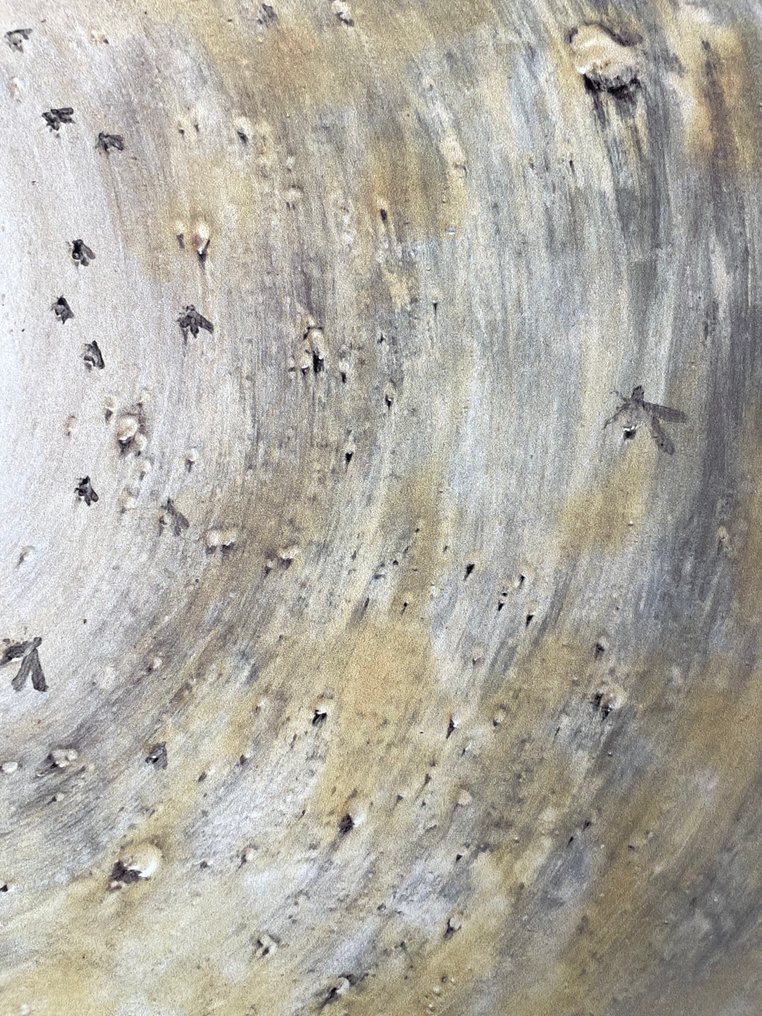
In the case of Constel·lació núm. 4 (Forat blanc), a word that seems drawn from the mythical world of another great Mallorcan painter, Joan Miró, we are faced with a cosmogonical space, without limits or references to a particular place or a determined scale, in which everything seems to revolve around a large white hole, as if planets or stars formed a milky constellation around a central great void. However, some material protuberances on the painting seem to cast shadows on the canvas suggesting shapes of dragonflies or flying insects, which would place this constellation on the scale of the tiny.
But if we compare those protuberances that, like excrescences, populate the painting’s fabric with those that appear in La flaque, we could interpret this space as the consequence of a mirage produced by desert light, where stones on the ground, with blinding sand, seem to have begun to spin before our eyes. In this painting, the cosmic and the earthly go hand in hand.
À propos du vendeur
EsKobARTE sélectionne avec soin des œuvres d'art d'artistes renommés et émergents du monde entier, et les propose ici à des prix abordables. *** IMPRESSIONS LICENCIEES DE HAUTE QUALITÉ *** Nous ne vendons que des œuvres authentiques et des impressions licenciées de haute qualité. *** NOUS SOMMES DES PROFESSIONNELS *** Vous pouvez enchérir sur nos articles en toute confiance. Plus de 1000 avis positifs sur Catawiki attestent de notre professionnalisme. *** EXPÉDITION SÉCURISÉE, CERTIFIÉE ET ASSURÉE *** Tous nos articles sont soigneusement emballés dans des boîtes en carton écologiques. Nous travaillons avec les meilleurs services de courrier (UPS, DPD, DHL, FedEx) pour garantir le meilleur service et un suivi optimisé. Nos expéditions incluent également une assurance contre les dommages ou la perte, sans coût supplémentaire pour l'acheteur *** EXPÉDITION COMBINÉE *** Si vous achetez plusieurs articles — même issus de différentes enchères — vous ne payez les frais de port qu'une seule fois *** DES QUESTIONS ? *** N'hésitez pas à nous contacter via le chat, nous vous aiderons avec plaisir dans les plus brefs délais *** MERCI ET BONNE CHANCE POUR VOS ENCHÈRES !
Traduit par Google TraductionOffset lithography after Miquel Barceló (*)
Reproduction of the work “Constelació Nº4” (**), mixed media of pigments and latex on canvas created by Barceló in 1989
Printed on thick high-quality Art Fine paper (200g)
Published by Mueso d’Art Espanyol Contemporani de Palma de Mallorca.
Authorized print with copyright and legal serial number.
Large Format.
- Sheet dimensions: 68 x 68 cm
- Condition: Excellent (this work has never been framed or exhibited, always kept in a professional art folder, thus in perfect condition).
The work will be carefully handled and packed in reinforced cardboard packaging. The shipment will be traceable with a tracking number.
The shipment will also include transport insurance for the final value of the work with full reimbursement in case of loss or damage, at no cost to the buyer.
(*) Miquel Barceló’s early interest in art comes largely from his mother, a painter in the Mallorca landscape tradition; his first dazzlement occurred when he traveled to Paris in 1974 and discovered the painting of Paul Klee, Jean Dubuffet, and the art brut works in general, which would have a lasting impact on him.
That same year he began attending drawing and modeling classes at the Palma de Mallorca School of Decorative Arts, and shortly after he entered the Sant Jordi School of Fine Arts in Barcelona, although he hardly attended classes during the first months; instead, his self-taught education was decisive: he read voraciously all kinds of works and gradually explored the paintings of Lucio Fontana, Mark Rothko, Jackson Pollock and Willem de Kooning, among other prominent artists.
In 1976 he participated in happenings and protest actions of the Taller Llunàtic group, and with them staged his first exhibition in Barcelona, at the Mec-Mec gallery, in 1977; the following year he exhibited in Mallorca canvases covered with paint into which organic elements were incorporated. Later he experimented with thick layers of paint on canvases subjected to the elements, to provoke spontaneous physical and chemical reactions, such as oxidation or patination, which revealed the entrails of the painting. He would never abandon experimentation with organic materials and forms drawn from nature.
His participation in the São Paulo Biennial (1981) and in Documenta Kassel VII (1982) propelled him onto the international art scene in his youth. The world’s leading museums and galleries began to demand him, and his paintings reached an exceptionally high market value for an artist of his age. Equally rapid came important awards: in 1986 he won the National Plastic Arts Prize, and in 2003 he would receive the Prince of Asturias Award for the Arts.
Barceló has spent long periods in Mali, an African country whose light, like that of the Mediterranean, has left deep traces in his painting. In 1992 he secretly married in Artà to Cecile, a Dutch literature specialist. Months later, in August of that year, he became a father for the first time when giving birth to a girl named Marcela María Celia in Mallorca. The couple reside in his Sa Devesa de Ferrutx studio-house (Mallorca). In 2002 he produced a memorable illustration of Dante’s Divine Comedy, and in 2007 he inaugurated an extraordinary ceramic altarpiece in the Chapel of the Blessed Sacrament of Palma Cathedral, which recreates the miracle of bread and fishes.
In November 2008 the decoration of the cupola of Room XX at the United Nations Palace in Geneva was unveiled, named “Hall of Human Rights and the Alliance of Civilisations.” This work, covering 1600 square meters and costing 20 million euros, can only be appreciated by the viewer in fragments due to its vast surface; in it, the artist forged thousands of marine stalactites that together evoke a great universal sea.
Barceló’s painting tradition, art brut, American abstract expressionism, Italian povera, and the works of Joan Miró and Antoni Tàpies are among the influences he has transfigured into a formidable personal synthesis of neo-expressionist nature and exuberant imagination, with dense material presence and immense plastic richness.
(**) The enormous international success achieved by Miquel Barceló is largely due to the plastic force of his paintings, the originality of his characteristic themes, and a technique based on certain resources, such as mastery of aerial perspective, from which he tends to present piquant visions of spaces difficult to represent and the transition from tiny to cosmic scales, showing both objects of immediate presence and vast places, such as the sea that has no concrete limits.
In the case of Constel·lació núm. 4 (Forat blanc), a word that seems drawn from the mythical world of another great Mallorcan painter, Joan Miró, we are faced with a cosmogonical space, without limits or references to a particular place or a determined scale, in which everything seems to revolve around a large white hole, as if planets or stars formed a milky constellation around a central great void. However, some material protuberances on the painting seem to cast shadows on the canvas suggesting shapes of dragonflies or flying insects, which would place this constellation on the scale of the tiny.
But if we compare those protuberances that, like excrescences, populate the painting’s fabric with those that appear in La flaque, we could interpret this space as the consequence of a mirage produced by desert light, where stones on the ground, with blinding sand, seem to have begun to spin before our eyes. In this painting, the cosmic and the earthly go hand in hand.
À propos du vendeur
EsKobARTE sélectionne avec soin des œuvres d'art d'artistes renommés et émergents du monde entier, et les propose ici à des prix abordables. *** IMPRESSIONS LICENCIEES DE HAUTE QUALITÉ *** Nous ne vendons que des œuvres authentiques et des impressions licenciées de haute qualité. *** NOUS SOMMES DES PROFESSIONNELS *** Vous pouvez enchérir sur nos articles en toute confiance. Plus de 1000 avis positifs sur Catawiki attestent de notre professionnalisme. *** EXPÉDITION SÉCURISÉE, CERTIFIÉE ET ASSURÉE *** Tous nos articles sont soigneusement emballés dans des boîtes en carton écologiques. Nous travaillons avec les meilleurs services de courrier (UPS, DPD, DHL, FedEx) pour garantir le meilleur service et un suivi optimisé. Nos expéditions incluent également une assurance contre les dommages ou la perte, sans coût supplémentaire pour l'acheteur *** EXPÉDITION COMBINÉE *** Si vous achetez plusieurs articles — même issus de différentes enchères — vous ne payez les frais de port qu'une seule fois *** DES QUESTIONS ? *** N'hésitez pas à nous contacter via le chat, nous vous aiderons avec plaisir dans les plus brefs délais *** MERCI ET BONNE CHANCE POUR VOS ENCHÈRES !
Traduit par Google TraductionDétails
Époque
Après 2000
Designer/artist
Miquel Barceló (after)
Titre de l’affiche
Constelació Nº4 - Offset Lithograph - 68x68 - Licensed print
Sujet
Art
Pays d’origine
Espagne
Condition
A (excellent - état neuf)
Hauteur
68 cm
Largeur
68 cm
Vendu par