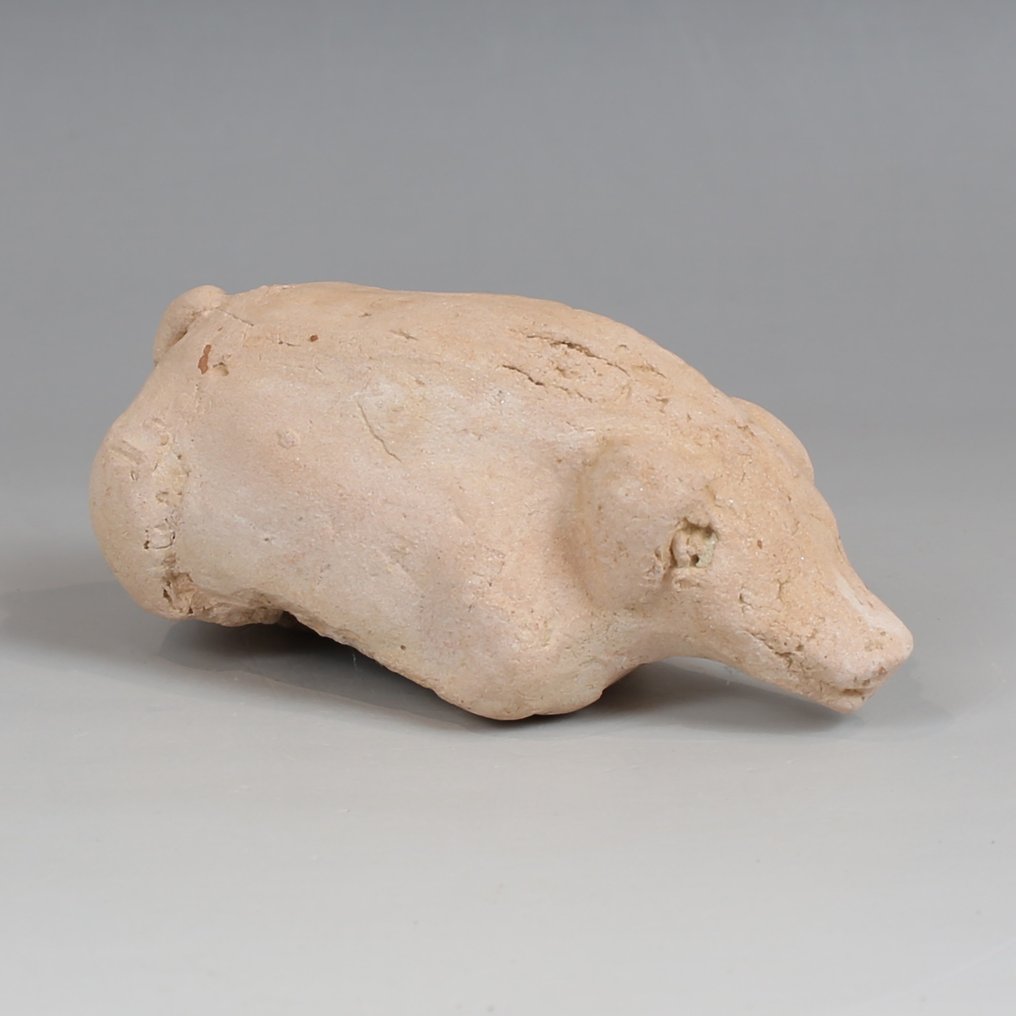
Chinois ancien, empire unifié des Tang Poterie Statuette d'un cochon (Sans Prix de Réserve)


01
jour
22
heures
25
minutes
08
secondes
Offre actuelle
€ 35
Sans prix de réserve

Expert
Sélectionné par Ruth Garrido Vila
A dirigé le musée de la collection Ifergan, spécialisée en archéologie phénicienne.
Estimation € 330 - € 400
13 autres personnes s’intéressent cet objet
 Enchérisseur 3578 Enchérisseur 3578 | 35 € | |
|---|---|---|
 Enchérisseur 3735 Enchérisseur 3735 | 30 € | |
| Enchérisseur 3578 | 30 € | |
Protection des acheteurs Catawiki
Votre paiement est en sécurité chez nous jusqu’à la réception de votre objet.Voir les informations
Trustpilot 4.4 | 121899 d’avis
Noté Excellent sur Trustpilot.
Statuette d'un cochonnet, sculpture en poterie chinoise de la dynastie Tang (45 mm × 45 mm × 94 mm), acquise en 2025 dans une collection privée allemande, en bon état et accompagnée d’un certificat d’authenticité et d’un permis d’exportation UE.
Résumé assisté par IA
Description fournie par le vendeur
ITEM: Statuette of a piggy
MATERIAL: Pottery
CULTURE: Chinese
PERIOD: Tang dynasty, 618 - 907 A.D
DIMENSIONS: 45 mm x 45 mm x 94 mm
CONDITION: Good condition
PROVENANCE: Ex German private collection, F.B., acquired in European antiquities auctions between 2000 - 2009.
Comes with Certificate of Authenticity and European Union export license
If you bid outside European Union and win the item, we must request a new export license to your country and the shipment will delay between 3 - 5 weeks.
The Tang Dynasty (618–907 CE) succeeded the brief Sui Dynasty and is universally regarded as a Golden Age and a zenith of Chinese civilization, characterized by extraordinary political stability, economic prosperity, and cultural flourishing. Founded by Emperor Gaozu and solidified by his son, Emperor Taizong, the Tang state successfully refined the centralized bureaucracy and legal code inherited from the Sui, establishing a powerful and efficient government that would serve as a model for subsequent dynasties. The capital, Chang’an (modern Xi'an) , became the largest and most cosmopolitan city in the world, a vibrant hub of international exchange where merchants, clerics, and envoys from Central Asia, Persia, India, and Japan mingled freely.
The Tang era is best known for an unparalleled bloom in arts and literature. It is considered the classical age of Chinese poetry, producing masters like Li Bai and Du Fu, whose approximately 50,000 surviving works captured both the courtly splendor and the hardships of the time. The dynasty also saw significant technological advancements, including the widespread adoption of woodblock printing, which facilitated greater literacy and the circulation of texts, including the world's oldest dated complete printed book, the Diamond Sutra (868 CE). Other innovations, such as the initial development of gunpowder (initially for fireworks) and sophisticated clockwork mechanisms, cemented China's position as a technological leader.
The dynasty reached its territorial and cultural height under Emperor Xuanzong in the early 8th century, a period of peace and prosperity that was famously interrupted by the An Lushan Rebellion (755–763 CE). This devastating civil war severely weakened the central government, leading to the rise of powerful, semi-autonomous regional military governors (jiedushi). Although the Tang was restored, the dynasty never fully recovered its former power. The ensuing decline saw the increasing influence of court eunuchs and a series of rebellions, culminating in its final collapse in 907 CE. Despite its eventual end, the Tang left an enduring legacy, profoundly shaping the legal, administrative, and cultural norms of East Asia, including Japan and Korea.
Catawiki disclaimer: This piece has been dated based on style by the seller . No further tests, such as, a TL test, analysis of metals(XRF-test), lapidary tests, analysis of pigments or radiography scans have been conducted to check the integrity of the piece.
À propos du vendeur
Votre Antiquaire propose de l'art ancien et des pièces de monnaie anciennes. Notre objectif principal est d'offrir la plus haute qualité au meilleur prix en respectant et en respectant strictement les lois de protection du patrimoine et les normes du patrimoine de l'UNESCO. Ainsi, toutes les pièces publiées proviennent de collections privées dont la provenance peut être vérifiée ou de ventes aux enchères internationales. Toutes nos antiquités et monnaies sont accompagnées de leur Certificat d'Authenticité. Nous avons une politique de retour sans compromis de 90 jours. Chez Your Antiquarian, nous nous engageons à aider les groupes défavorisés et pour cette raison, une partie de chaque achat est reversée à des œuvres caritatives pour aider les personnes dans le besoin.
Traduit par Google TraductionITEM: Statuette of a piggy
MATERIAL: Pottery
CULTURE: Chinese
PERIOD: Tang dynasty, 618 - 907 A.D
DIMENSIONS: 45 mm x 45 mm x 94 mm
CONDITION: Good condition
PROVENANCE: Ex German private collection, F.B., acquired in European antiquities auctions between 2000 - 2009.
Comes with Certificate of Authenticity and European Union export license
If you bid outside European Union and win the item, we must request a new export license to your country and the shipment will delay between 3 - 5 weeks.
The Tang Dynasty (618–907 CE) succeeded the brief Sui Dynasty and is universally regarded as a Golden Age and a zenith of Chinese civilization, characterized by extraordinary political stability, economic prosperity, and cultural flourishing. Founded by Emperor Gaozu and solidified by his son, Emperor Taizong, the Tang state successfully refined the centralized bureaucracy and legal code inherited from the Sui, establishing a powerful and efficient government that would serve as a model for subsequent dynasties. The capital, Chang’an (modern Xi'an) , became the largest and most cosmopolitan city in the world, a vibrant hub of international exchange where merchants, clerics, and envoys from Central Asia, Persia, India, and Japan mingled freely.
The Tang era is best known for an unparalleled bloom in arts and literature. It is considered the classical age of Chinese poetry, producing masters like Li Bai and Du Fu, whose approximately 50,000 surviving works captured both the courtly splendor and the hardships of the time. The dynasty also saw significant technological advancements, including the widespread adoption of woodblock printing, which facilitated greater literacy and the circulation of texts, including the world's oldest dated complete printed book, the Diamond Sutra (868 CE). Other innovations, such as the initial development of gunpowder (initially for fireworks) and sophisticated clockwork mechanisms, cemented China's position as a technological leader.
The dynasty reached its territorial and cultural height under Emperor Xuanzong in the early 8th century, a period of peace and prosperity that was famously interrupted by the An Lushan Rebellion (755–763 CE). This devastating civil war severely weakened the central government, leading to the rise of powerful, semi-autonomous regional military governors (jiedushi). Although the Tang was restored, the dynasty never fully recovered its former power. The ensuing decline saw the increasing influence of court eunuchs and a series of rebellions, culminating in its final collapse in 907 CE. Despite its eventual end, the Tang left an enduring legacy, profoundly shaping the legal, administrative, and cultural norms of East Asia, including Japan and Korea.
Catawiki disclaimer: This piece has been dated based on style by the seller . No further tests, such as, a TL test, analysis of metals(XRF-test), lapidary tests, analysis of pigments or radiography scans have been conducted to check the integrity of the piece.
À propos du vendeur
Votre Antiquaire propose de l'art ancien et des pièces de monnaie anciennes. Notre objectif principal est d'offrir la plus haute qualité au meilleur prix en respectant et en respectant strictement les lois de protection du patrimoine et les normes du patrimoine de l'UNESCO. Ainsi, toutes les pièces publiées proviennent de collections privées dont la provenance peut être vérifiée ou de ventes aux enchères internationales. Toutes nos antiquités et monnaies sont accompagnées de leur Certificat d'Authenticité. Nous avons une politique de retour sans compromis de 90 jours. Chez Your Antiquarian, nous nous engageons à aider les groupes défavorisés et pour cette raison, une partie de chaque achat est reversée à des œuvres caritatives pour aider les personnes dans le besoin.
Traduit par Google TraductionDétails
Culture
Chinois ancien, empire unifié des Tang
Siècle/ Période
618 - 907 A.D
Name of object
Statuette of a piggy
Acquis auprès de
Collection privée
Année d’acquisition
2025
Matériau
Poterie
Pays d’acquisition
Allemagne
Condition
Bon
Ancien propriétaire - acquis auprès de
Salon d’antiquités
Ancien propriétaire – année d’acquisition
2000
Ancien propriétaire – pays d’acquisition
Allemagne
Je confirme avoir acquis cet objet de manière légale et que je suis en droit de le vendre.
Oui
Vendu par
Mentions légales
Le vendeur a été informé par Catawiki des exigences en matière de documentation et garantit les éléments suivants : - l’objet a été obtenu de manière légale, - le vendeur a le droit de vendre et/ou d’exporter l’objet, le cas échéant, - le vendeur fournira toutes les informations nécessaires sur la provenance, et tiendra à disposition les documents, permis ou licences requis, conformément aux lois locales, - le vendeur informera l’acheteur de tout retard dans l’obtention de ces permis ou licences. En enchérissant, vous reconnaissez que des documents d’importation peuvent être requis selon votre pays de résidence, et que l’obtention de permis ou licences est susceptible de retarder la livraison de votre objet.
Le vendeur a été informé par Catawiki des exigences en matière de documentation et garantit les éléments suivants : - l’objet a été obtenu de manière légale, - le vendeur a le droit de vendre et/ou d’exporter l’objet, le cas échéant, - le vendeur fournira toutes les informations nécessaires sur la provenance, et tiendra à disposition les documents, permis ou licences requis, conformément aux lois locales, - le vendeur informera l’acheteur de tout retard dans l’obtention de ces permis ou licences. En enchérissant, vous reconnaissez que des documents d’importation peuvent être requis selon votre pays de résidence, et que l’obtention de permis ou licences est susceptible de retarder la livraison de votre objet.
