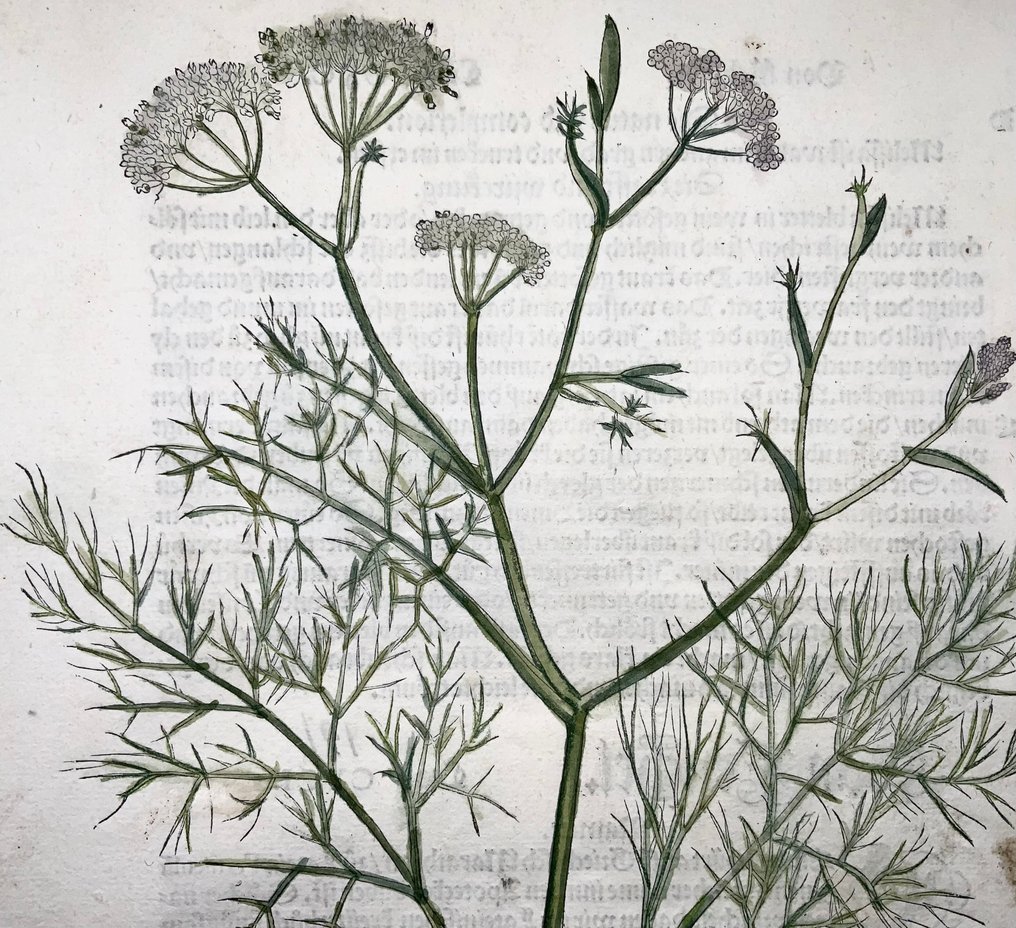
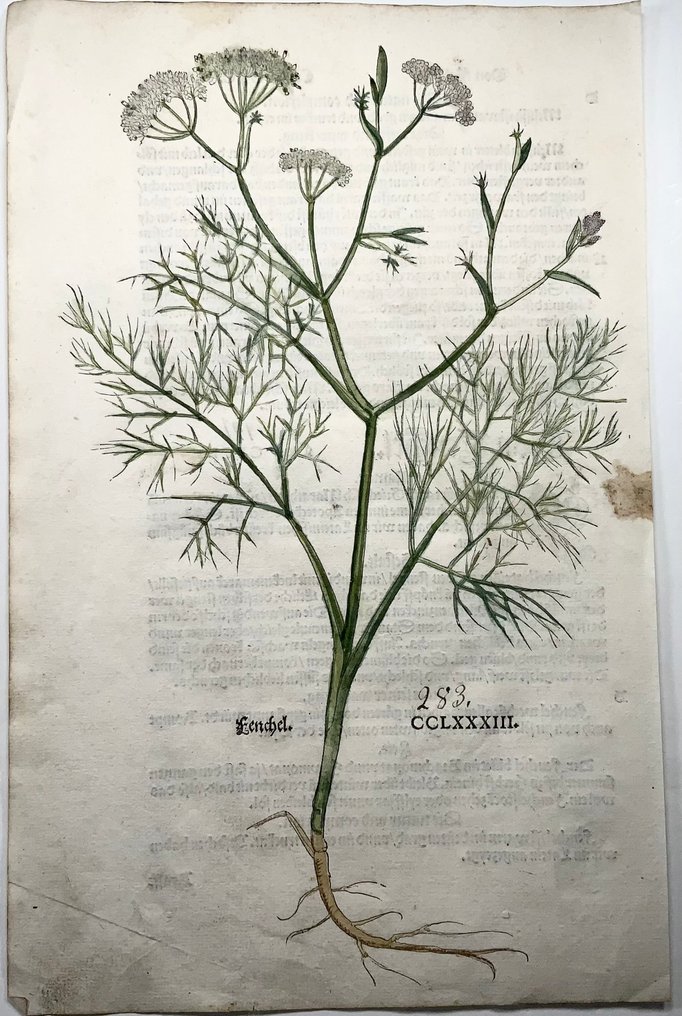
Leonhard Fuchs - Large folio with large woodcut, Fennel (Foeniculum vulgare) - 1543


01
jour
16
heures
20
minutes
22
secondes
Offre actuelle
€ 30
Sans prix de réserve

Expert
Sélectionné par Volker Riepenhausen
Spécialiste de la littérature de voyage et des rares imprimés avant 1600, 28 ans d'expérience.
Estimation € 140 - € 200
18 autres personnes s’intéressent cet objet
 Enchérisseur 3042 Enchérisseur 3042 | 30 € | |
|---|---|---|
 Enchérisseur 9930 Enchérisseur 9930 | 25 € | |
| Enchérisseur 3042 | 20 € | |
Protection des acheteurs Catawiki
Votre paiement est en sécurité chez nous jusqu’à la réception de votre objet.Voir les informations
Trustpilot 4.4 | 121798 d’avis
Noté Excellent sur Trustpilot.
Le grand folio de Leonhard Fuchs de 1543 illustre le fenouil au bois tiré et colori à la main par Meyer, Füllmaurer et Speckle, une pièce d’exception pour les collectionneurs sérieux.
Résumé assisté par IA
Description fournie par le vendeur
Folio with large woodcut to recto hand coloured.
Fuch’s work and its beautiful illustrations effected a revolution in the natural sciences, comparable to that of Copernicus in astronomy and Vesalius in anatomy, both of which were published the following year, 1543.
To effect this reform accurate illustration and identification was the first requirement and it was to this task that Fuchs addressed himself.
Fuchs employed the best artists then available in Basle: Albrecht Meyer did the drawings, Heinrich Füllmaurer transferred them to the woodblocks, and they were cut by Veit Rudolph Speckle. All three are depicted in the book, the first time that book illustrators are themselves portrayed and named. These illustrations set a new standard for botanical depiction and were some of the most influential in botanical history, being copied for innumerable works well into the 18th century.
Early manuscript to leaf. Fingering to lower corners. Small stain to right margin. Old corner crease. Please view the images carefully.
À propos du vendeur
Ayant étudié à l'Université d'Oxford au début des années 1980, j'ai eu la chance de découvrir le commerce du livre rare et de l'imprimerie en parcourant les marchés et les maisons de vente aux enchères de Londres à une époque où il était encore tout à fait possible de découvrir « cette trouvaille ». De même, j'ai pu affiner mes intérêts de spécialiste pour l'histoire naturelle illustrée, la mythologie et la science, ce qui, je l'espère, se reflète toujours dans les articles que je propose.
L'objectif est d'offrir le rare, l'intéressant, l'insolite, le beau et l'étrange, des gravures de maître aux folios exquis. Donc, à tout le moins, nous espérons que votre visite sur le site sera une expérience enrichissante et enrichissante !
Daniel Bon Livres Rares
Traduit par Google TraductionFolio with large woodcut to recto hand coloured.
Fuch’s work and its beautiful illustrations effected a revolution in the natural sciences, comparable to that of Copernicus in astronomy and Vesalius in anatomy, both of which were published the following year, 1543.
To effect this reform accurate illustration and identification was the first requirement and it was to this task that Fuchs addressed himself.
Fuchs employed the best artists then available in Basle: Albrecht Meyer did the drawings, Heinrich Füllmaurer transferred them to the woodblocks, and they were cut by Veit Rudolph Speckle. All three are depicted in the book, the first time that book illustrators are themselves portrayed and named. These illustrations set a new standard for botanical depiction and were some of the most influential in botanical history, being copied for innumerable works well into the 18th century.
Early manuscript to leaf. Fingering to lower corners. Small stain to right margin. Old corner crease. Please view the images carefully.
À propos du vendeur
Ayant étudié à l'Université d'Oxford au début des années 1980, j'ai eu la chance de découvrir le commerce du livre rare et de l'imprimerie en parcourant les marchés et les maisons de vente aux enchères de Londres à une époque où il était encore tout à fait possible de découvrir « cette trouvaille ». De même, j'ai pu affiner mes intérêts de spécialiste pour l'histoire naturelle illustrée, la mythologie et la science, ce qui, je l'espère, se reflète toujours dans les articles que je propose.
L'objectif est d'offrir le rare, l'intéressant, l'insolite, le beau et l'étrange, des gravures de maître aux folios exquis. Donc, à tout le moins, nous espérons que votre visite sur le site sera une expérience enrichissante et enrichissante !
Daniel Bon Livres Rares
Traduit par Google TraductionDétails
Nombre de livres
1
Titre du livre
Leonhard Fuchs - Large folio with large woodcut, Fennel (Foeniculum vulgare)
Condition
État raisonnable
Année de publication de l’ouvrage le plus ancien
1543
Hauteur
34,7 cm
Largeur
22,1 cm
Vendu par
