Wild Chrysanthemum - Beauty of Simplicity and Blank with Box - Attributed to Kano Tan'yū 狩野探幽 (1602-1674) - Japon - Début de la période Edo (Sans Prix de Réserve)


01
jour
10
heures
42
minutes
59
secondes
Offre actuelle
€ 140
Sans prix de réserve

Expert
Sélectionné par Giovanni Bottero
Détient un master en histoire de l'art japonais avec plus de 10 ans d'expérience.
Estimation € 400 - € 500
38 autres personnes s’intéressent cet objet
 Enchérisseur 1281 Enchérisseur 1281 | 140 € | |
|---|---|---|
| Enchérisseur 8175 | 130 € | |
| Enchérisseur 1281 | 110 € | |
Protection des acheteurs Catawiki
Votre paiement est en sécurité chez nous jusqu’à la réception de votre objet.Voir les informations
Trustpilot 4.4 | 121899 d’avis
Noté Excellent sur Trustpilot.
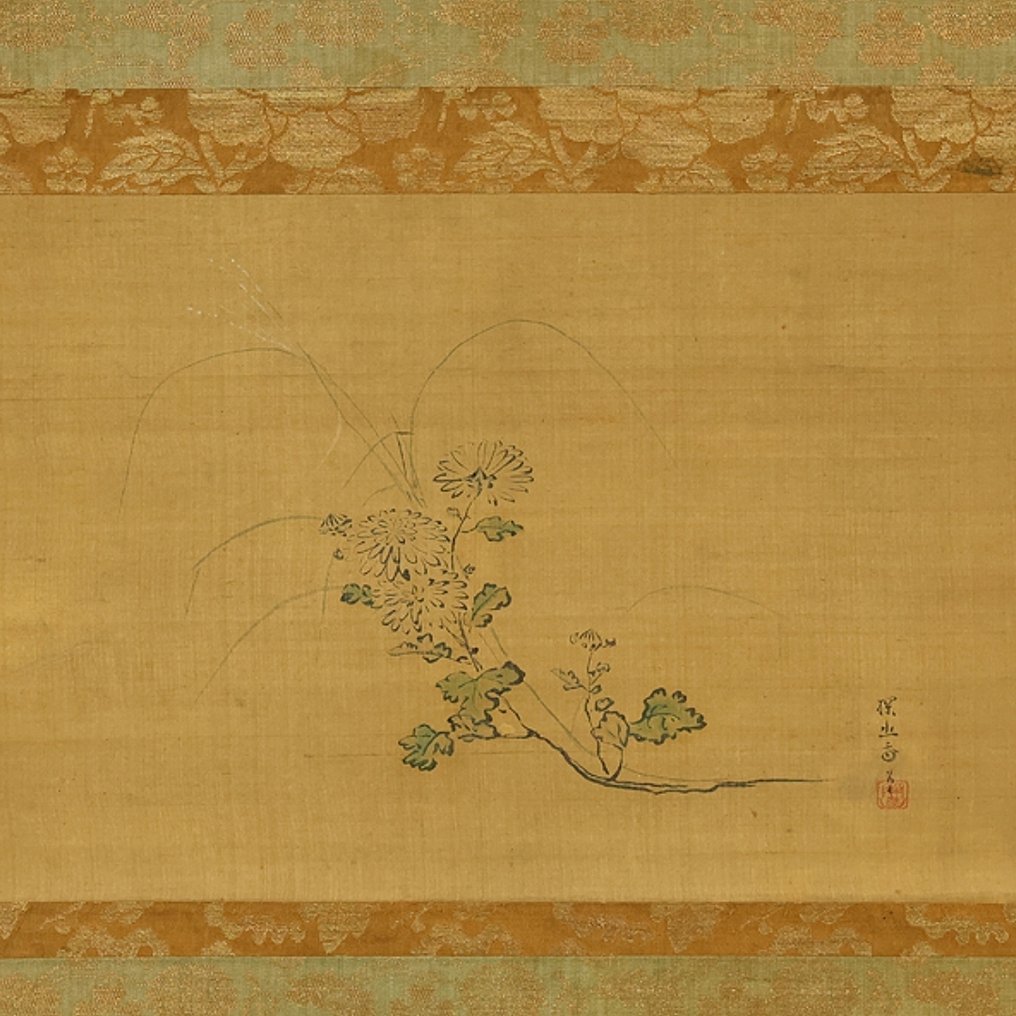
Une kakeméjiku raffinée attribuée à Kano Tan’yū du XVIIe siècle, peint à la main de nogiku fraisi et une composition minimale invitant à la contemplation.
Résumé assisté par IA
Description fournie par le vendeur
狩野探幽 Kano Tanyu (1602-1674)
Painter of the early Edo period and establisher of Edo Kano school. The eldest son of 狩野孝信 Kano Takanobu (1751-1618) and grandson of Kano Eitoku (1543-1590). Founder of the Kajibashi Kano school. He is said to be a precocious genius and is praised as the second coming of Eitoku. His wide range of works includes Sansui landscapes, figures, flowers, and birds. Tanyu's elegant new style, which made use of marginal spaces, was called the Edo Kano style, and it was inherited as the standard of the Kano school thereafter. He was active in the paintings of castles such as Nijo Castle, Osaka Castle, Nagoya Castle, and Edo Castle, as well as in the painting of the inner court. He was also in charge of the decoration of the Tokugawa family mausoleums such as Nikko Toshogu, Zojoji, Kan-eiji, and Edo Castle's Momijiyama.
with signature 'Tanyusai hitsu' 探幽斎筆 and seal 'Tanyu' 探幽
A refined Japanese hanging scroll attributed to Kanō Tan’yū (狩野探幽), a leading master of the early Edo period and one of the most influential painters of the Kanō school. The artwork presents a delicate rendering of wild chrysanthemums (nogiku), executed in subtle ink and color with a minimalist composition. In Japanese aesthetics, wild chrysanthemums symbolize modesty, transience, and seasonal change. Their understated beauty reflects the principles of wabi (quiet elegance) and kanso (simplicity), while the use of blank space (ma) invites contemplation and emotional resonance. Tan’yū’s botanical works are known for their poetic restraint and refined brushwork, capturing nature’s essence with minimal means. The scroll is accompanied by a preservation box. Likely produced in the mid-17th century, it embodies the philosophical depth and visual clarity of classical Japanese painting.
Attributed to 狩野探幽 Kano Tan'yū (1602-1674) Japanese antique art kakejiku kakemono wall hanging scroll / Wild Chrysanthemum - Beauty of Simplicity and Blank with Box
Whole dimensions: 20.3" W x 41.5" H / 51.6cm x 105.5cm
Inside dimensions: 14" W x 8.8" H / 35.6cm x 22.5cm
Material: Silk
Technique: Handpainted
Roller ends: Bone
Weight: 580g including Box
Condition
Antique items have originally crease, stain, damage, and more. I would like you to refer to the listing photos, but please understand that it's difficult to show all conditions by the photos. Special notes: STAIN, CREASE, DAMAGE a little, FOLD, STAIN in the back of the mounting.
Shipping
"FREE SHIPPING" all over the world by Registered Airmail, EMS, or DHL.
À propos du vendeur
Reiwa Antiques est un antiquaire sous licence officielle basé au Japon, proposant une gamme d'antiquités japonaises authentiques, notamment des peintures traditionnelles, des calligraphies exquises et de magnifiques ustensiles à thé. Notre objectif est de continuer à vous offrir une expérience d'achat agréable. Dans ce cadre, afin de réduire autant que possible votre charge de TVA et de taxes à l'importation, nous offrons la livraison gratuite. Nous traitons des transactions à l'étranger depuis plus de 10 ans. Soyez assuré que nous emballerons toujours vos articles avec soin et ferons de notre mieux pour les livrer en toute sécurité. Les méthodes d'expédition habituelles sont la poste aérienne enregistrée, EMS (Postal accéléré) ou DHL. N'hésitez pas à me faire savoir si vous avez des questions ou si vous avez besoin d'aide.
Cordialement,
Reiwa Antiquités
Traduit par Google Traduction狩野探幽 Kano Tanyu (1602-1674)
Painter of the early Edo period and establisher of Edo Kano school. The eldest son of 狩野孝信 Kano Takanobu (1751-1618) and grandson of Kano Eitoku (1543-1590). Founder of the Kajibashi Kano school. He is said to be a precocious genius and is praised as the second coming of Eitoku. His wide range of works includes Sansui landscapes, figures, flowers, and birds. Tanyu's elegant new style, which made use of marginal spaces, was called the Edo Kano style, and it was inherited as the standard of the Kano school thereafter. He was active in the paintings of castles such as Nijo Castle, Osaka Castle, Nagoya Castle, and Edo Castle, as well as in the painting of the inner court. He was also in charge of the decoration of the Tokugawa family mausoleums such as Nikko Toshogu, Zojoji, Kan-eiji, and Edo Castle's Momijiyama.
with signature 'Tanyusai hitsu' 探幽斎筆 and seal 'Tanyu' 探幽
A refined Japanese hanging scroll attributed to Kanō Tan’yū (狩野探幽), a leading master of the early Edo period and one of the most influential painters of the Kanō school. The artwork presents a delicate rendering of wild chrysanthemums (nogiku), executed in subtle ink and color with a minimalist composition. In Japanese aesthetics, wild chrysanthemums symbolize modesty, transience, and seasonal change. Their understated beauty reflects the principles of wabi (quiet elegance) and kanso (simplicity), while the use of blank space (ma) invites contemplation and emotional resonance. Tan’yū’s botanical works are known for their poetic restraint and refined brushwork, capturing nature’s essence with minimal means. The scroll is accompanied by a preservation box. Likely produced in the mid-17th century, it embodies the philosophical depth and visual clarity of classical Japanese painting.
Attributed to 狩野探幽 Kano Tan'yū (1602-1674) Japanese antique art kakejiku kakemono wall hanging scroll / Wild Chrysanthemum - Beauty of Simplicity and Blank with Box
Whole dimensions: 20.3" W x 41.5" H / 51.6cm x 105.5cm
Inside dimensions: 14" W x 8.8" H / 35.6cm x 22.5cm
Material: Silk
Technique: Handpainted
Roller ends: Bone
Weight: 580g including Box
Condition
Antique items have originally crease, stain, damage, and more. I would like you to refer to the listing photos, but please understand that it's difficult to show all conditions by the photos. Special notes: STAIN, CREASE, DAMAGE a little, FOLD, STAIN in the back of the mounting.
Shipping
"FREE SHIPPING" all over the world by Registered Airmail, EMS, or DHL.
À propos du vendeur
Reiwa Antiques est un antiquaire sous licence officielle basé au Japon, proposant une gamme d'antiquités japonaises authentiques, notamment des peintures traditionnelles, des calligraphies exquises et de magnifiques ustensiles à thé. Notre objectif est de continuer à vous offrir une expérience d'achat agréable. Dans ce cadre, afin de réduire autant que possible votre charge de TVA et de taxes à l'importation, nous offrons la livraison gratuite. Nous traitons des transactions à l'étranger depuis plus de 10 ans. Soyez assuré que nous emballerons toujours vos articles avec soin et ferons de notre mieux pour les livrer en toute sécurité. Les méthodes d'expédition habituelles sont la poste aérienne enregistrée, EMS (Postal accéléré) ou DHL. N'hésitez pas à me faire savoir si vous avez des questions ou si vous avez besoin d'aide.
Cordialement,
Reiwa Antiquités
Traduit par Google TraductionDétails
Artiste
Attributed to Kano Tan'yū 狩野探幽 (1602-1674)
Attribution
Attribué(e) à
Titre de l'œuvre d'art
Wild Chrysanthemum - Beauty of Simplicity and Blank with Box
Signature
Signé à la main
Pays d’origine
Japon
Condition
Bon état
Hauteur
105,5 cm
Largeur
51,6 cm
Poids
580 g
Représentation/thème
Plantes et fleurs
Style
Classique
Période
XVIIe siècle
Style/période dynastique
Début de la période Edo
Provenance
Galerie/Antiquaire
Vendu par
