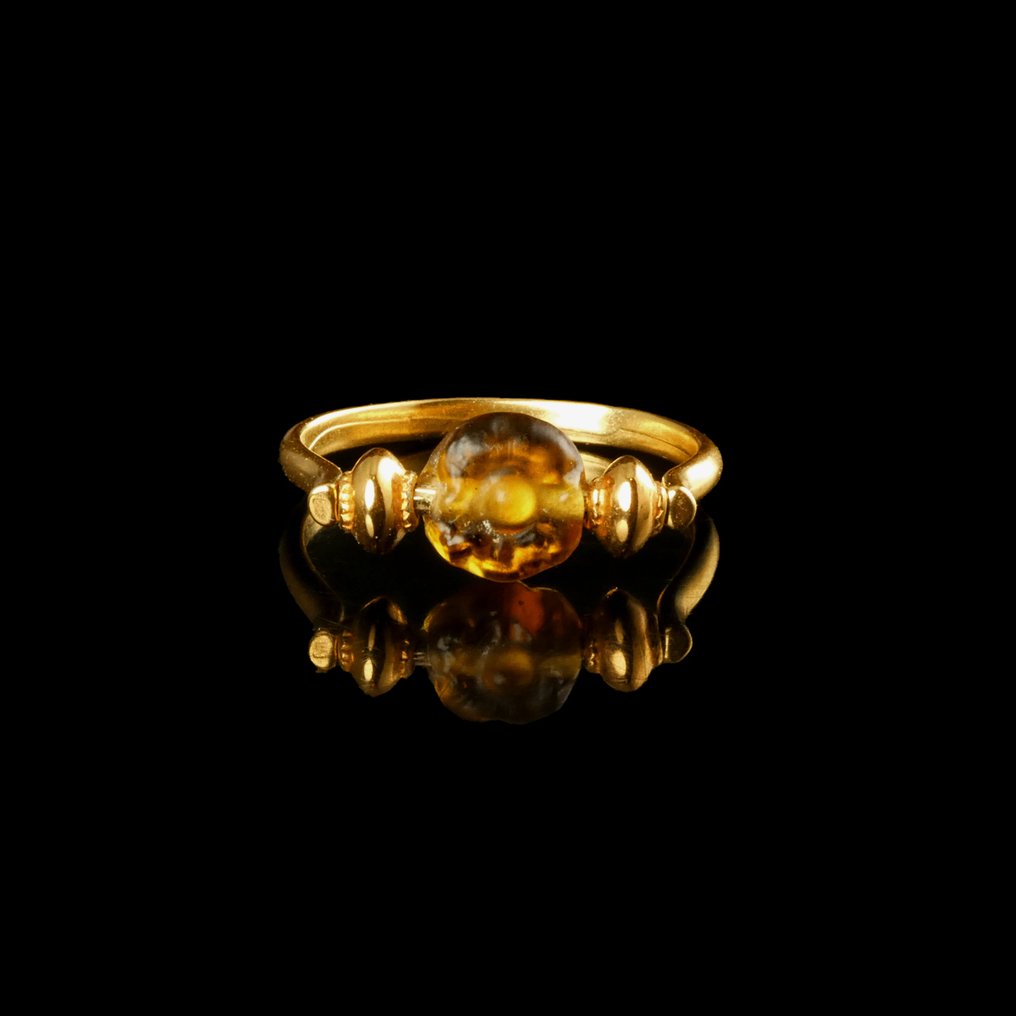
Romain tardif / protobyzantine Bague avec perle d'amulette décorée


01
jour
13
heures
35
minutes
46
secondes
Offre actuelle
€ 80
Prix de réserve non atteint

Expert
Sélectionné par Peter Reynaers
Bénéficie d'environ 30 ans d'expérience et a modéré plusieurs groupes de recherche artistique en ligne.
Estimation € 160 - € 200
37 autres personnes s’intéressent cet objet
 Enchérisseur 4101 Enchérisseur 4101 | 80 € | |
|---|---|---|
| Enchérisseur 4101 | 75 € | |
 Enchérisseur 4512 Enchérisseur 4512 | 65 € | |
Protection des acheteurs Catawiki
Votre paiement est en sécurité chez nous jusqu’à la réception de votre objet.Voir les informations
Trustpilot 4.4 | 121899 d’avis
Noté Excellent sur Trustpilot.
Bague avec une perle amulette décorée d’époque tardive romaine/Byzance primitive, perle en verre montée sur une bague moderne plaquée-or pouvant tourner, diamètre de la perle environ 8,6 mm, diamètres extérieur 23,1 mm et intérieur 20,1–18,8 mm, datée du IVe–VIIe siècle après J.-C., en bon état et portable, perles réemboîtées avec des entretoises modernes, acquise en 2016 au Royaume‑Uni chez une galerie/antiquaire; certificat d’authenticité disponible sur demande.
Résumé assisté par IA
Description fournie par le vendeur
Attention: due to customs regulations we can only ship inside the European Union. Please ensure you have a valid EU shipping address before placing a bid.
Ring with a late Roman decorated amber colour glass amulet bead. The ancient bead is set on a modern gold-plated ring and is free to rotate (swivel-type).
Outside diameter: ± 23,1 mm
Inside diameter: ± 20,1 - 18,8 mm
Diameter bead: ± 8,6 mm
Condition: good condition and wearable. The ancient beads are restrung and combined with modern gold-plated spacer beads and fittings. Signs of wear consistent with age and use. See images.
Composed with beads originating from various old collections, acquired in the UK between 2016-2024.
Every ancient bead shows subtle variations and signs of age, reflecting its history and adding to the unique charm of every composition.
Certificate of Authenticity (PDF) is available upon request.
ANCIENT GLASS
Glass has always been found in nature, but the humans first created glass about 4.000 years ago. when ancient craftsmen in Mesopotamia discovered the art of mixing sand, soda and lime to make glass.
For centuries, glass was a luxury item and reserved for the upper classes.
Glassmaking centers around the Mediterranean world experimented with new techniques (casting, core-forming, mosaic glass) and with colours by adding metallic oxides (cobalt, copper, etc) to the mixture.
The Romans learned the glass-making craft after the conquest of Egypt in the 1st century BC. During the 1st century AD the glassblowing technique revolutionized the production and made it possible to produce larger quantities. By adding manganese dioxide Roman glassmakers successfully produced colourless or ‘aqua’ glass for the first time.
Roman glass became a very popular material, used for beads, glass windows, mosaic tiles, tableware pieces etc. Roman glass was traded all over the Roman Empire and far beyond to Central Africa, Scandinavia and via the Silk Route to China.
À propos du vendeur
Veuillez lire attentivement nos informations.
*INFORMATION LIVRAISON En raison des procédures d'assurance, l'expédition combinée n'est possible qu'avec un seul paiement. (Une référence de paiement = un colis assuré.) Si vous acceptez une offre après la vente aux enchères et payez séparément, il ne sera pas possible de regrouper manuellement les envois par la suite. Veuillez vous assurer que votre adresse de livraison est complète et correcte avant de payer. Les modifications effectuées après le paiement ne sont pas automatiquement transmises à notre service.
* CERTIFICAT D'AUTHENTICITÉ (COA) Pour des raisons d'assurance, nous pouvons fournir un certificat d'authenticité numérique (PDF) pour chaque article dont le prix de marteau est de 100 euros ou plus. Le COA est disponible sur demande dans les 20 jours suivant la date de la vente aux enchères. Des instructions seront fournies lors de l'expédition de votre commande. Les certificats ne sont pas inclus dans le colis.
ASSURANCE & RÉCLAMATIONS Tous nos colis sont expédiés avec une assurance extérieure. Cette assurance nécessite ce qui suit :
Surveiller le suivi en ligne et notifier les retards dans les 14 jours après la date d'expédition.
En cas de dommage : inscrivez une réserve sur le bon de livraison, conservez tous les emballages et envoyez-nous des photos du dommage.
* ACHETEURS IMPORTANTS HORS DE L'UE : Nous ne pouvons pas expédier vers des pays hors de l'Union européenne. Veuillez vous assurer d'avoir une adresse de livraison dans l'UE avant de faire une offre. Aucune exception ne pourra être faite. La Suisse, la Norvège et le Royaume-Uni ne font pas partie de l'UE.
*AVIS DE DOCUMENTATION : Les factures précédentes et les documents d'import/export ne seront pas communiqués aux clients.
Merci de votre intérêt, et bonne chance pour vos offres !
Traduit par Google TraductionAttention: due to customs regulations we can only ship inside the European Union. Please ensure you have a valid EU shipping address before placing a bid.
Ring with a late Roman decorated amber colour glass amulet bead. The ancient bead is set on a modern gold-plated ring and is free to rotate (swivel-type).
Outside diameter: ± 23,1 mm
Inside diameter: ± 20,1 - 18,8 mm
Diameter bead: ± 8,6 mm
Condition: good condition and wearable. The ancient beads are restrung and combined with modern gold-plated spacer beads and fittings. Signs of wear consistent with age and use. See images.
Composed with beads originating from various old collections, acquired in the UK between 2016-2024.
Every ancient bead shows subtle variations and signs of age, reflecting its history and adding to the unique charm of every composition.
Certificate of Authenticity (PDF) is available upon request.
ANCIENT GLASS
Glass has always been found in nature, but the humans first created glass about 4.000 years ago. when ancient craftsmen in Mesopotamia discovered the art of mixing sand, soda and lime to make glass.
For centuries, glass was a luxury item and reserved for the upper classes.
Glassmaking centers around the Mediterranean world experimented with new techniques (casting, core-forming, mosaic glass) and with colours by adding metallic oxides (cobalt, copper, etc) to the mixture.
The Romans learned the glass-making craft after the conquest of Egypt in the 1st century BC. During the 1st century AD the glassblowing technique revolutionized the production and made it possible to produce larger quantities. By adding manganese dioxide Roman glassmakers successfully produced colourless or ‘aqua’ glass for the first time.
Roman glass became a very popular material, used for beads, glass windows, mosaic tiles, tableware pieces etc. Roman glass was traded all over the Roman Empire and far beyond to Central Africa, Scandinavia and via the Silk Route to China.
À propos du vendeur
Veuillez lire attentivement nos informations.
*INFORMATION LIVRAISON En raison des procédures d'assurance, l'expédition combinée n'est possible qu'avec un seul paiement. (Une référence de paiement = un colis assuré.) Si vous acceptez une offre après la vente aux enchères et payez séparément, il ne sera pas possible de regrouper manuellement les envois par la suite. Veuillez vous assurer que votre adresse de livraison est complète et correcte avant de payer. Les modifications effectuées après le paiement ne sont pas automatiquement transmises à notre service.
* CERTIFICAT D'AUTHENTICITÉ (COA) Pour des raisons d'assurance, nous pouvons fournir un certificat d'authenticité numérique (PDF) pour chaque article dont le prix de marteau est de 100 euros ou plus. Le COA est disponible sur demande dans les 20 jours suivant la date de la vente aux enchères. Des instructions seront fournies lors de l'expédition de votre commande. Les certificats ne sont pas inclus dans le colis.
ASSURANCE & RÉCLAMATIONS Tous nos colis sont expédiés avec une assurance extérieure. Cette assurance nécessite ce qui suit :
Surveiller le suivi en ligne et notifier les retards dans les 14 jours après la date d'expédition.
En cas de dommage : inscrivez une réserve sur le bon de livraison, conservez tous les emballages et envoyez-nous des photos du dommage.
* ACHETEURS IMPORTANTS HORS DE L'UE : Nous ne pouvons pas expédier vers des pays hors de l'Union européenne. Veuillez vous assurer d'avoir une adresse de livraison dans l'UE avant de faire une offre. Aucune exception ne pourra être faite. La Suisse, la Norvège et le Royaume-Uni ne font pas partie de l'UE.
*AVIS DE DOCUMENTATION : Les factures précédentes et les documents d'import/export ne seront pas communiqués aux clients.
Merci de votre intérêt, et bonne chance pour vos offres !
Traduit par Google TraductionDétails
Culture
Romain tardif / protobyzantine
Siècle/ Période
4th - 7th century AD
Name of object
Ring with decorated amulet bead
Acquis auprès de
Galerie/Antiquaire
Année d’acquisition
2016
Pays d’acquisition
Royaume-Uni
Condition
Bon
Ancien propriétaire - acquis auprès de
Galerie/Antiquaire
Ancien propriétaire – année d’acquisition
2016
Ancien propriétaire – pays d’acquisition
Royaume-Uni
Je confirme avoir acquis cet objet de manière légale et que je suis en droit de le vendre.
Oui
Vendu par
Mentions légales
Le vendeur a été informé par Catawiki des exigences en matière de documentation et garantit les éléments suivants : - l’objet a été obtenu de manière légale, - le vendeur a le droit de vendre et/ou d’exporter l’objet, le cas échéant, - le vendeur fournira toutes les informations nécessaires sur la provenance, et tiendra à disposition les documents, permis ou licences requis, conformément aux lois locales, - le vendeur informera l’acheteur de tout retard dans l’obtention de ces permis ou licences. En enchérissant, vous reconnaissez que des documents d’importation peuvent être requis selon votre pays de résidence, et que l’obtention de permis ou licences est susceptible de retarder la livraison de votre objet.
Le vendeur a été informé par Catawiki des exigences en matière de documentation et garantit les éléments suivants : - l’objet a été obtenu de manière légale, - le vendeur a le droit de vendre et/ou d’exporter l’objet, le cas échéant, - le vendeur fournira toutes les informations nécessaires sur la provenance, et tiendra à disposition les documents, permis ou licences requis, conformément aux lois locales, - le vendeur informera l’acheteur de tout retard dans l’obtention de ces permis ou licences. En enchérissant, vous reconnaissez que des documents d’importation peuvent être requis selon votre pays de résidence, et que l’obtention de permis ou licences est susceptible de retarder la livraison de votre objet.
