Wild Chrysanthemum - Beauty of Simplicity and Blank with Box - Attributed to Kano Tan'yū 狩野探幽 (1602-1674) - Japonia - Wczesny okres Edo (Bez ceny minimalnej )


02
dni
11
godziny
18
minuty
10
sekundy
Aktualna oferta
€ 55
Bez ceny minimalnej

Ekspert
Wyselekcjonowany przez Giovanni Bottero
Posiada magisterium z historii sztuki japońskiej i ponad 10 lat doświadczenia.
Oszacuj cenę € 400 - € 500
Liczba osób obserwujących ten przedmiot: 37
 Licytant 1281 Licytant 1281 | € 55 | |
|---|---|---|
 Licytant 1180 Licytant 1180 | € 50 | |
| Licytant 1281 | € 45 | |
Ochrona nabywców Catawiki
Twoja płatność jest u nas bezpieczna, dopóki nie otrzymasz przedmiotu.Zobacz szczegóły
Trustpilot: 4.4 | opinie: 121798
Doskonała ocena na Trustpilot.
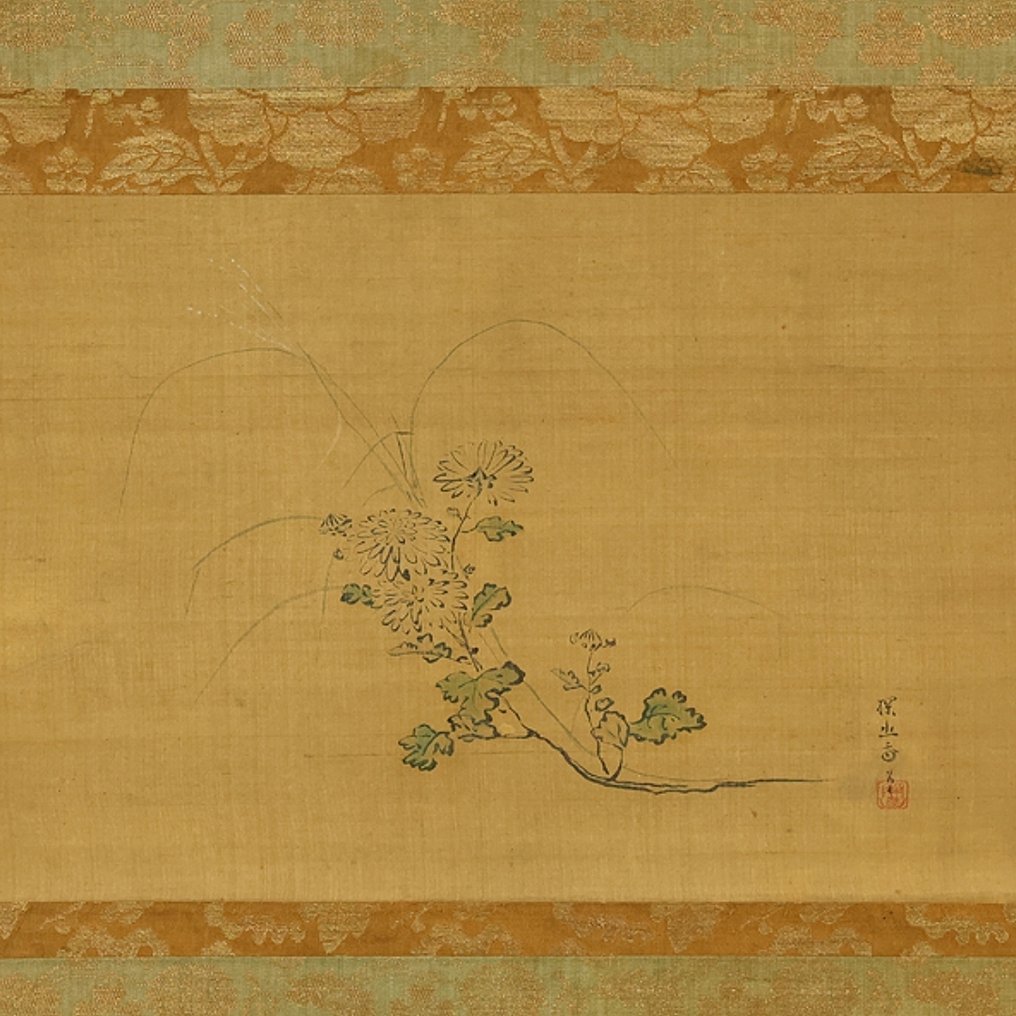
Wytworna kakejiku przypisywana Kano Tan’yū z XVII wieku, ręcznie malowana nogiku i minimalistyczna kompozycja zapraszająca do kontemplacji.
Podsumowanie wspomagane sztuczną inteligencją
Opis od sprzedawcy
狩野探幽 Kano Tanyu (1602-1674)
Painter of the early Edo period and establisher of Edo Kano school. The eldest son of 狩野孝信 Kano Takanobu (1751-1618) and grandson of Kano Eitoku (1543-1590). Founder of the Kajibashi Kano school. He is said to be a precocious genius and is praised as the second coming of Eitoku. His wide range of works includes Sansui landscapes, figures, flowers, and birds. Tanyu's elegant new style, which made use of marginal spaces, was called the Edo Kano style, and it was inherited as the standard of the Kano school thereafter. He was active in the paintings of castles such as Nijo Castle, Osaka Castle, Nagoya Castle, and Edo Castle, as well as in the painting of the inner court. He was also in charge of the decoration of the Tokugawa family mausoleums such as Nikko Toshogu, Zojoji, Kan-eiji, and Edo Castle's Momijiyama.
with signature 'Tanyusai hitsu' 探幽斎筆 and seal 'Tanyu' 探幽
A refined Japanese hanging scroll attributed to Kanō Tan’yū (狩野探幽), a leading master of the early Edo period and one of the most influential painters of the Kanō school. The artwork presents a delicate rendering of wild chrysanthemums (nogiku), executed in subtle ink and color with a minimalist composition. In Japanese aesthetics, wild chrysanthemums symbolize modesty, transience, and seasonal change. Their understated beauty reflects the principles of wabi (quiet elegance) and kanso (simplicity), while the use of blank space (ma) invites contemplation and emotional resonance. Tan’yū’s botanical works are known for their poetic restraint and refined brushwork, capturing nature’s essence with minimal means. The scroll is accompanied by a preservation box. Likely produced in the mid-17th century, it embodies the philosophical depth and visual clarity of classical Japanese painting.
Attributed to 狩野探幽 Kano Tan'yū (1602-1674) Japanese antique art kakejiku kakemono wall hanging scroll / Wild Chrysanthemum - Beauty of Simplicity and Blank with Box
Whole dimensions: 20.3" W x 41.5" H / 51.6cm x 105.5cm
Inside dimensions: 14" W x 8.8" H / 35.6cm x 22.5cm
Material: Silk
Technique: Handpainted
Roller ends: Bone
Weight: 580g including Box
Condition
Antique items have originally crease, stain, damage, and more. I would like you to refer to the listing photos, but please understand that it's difficult to show all conditions by the photos. Special notes: STAIN, CREASE, DAMAGE a little, FOLD, STAIN in the back of the mounting.
Shipping
"FREE SHIPPING" all over the world by Registered Airmail, EMS, or DHL.
Historie sprzedawców
Reiwa Antiques to oficjalnie licencjonowany handlarz antykami z siedzibą w Japonii, oferujący szereg autentycznych japońskich antyków, w tym tradycyjne obrazy, wykwintną kaligrafię i piękne przybory do herbaty. Naszym celem jest dalsze zapewnianie Państwu przyjemnych zakupów. W ramach tego, aby maksymalnie zmniejszyć obciążenie podatkiem VAT i importowym, oferujemy bezpłatną wysyłkę. Transakcjami zagranicznymi zajmujemy się od ponad 10 lat. Możesz mieć pewność, że zawsze starannie pakujemy Twoje produkty i dokładamy wszelkich starań, aby bezpiecznie je dostarczyć. Typowe metody wysyłki to rejestrowana poczta lotnicza, EMS (przyspieszona przesyłka pocztowa) lub DHL. Jeśli masz jakiekolwiek pytania lub potrzebujesz pomocy, nie wahaj się i daj mi znać.
Z poważaniem
Antyki Reiwy
Przetłumaczone przez Tłumacz Google狩野探幽 Kano Tanyu (1602-1674)
Painter of the early Edo period and establisher of Edo Kano school. The eldest son of 狩野孝信 Kano Takanobu (1751-1618) and grandson of Kano Eitoku (1543-1590). Founder of the Kajibashi Kano school. He is said to be a precocious genius and is praised as the second coming of Eitoku. His wide range of works includes Sansui landscapes, figures, flowers, and birds. Tanyu's elegant new style, which made use of marginal spaces, was called the Edo Kano style, and it was inherited as the standard of the Kano school thereafter. He was active in the paintings of castles such as Nijo Castle, Osaka Castle, Nagoya Castle, and Edo Castle, as well as in the painting of the inner court. He was also in charge of the decoration of the Tokugawa family mausoleums such as Nikko Toshogu, Zojoji, Kan-eiji, and Edo Castle's Momijiyama.
with signature 'Tanyusai hitsu' 探幽斎筆 and seal 'Tanyu' 探幽
A refined Japanese hanging scroll attributed to Kanō Tan’yū (狩野探幽), a leading master of the early Edo period and one of the most influential painters of the Kanō school. The artwork presents a delicate rendering of wild chrysanthemums (nogiku), executed in subtle ink and color with a minimalist composition. In Japanese aesthetics, wild chrysanthemums symbolize modesty, transience, and seasonal change. Their understated beauty reflects the principles of wabi (quiet elegance) and kanso (simplicity), while the use of blank space (ma) invites contemplation and emotional resonance. Tan’yū’s botanical works are known for their poetic restraint and refined brushwork, capturing nature’s essence with minimal means. The scroll is accompanied by a preservation box. Likely produced in the mid-17th century, it embodies the philosophical depth and visual clarity of classical Japanese painting.
Attributed to 狩野探幽 Kano Tan'yū (1602-1674) Japanese antique art kakejiku kakemono wall hanging scroll / Wild Chrysanthemum - Beauty of Simplicity and Blank with Box
Whole dimensions: 20.3" W x 41.5" H / 51.6cm x 105.5cm
Inside dimensions: 14" W x 8.8" H / 35.6cm x 22.5cm
Material: Silk
Technique: Handpainted
Roller ends: Bone
Weight: 580g including Box
Condition
Antique items have originally crease, stain, damage, and more. I would like you to refer to the listing photos, but please understand that it's difficult to show all conditions by the photos. Special notes: STAIN, CREASE, DAMAGE a little, FOLD, STAIN in the back of the mounting.
Shipping
"FREE SHIPPING" all over the world by Registered Airmail, EMS, or DHL.
Historie sprzedawców
Reiwa Antiques to oficjalnie licencjonowany handlarz antykami z siedzibą w Japonii, oferujący szereg autentycznych japońskich antyków, w tym tradycyjne obrazy, wykwintną kaligrafię i piękne przybory do herbaty. Naszym celem jest dalsze zapewnianie Państwu przyjemnych zakupów. W ramach tego, aby maksymalnie zmniejszyć obciążenie podatkiem VAT i importowym, oferujemy bezpłatną wysyłkę. Transakcjami zagranicznymi zajmujemy się od ponad 10 lat. Możesz mieć pewność, że zawsze starannie pakujemy Twoje produkty i dokładamy wszelkich starań, aby bezpiecznie je dostarczyć. Typowe metody wysyłki to rejestrowana poczta lotnicza, EMS (przyspieszona przesyłka pocztowa) lub DHL. Jeśli masz jakiekolwiek pytania lub potrzebujesz pomocy, nie wahaj się i daj mi znać.
Z poważaniem
Antyki Reiwy
Przetłumaczone przez Tłumacz GoogleSzczegóły
Artysta
Attributed to Kano Tan'yū 狩野探幽 (1602-1674)
Przypisywanie autorstwa
Przypisany do
Tytuł dzieła
Wild Chrysanthemum - Beauty of Simplicity and Blank with Box
Podpis
z odręcznym podpisem
Kraj pochodzenia
Japonia
Stan
W Dobrym Stanie
Wysokość
105,5 cm
Szerokość
51,6 cm
Waga
580 g
Temat
Rośliny i kwiaty
Styl
Klasycyzm
Okres
XVII wiek
Styl/okres dynastii
Wczesny okres Edo
Pochodzenie
Galeria / Handlarz antyków
Sprzedawane przez
