Nr. 106199139

Nr. 106199139
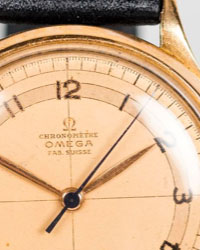
This appears to be a small vintage wristwatch, likely from the 1915–1935 period. Here are some observations based on the photo:
* Porcelain/enamel dial: The white dial appears to be enamel, a common feature of higher-quality watches from the early 20th century. It has some chips around the edge, especially near 6 o’clock.
* Ornate “Louis XV” style hands: These decorative hands were popular on dress watches from the 1910s and 1920s.
* Wire lugs: The thin wire-style lugs are characteristic of some of the earliest wristwatches, many of which evolved from pocket watch movements.
* Small case: Judging from the proportions, the case is probably around 28–32 mm, typical for the era.
* Rose gold or gold-filled case: The case has a warm rose-gold color. It could be solid gold, gold-filled, or gold-plated—there isn’t enough visible evidence to determine which.
From the photo of the inside of the case back, I can make out several important hallmarks:
* “K&M 0.800” — This indicates the case is made of 80% silver (800 silver). The “K&M” is almost certainly the case maker’s mark rather than the watch manufacturer.
* Crescent moon and crown — This is the German national silver hallmark, introduced in 1888, indicating the silver was assayed in Germany.
* “1071 A” (or similar) and “6” — These appear to be production or case serial numbers used by the manufacturer.
* There is also a small, worn punch to the left of the K&M mark that is difficult to identify from this angle.
What this tells us
* The watch case was made in Germany.
* It is 800 silver, a common standard for German and Swiss pocket watches from the late 19th to early 20th century.
* The case likely dates from approximately 1890–1915, though the movement inside would help narrow that down.
To identify the watch itself
The case back alone usually doesn’t identify the watch brand. The most useful photo would be:
1. The movement (open the inner dust cover if there is one).
2. The dial.
3. Any markings inside the dust cover.
Those often reveal the maker (Junghans, Alpina, Omega, Longines, etc.) and the exact model.
Funcțional!
Sådan køber du hos Catawiki
1. Opdag noget særligt
2. Afgiv det højeste bud
3. Foretag en sikker betaling