Arthur Miller (1915–2005) famous American actor and writer, husband of Marilyn Monroe - Important typed and autograph signed letter to a german journal about Antisemitism in the word - 1960
Opens 11:00
Starting bid
€ 1
Add to your favourites to get an alert when the auction starts.

Catawiki Buyer Protection
Your payment’s safe with us until you receive your object.View details
Trustpilot 4.4 | 122910 reviews
Rated Excellent on Trustpilot.
Description from the seller
Arthur Miller (1915–2005) famous American actor and writer, husband of Marilyn Monroe
- Important typed and autograph signed letter to a german journal about Antisemitism in the word
- dated February 4, 1960 (shortly before his separation from Marilyn Monroe and while he was under private and political pressure)
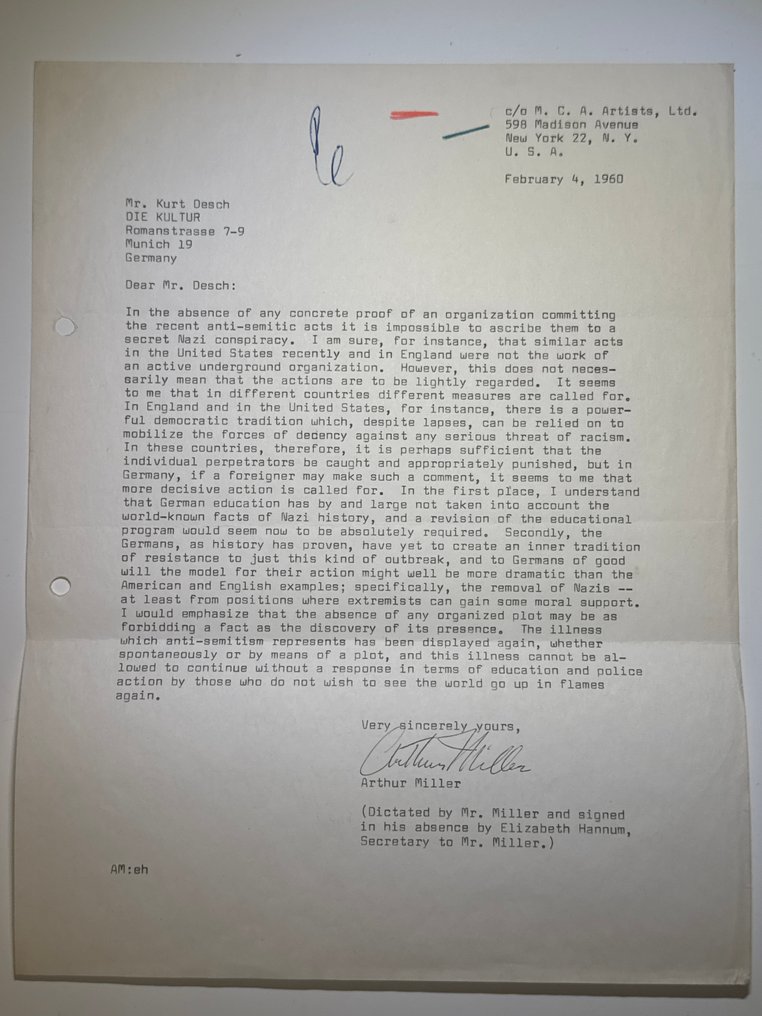
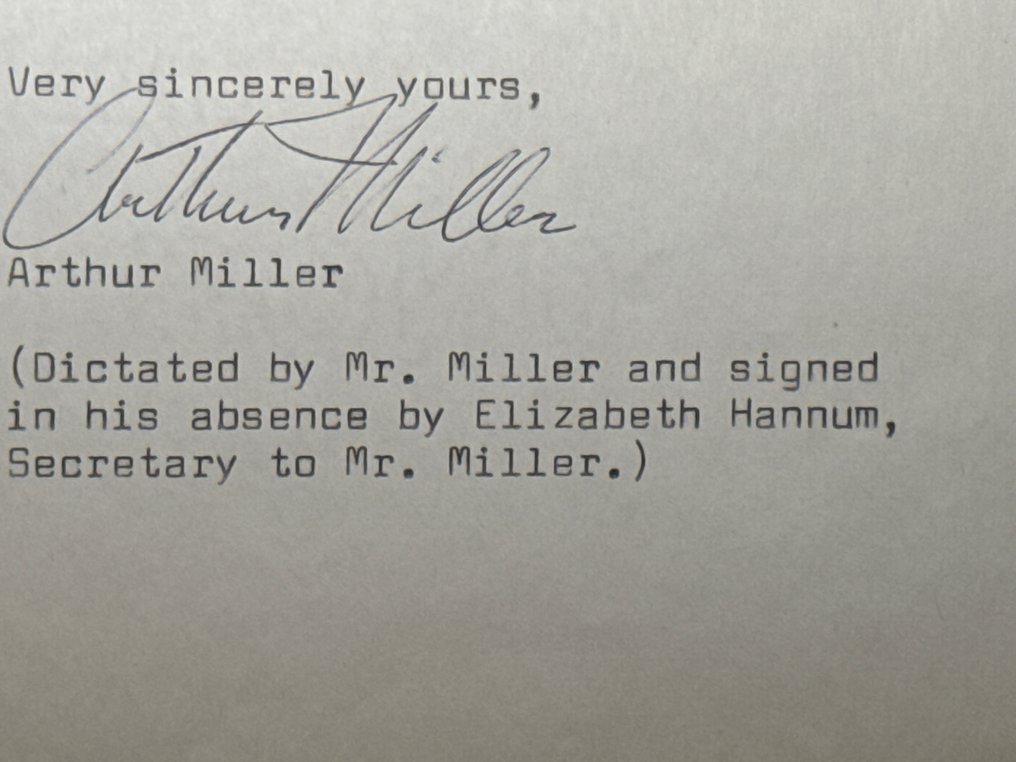
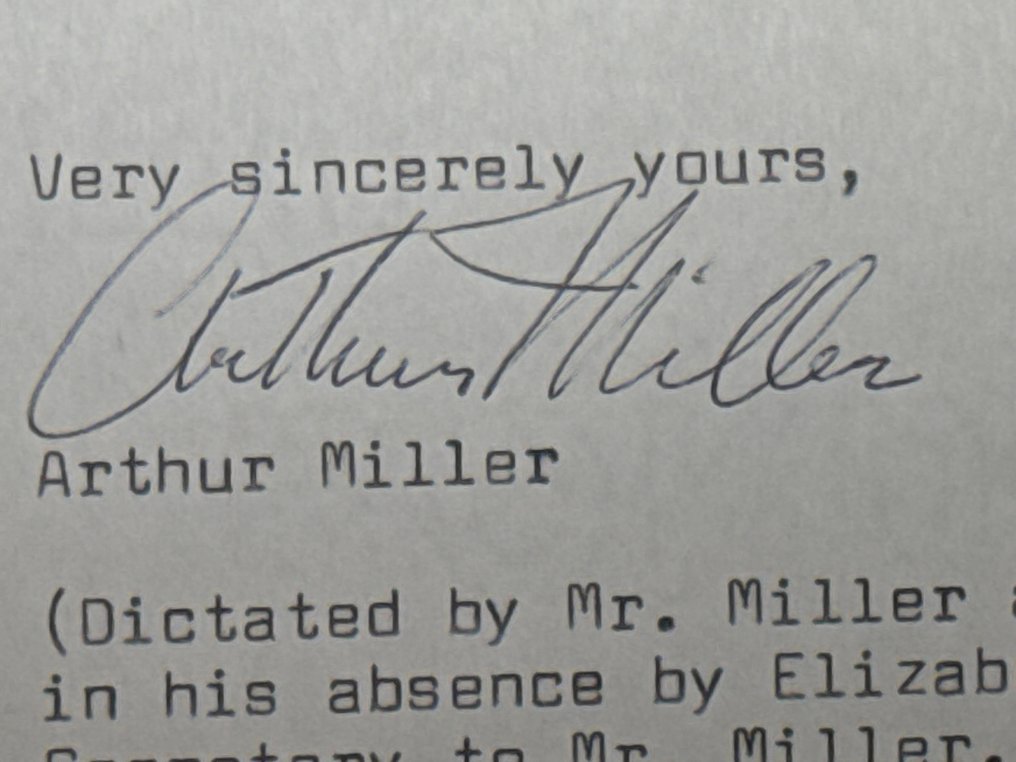
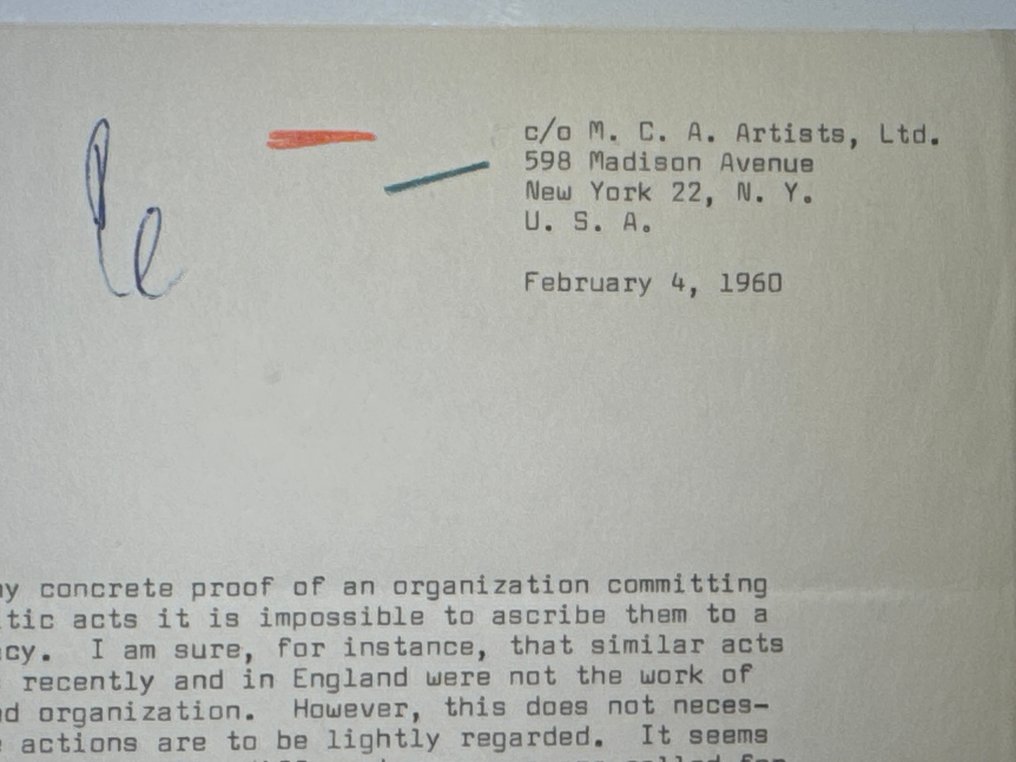
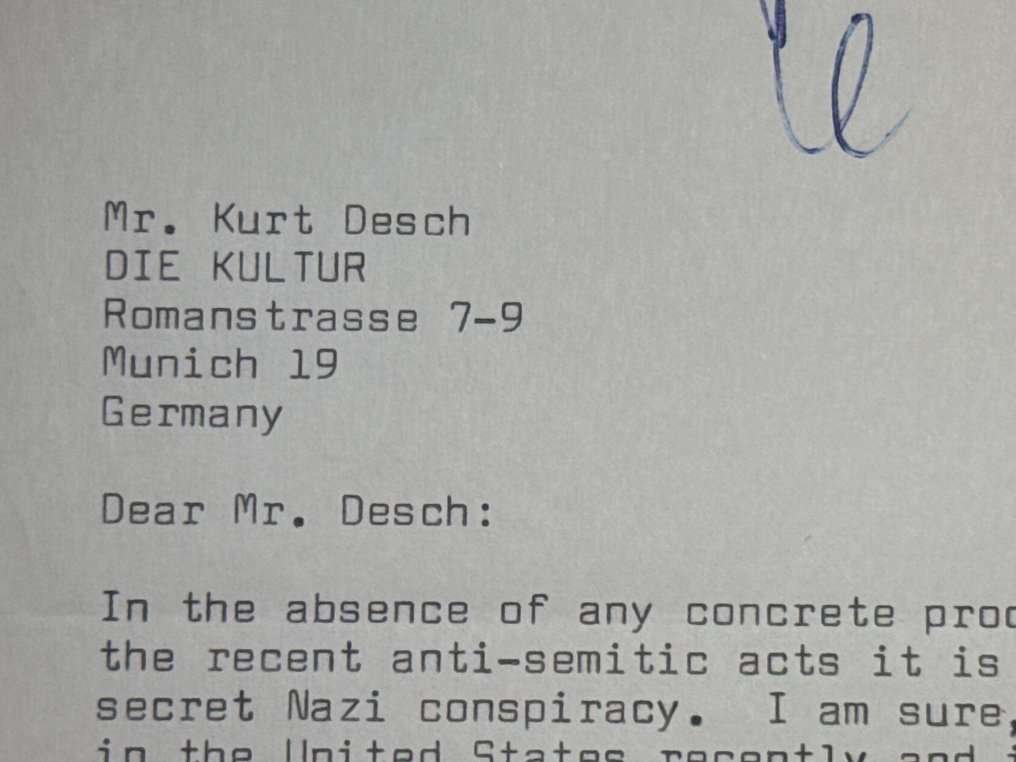
Typewritten letter on stationery c/o M.C.A. Artists, Ltd., New York, one page, with handwritten signature "Arthur Miller" at the bottom. His professional secretary (during 1959-1960), Elizabeth Hannum, typed this letter (therfore the sign AM : eh) and afterwards Miller signed original this letter, what usual happened. The secretary certainly did not imitate his signature, as all the characteristics of Miller's original signature are present.
The letter was dictated by Miller; typewritten notation and initials "AM:eh". Sent during his marriage to Marilyn Monroe.
Miller's letter addresses the antisemitic acts of vandalism and violence in West Germany during 1959/60. He rejects the notion of an organized National Socialist conspiracy but strongly warns against downplaying these acts. Miller calls for decisive action, particularly in Germany, including a fundamental reform of historical education and the removal of former National Socialists from positions of influence. He describes antisemitism as a societal "disease" that must be actively combated to prevent a recurrence of historical catastrophes.
The recipient, Kurt Oesch, was editor of the cultural policy journal Die Kultur (Munich). The letter is intended as a contribution to public debate and is situated within the context of international reactions to the wave of antisemitic vandalism in Europe.
The letter goes to the german newspaper "DIE KULTUR" a cultural policy journal of the early Federal Republic of Germany, Essays, commentaries, international voices, strongly interested in democratization, coming to terms with National Socialism, germany's intellectual reorientation, entirely in a political sense of Arthus Miller.
Very good condition.
Arthur Asher Miller (October 17, 1915 – February 10, 2005) was an American actor and writer of plays in the 20th-century American theater. Among his most popular plays are All My Sons (1947), Death of a Salesman (1949), The Crucible (1953), and A View from the Bridge (1955). He wrote several screenplays, including The Misfits (1961). The drama Death of a Salesman is considered one of the best American plays of the 20th century.
Miller was often in the public eye, particularly during the late 1940s, 1950s and early 1960s. During this time, he received a Pulitzer Prize for Drama, testified before the House Un-American Activities Committee, and married Marilyn Monroe. In 1980, he received the St. Louis Literary Award from the Saint Louis University Library Associates. He received the Praemium Imperiale prize in 2001, the Prince of Asturias Award in 2002, and the Jerusalem Prize in 2003, and the Dorothy and Lillian Gish Prize in 1999.
The HUAC took an interest in Miller himself not long after The Crucible opened, engineering the US State Department's denying him a passport to attend the play's London opening in 1954. When Miller applied in 1956 for a routine renewal of his passport, the House Un-American Activities Committee used this opportunity to subpoena him to appear before the committee. Before appearing, Miller asked the committee not to ask him to name names, to which the chairman, Francis E. Walter (D-PA) agreed. When Miller attended the hearing, to which Monroe accompanied him, risking her own career, he gave the committee a detailed account of his political activities. Miller emphasized that his cooperation with various Communist-front organizations had been unfortunate and a mistake. He stressed his own patriotism and portrayed himself as a changed man who regretted his errors. “I think it would be a disaster and a calamity if the Communist Party ever took over this country,” said Miller. “That is an opinion that has come to me not out of the blue sky but out of long thought. Reneging on the chairman's promise, the committee demanded the names of friends and colleagues who had participated in similar activities. Miller refused to comply, saying "I could not use the name of another person and bring trouble on him." As a result, a judge found Miller guilty of contempt of Congress in May 1957. Miller was sentenced to a fine and a prison sentence, blacklisted from Hollywood, and disallowed a US passport. In August 1958, his conviction was overturned by the court of appeals, which ruled that Miller had been misled by the chairman of the HUAC.
Miller's experience with the HUAC affected him throughout his life. In the late 1970s, he joined other celebrities (including William Styron and Mike Nichols) who were brought together by the journalist Joan Barthel. Barthel's coverage of the highly publicized Barbara Gibbons murder case helped raise bail for Gibbons' son Peter Reilly, who had been convicted of his mother's murder based on what many felt was a coerced confession and little other evidence. Barthel documented the case in her book A Death in Canaan, which was made as a television film of the same name and broadcast in 1978. City Confidential, an A&E Network series, produced an episode about the murder, postulating that part of the reason Miller took such an active interest (including supporting Reilly's defense and using his own celebrity to bring attention to Reilly's plight) was because he had felt similarly persecuted in his run-ins with the HUAC. He sympathized with Reilly, whom he firmly believed to be innocent and to have been railroaded by the Connecticut State Police and the Attorney General who had initially prosecuted the case.
Miller began work on writing the screenplay for The Misfits in 1960, directed by John Huston and starring Monroe. It was during the filming that Miller's and Monroe's relationship hit difficulties, and he later said that the filming was one of the lowest points in his life. Monroe was taking drugs to help her sleep and other drugs to help her wake up, arriving on the set late, and having trouble remembering her lines. Huston was unaware that Miller and Monroe were having problems in their private life. He recalled later, "I was impertinent enough to say to Arthur that to allow her to take drugs of any kind was criminal and utterly irresponsible. Shortly after that I realized that she wouldn't listen to Arthur at all; he had no say over her actions."
Shortly before the film's premiere in 1961, Miller and Monroe divorced after five years of marriage. Nineteen months later, on August 5, 1962, Monroe died of a likely drug overdose. Huston, who had also directed her in her first major role in The Asphalt Jungle in 1950, and who had seen her rise to stardom, put the blame for her death on her doctors as opposed to the stresses of being a star: "The girl was an addict of sleeping pills and she was made so by the God-damn doctors. It had nothing to do with the Hollywood set-up."
Here the complet text of the letter:
"c/o M. C. A. Artists, Ltd.
598 Madison Avenue
New York 22, N. Y.
U. S. A.
February 4, 1960
Mr. Kurt Oesch
DIE KULTUR
Romanstrasse 7–9
Munich 19
Germany
Dear Mr. Oesch:
In the absence of any concrete proof of an organization committing the recent anti-semitic acts it is impossible to ascribe them to a secret Nazi conspiracy. I am sure, for instance, that similar acts in the United States recently and in England were not the work of an active underground organization. However, this does not necessarily mean that the actions are to be lightly regarded. It seems to me that in different countries different measures are called for. In England and in the United States, for instance, there is a powerful democratic tradition which, despite lapses, can be relied on to mobilize the forces of decency against any serious threat of racism. In these countries, therefore, it is perhaps sufficient that the individual perpetrators be caught and appropriately punished, but in Germany, if a foreigner may make such a comment, it seems to me that more decisive action is called for. In the first place, I understand that German education has by and large not taken into account the world-known facts of Nazi history, and a revision of the educational program would seem now to be absolutely required. Secondly, the Germans, as history has proven, have yet to create an inner tradition of resistance to just this kind of outbreak, and to Germans of good will the model for their action might well be more dramatic than the American and English examples; specifically, the removal of Nazis — at least from positions where extremists can gain some moral support. I would emphasize that the absence of any organized plot may be as forbidding a fact as the discovery of its presence. The illness which anti-semitism represents has been displayed again, whether spontaneously or by means of a plot, and this illness cannot be allowed to continue without a response in terms of education and police action by those who do not wish to see the world go up in flames again.
Very sincerely yours,
Arthur Miller
(Dictated by Mr. Miller and signed in his absence by Elizabeth Hannum,
Secretary to Mr. Miller.)
AM:eh"
#C049
Look to the pictures, we guarentee the origin and date!
Arthur Miller (1915–2005) famous American actor and writer, husband of Marilyn Monroe
- Important typed and autograph signed letter to a german journal about Antisemitism in the word
- dated February 4, 1960 (shortly before his separation from Marilyn Monroe and while he was under private and political pressure)
Typewritten letter on stationery c/o M.C.A. Artists, Ltd., New York, one page, with handwritten signature "Arthur Miller" at the bottom. His professional secretary (during 1959-1960), Elizabeth Hannum, typed this letter (therfore the sign AM : eh) and afterwards Miller signed original this letter, what usual happened. The secretary certainly did not imitate his signature, as all the characteristics of Miller's original signature are present.
The letter was dictated by Miller; typewritten notation and initials "AM:eh". Sent during his marriage to Marilyn Monroe.
Miller's letter addresses the antisemitic acts of vandalism and violence in West Germany during 1959/60. He rejects the notion of an organized National Socialist conspiracy but strongly warns against downplaying these acts. Miller calls for decisive action, particularly in Germany, including a fundamental reform of historical education and the removal of former National Socialists from positions of influence. He describes antisemitism as a societal "disease" that must be actively combated to prevent a recurrence of historical catastrophes.
The recipient, Kurt Oesch, was editor of the cultural policy journal Die Kultur (Munich). The letter is intended as a contribution to public debate and is situated within the context of international reactions to the wave of antisemitic vandalism in Europe.
The letter goes to the german newspaper "DIE KULTUR" a cultural policy journal of the early Federal Republic of Germany, Essays, commentaries, international voices, strongly interested in democratization, coming to terms with National Socialism, germany's intellectual reorientation, entirely in a political sense of Arthus Miller.
Very good condition.
Arthur Asher Miller (October 17, 1915 – February 10, 2005) was an American actor and writer of plays in the 20th-century American theater. Among his most popular plays are All My Sons (1947), Death of a Salesman (1949), The Crucible (1953), and A View from the Bridge (1955). He wrote several screenplays, including The Misfits (1961). The drama Death of a Salesman is considered one of the best American plays of the 20th century.
Miller was often in the public eye, particularly during the late 1940s, 1950s and early 1960s. During this time, he received a Pulitzer Prize for Drama, testified before the House Un-American Activities Committee, and married Marilyn Monroe. In 1980, he received the St. Louis Literary Award from the Saint Louis University Library Associates. He received the Praemium Imperiale prize in 2001, the Prince of Asturias Award in 2002, and the Jerusalem Prize in 2003, and the Dorothy and Lillian Gish Prize in 1999.
The HUAC took an interest in Miller himself not long after The Crucible opened, engineering the US State Department's denying him a passport to attend the play's London opening in 1954. When Miller applied in 1956 for a routine renewal of his passport, the House Un-American Activities Committee used this opportunity to subpoena him to appear before the committee. Before appearing, Miller asked the committee not to ask him to name names, to which the chairman, Francis E. Walter (D-PA) agreed. When Miller attended the hearing, to which Monroe accompanied him, risking her own career, he gave the committee a detailed account of his political activities. Miller emphasized that his cooperation with various Communist-front organizations had been unfortunate and a mistake. He stressed his own patriotism and portrayed himself as a changed man who regretted his errors. “I think it would be a disaster and a calamity if the Communist Party ever took over this country,” said Miller. “That is an opinion that has come to me not out of the blue sky but out of long thought. Reneging on the chairman's promise, the committee demanded the names of friends and colleagues who had participated in similar activities. Miller refused to comply, saying "I could not use the name of another person and bring trouble on him." As a result, a judge found Miller guilty of contempt of Congress in May 1957. Miller was sentenced to a fine and a prison sentence, blacklisted from Hollywood, and disallowed a US passport. In August 1958, his conviction was overturned by the court of appeals, which ruled that Miller had been misled by the chairman of the HUAC.
Miller's experience with the HUAC affected him throughout his life. In the late 1970s, he joined other celebrities (including William Styron and Mike Nichols) who were brought together by the journalist Joan Barthel. Barthel's coverage of the highly publicized Barbara Gibbons murder case helped raise bail for Gibbons' son Peter Reilly, who had been convicted of his mother's murder based on what many felt was a coerced confession and little other evidence. Barthel documented the case in her book A Death in Canaan, which was made as a television film of the same name and broadcast in 1978. City Confidential, an A&E Network series, produced an episode about the murder, postulating that part of the reason Miller took such an active interest (including supporting Reilly's defense and using his own celebrity to bring attention to Reilly's plight) was because he had felt similarly persecuted in his run-ins with the HUAC. He sympathized with Reilly, whom he firmly believed to be innocent and to have been railroaded by the Connecticut State Police and the Attorney General who had initially prosecuted the case.
Miller began work on writing the screenplay for The Misfits in 1960, directed by John Huston and starring Monroe. It was during the filming that Miller's and Monroe's relationship hit difficulties, and he later said that the filming was one of the lowest points in his life. Monroe was taking drugs to help her sleep and other drugs to help her wake up, arriving on the set late, and having trouble remembering her lines. Huston was unaware that Miller and Monroe were having problems in their private life. He recalled later, "I was impertinent enough to say to Arthur that to allow her to take drugs of any kind was criminal and utterly irresponsible. Shortly after that I realized that she wouldn't listen to Arthur at all; he had no say over her actions."
Shortly before the film's premiere in 1961, Miller and Monroe divorced after five years of marriage. Nineteen months later, on August 5, 1962, Monroe died of a likely drug overdose. Huston, who had also directed her in her first major role in The Asphalt Jungle in 1950, and who had seen her rise to stardom, put the blame for her death on her doctors as opposed to the stresses of being a star: "The girl was an addict of sleeping pills and she was made so by the God-damn doctors. It had nothing to do with the Hollywood set-up."
Here the complet text of the letter:
"c/o M. C. A. Artists, Ltd.
598 Madison Avenue
New York 22, N. Y.
U. S. A.
February 4, 1960
Mr. Kurt Oesch
DIE KULTUR
Romanstrasse 7–9
Munich 19
Germany
Dear Mr. Oesch:
In the absence of any concrete proof of an organization committing the recent anti-semitic acts it is impossible to ascribe them to a secret Nazi conspiracy. I am sure, for instance, that similar acts in the United States recently and in England were not the work of an active underground organization. However, this does not necessarily mean that the actions are to be lightly regarded. It seems to me that in different countries different measures are called for. In England and in the United States, for instance, there is a powerful democratic tradition which, despite lapses, can be relied on to mobilize the forces of decency against any serious threat of racism. In these countries, therefore, it is perhaps sufficient that the individual perpetrators be caught and appropriately punished, but in Germany, if a foreigner may make such a comment, it seems to me that more decisive action is called for. In the first place, I understand that German education has by and large not taken into account the world-known facts of Nazi history, and a revision of the educational program would seem now to be absolutely required. Secondly, the Germans, as history has proven, have yet to create an inner tradition of resistance to just this kind of outbreak, and to Germans of good will the model for their action might well be more dramatic than the American and English examples; specifically, the removal of Nazis — at least from positions where extremists can gain some moral support. I would emphasize that the absence of any organized plot may be as forbidding a fact as the discovery of its presence. The illness which anti-semitism represents has been displayed again, whether spontaneously or by means of a plot, and this illness cannot be allowed to continue without a response in terms of education and police action by those who do not wish to see the world go up in flames again.
Very sincerely yours,
Arthur Miller
(Dictated by Mr. Miller and signed in his absence by Elizabeth Hannum,
Secretary to Mr. Miller.)
AM:eh"
#C049
Look to the pictures, we guarentee the origin and date!
Details
Era
1900-2000
Subject
History, Literature, Politics
Number of Books
1
Height
27.8 cm
Author/ Illustrator
Arthur Miller (1915–2005) famous American actor and writer, husband of Marilyn Monroe
Width
21.6 cm
Title
Important typed and autograph signed letter to a german journal about Antisemitism in the word
Condition
Good
Year
1960
Language
English
Original language
Yes
Sold by
GermanyVerified
protop
Rechtliche Informationen des Verkäufers
- Unternehmen:
- Kunsthandel Anabel Walter
- Repräsentant:
- Anabel Walter
- Adresse:
- Kunsthandel Anabel Walter
Emil-Fuchs-Str. 6
04105 Leipzig
GERMANY - Telefonnummer:
- +4915111607266
- Email:
- info@antique-world-art.com
- USt-IdNr.:
- DE338352001
AGB
AGB des Verkäufers. Mit einem Gebot auf dieses Los akzeptieren Sie ebenfalls die AGB des Verkäufers.
Widerrufsbelehrung
- Frist: 14 Tage sowie gemäß den hier angegebenen Bedingungen
- Rücksendkosten: Käufer trägt die unmittelbaren Kosten der Rücksendung der Ware
- Vollständige Widerrufsbelehrung