Side table - Tip-top - Noble wood, ebony, with golden details. - Gueridon Table



06
days
10
hours
12
minutes
07
seconds

No bids placed
Catawiki Buyer Protection
Your payment’s safe with us until you receive your object.View details
Trustpilot 4.4 | 123053 reviews
Rated Excellent on Trustpilot.
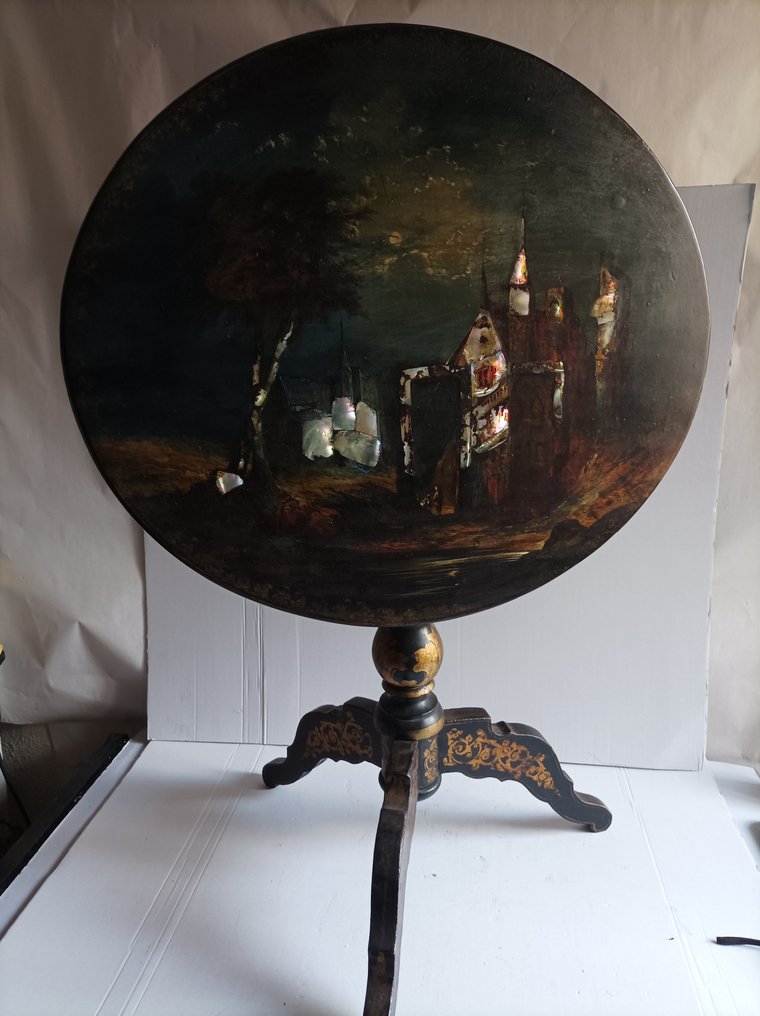
Hispano‑Filipino guéridon model Tip‑top, round Ø70 cm with a 70 cm height, ebony wood with mother‑of‑pearl inlays and gold detailing, dating to the second half of the 19th century in an antique Napoleonic III style, featuring a folding bascule mechanism and origin in the Philippines, in good used condition with minor wear.
AI-assisted summary
Description from the seller
Difficult to describe this work of art.
Tip-top model gueridon table
Philippines in the second half of the 19th century.
Noble ebony wood
Details in mother-of-pearl and gold.
Tip-top model, suitable as a side table and decorative element to showcase the beauty of the table.
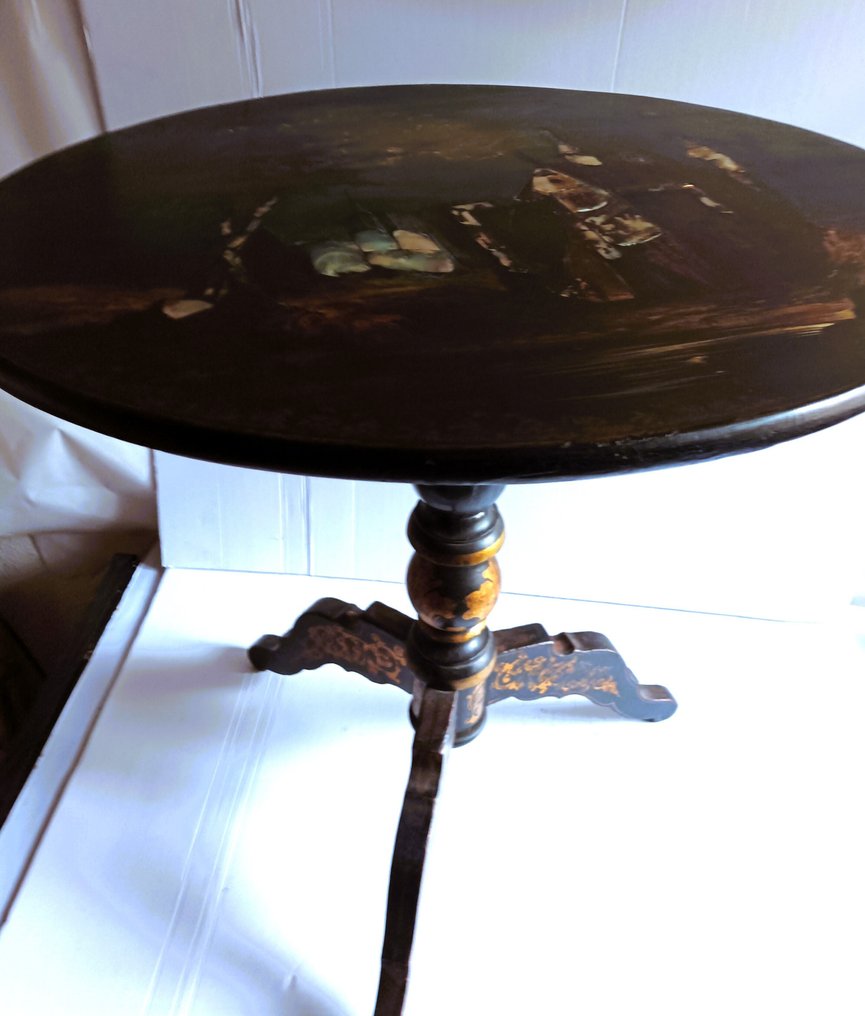
Original gold plating on the legs and central axis.
Ø 70 cm of base and height around 70 cm.
A unique and exclusive marvel
It will be properly disassembled and packaged in insured and guaranteed shipping.
Tilting table 'tip-top' (guéridon) Spanish-Filipino with mother-of-pearl inlays and gilding | Second half of the 19th century
Category: Hispano-Filipino export Asian art furniture, 19th century.
Approximate dimensions: Ø 70 cm; height 70 cm; foldable tilting mechanism. TIp/top
Materials and manufacturing technique
Hardwoods: tropical hardwood. Likely ebony, narra (Pterocarpus indicus), or kamagong (Diospyros blancoi), with 'wengué' (an African species, unlikely in 19th-century Philippines).
Lid decoration: polychromy and lacquer with mother-of-pearl inlays and gold leaf gilding.
Painting technique: lacquered/polychromed base with architectural scenes and strong light-shadow contrasts; iridescent reflections compatible with nacre.
Hardware: hinge and locking mechanism for vertical position (display) and horizontal position (use).
Style and design
Eclectic language typical of the Hispano-Filipino export production (second half of the 19th century), which combines European taste supports with Oriental techniques (lacquer and mother-of-pearl). The architectural scene with romantic inspiration, featuring dramatic lighting, is consistent with decorations of the period intended for the Iberian and French markets.
No inscriptions, signatures, or seals are visible in the provided images. The absence of marks is common in nineteenth-century Filipino workshop pieces; it does not affect authenticity but limits specific attributions and, consequently, the valuation ceiling.
Condition of preservation
Minor surface wear on the lacquered or polychrome finish, with visible paint layer losses, especially in lighter areas.
Nacre inlays with a strong visual impact.
Structure with presence: no evidence of breakages, stability of the tilting mechanism, and no play.
Decorated support/stand consistent with the typology.
Condition conclusion: Good with slight wear from use and the passage of time; maintains sufficient presence for its category.
Historical Origin and Context
Hispano-Filipino workshop (probably Manila), second half of the 19th century (c. 1860–1900). The combination of tropical wood, polychrome lacquer, mother-of-pearl inlay, and tilting format aligns with colonial Filipino production intended for Iberian and European markets.
Original purpose: living room piece for display and occasional use. The tilting function allowed the decorated lid to be displayed vertically when not in use.
Stylistic relevance: it represents the Asia–Europe dialogue in decorative arts of the 19th century, with Eastern techniques adapted to the European Romantic taste. This cultural crossing continues to hold collector interest.
Trends and demand: a solid market in Spain and France for Hispano-Filipino furniture with mother-of-pearl; demand is sensitive to the condition of the lacquer and the quality of the motif. Prices have remained stable in the mid-range from 2021 to 2024, with peaks in well-preserved or thoughtfully restored specimens.
Evaluation criteria
Authenticity and typological attribution (material and technical coherence with the Philippines, 19th century).
Decorative quality (composition, richness of mother-of-pearl, and gold).
Condition of lacquer/polychromy, integrity of mother-of-pearl, and stability of the balance wheel.
Rarity of the format and size (Ø ~70 cm is attractive).
Demand and liquidity observed in auctions and specialized platforms.
Sources and references used
Auction and online sales results files (queries by type and materials, 2018–2024)
Bibliography and general catalogs on colonial and Hispano-Filipino furniture of the 19th century.
Market comparisons (real observed sales)
Recent public lots exactly identical in motive and measurements with accessible documentation have not been located; very close comparables are used instead (Philippines/Asia, 19th century, round top 60–75 cm, lacquer/polychrome with mother-of-pearl inlay, sometimes tilting). The ranges reflect hammer prices, not starting prices.
Spanish-Filipino small tables with shell/mother-of-pearl and polychromy. Closed sales range between €700 and €1,600 in average condition; restored/attractive specimens up to approximately €2,000.
Catawiki (2022–2024): Filipino/Asian tables from the 19th century, round top with mother-of-pearl, some tilting. Typical finishes €900–€2,000 depending on size and condition.
French and British rooms (Drouot/Bonhams) (2018–2023): side tables with black lacquer or polychromy and mother-of-pearl inlay. Pieces of higher quality/restoration reach €2,500–5,000 at hammer price.
1stdibs (offer reference, not auction): restored and high-end Hispano-Filipino tables with asking prices in the range of €2,000–6,000; indicative utility regarding the expectations of the international retail channel.
Factors that influence the value
A favor: 70 cm diameter, functional and decorative tilting mechanism, presence of mother of pearl and gold accents, a typology sought after in the Hispanic-Filipino market.
Raw material: the value lies in the artistic work and typology, not in the precious metal of the gilding (gold leaf with negligible intrinsic value in this context).
Type of wood: identify ebony, or kamagong, through macro photography of the pore and reverse side to reinforce attribution and value; 'wengué' is unlikely for the Philippines 19th century.
Value Estimation
Current value range (EUR)
Excellent (almost intact lacquer, minimal loss, solid mechanism, high-quality restoration): €3,000–5,000
Good (light wear, small stabilized flaws): €1,800–€3,000
Acceptable – observed state: €1,000–€1,800
For restoration (significant faults or instability): €600–1,000
Conclusion for the analyzed piece: given the visible losses and overall wear, the most probable market value today ranges between €1,000 and €1,800 (sale between individuals/auction in Spain/EU), conditioned on the stability of the hinge mechanism and the absence of hidden structural damages.
Revaluation scenarios
Professional conservative restoration (lacquer cleaning, reversible spot reintegration, nacre consolidation): could raise the value of the piece to €1,800–3,000.
Material accreditation (wood identification, conservation technical report, provenance): improves buyer confidence and the price ceiling.
Recommended sales channels
todocoleccion.net (first option): high concentration of buyers of Hispanic-Filipino furniture in Spain, a history of comparable sales, and good liquidity. Recommended auction with reserve or fixed price with the best offer.
Final estimate (today): €1,000–€1,800, based on market comparables from 2021–2024 and on the observed condition.
Conservation and Restoration Tips
Avoid aggressive cleaning; do not use solvents. Dust with a soft brush and, if necessary, apply microcrystalline wax by a professional.
Environmental control: HR 45–60%, stable temperature; avoid direct sunlight to prevent additional cracking and discoloration of mother-of-pearl/golden.
If restored: opt for reversible and documented interventions; avoid general repaintings or extensive re-gilding that devalue.
Recommended sales strategy
Condition: Acceptable, with wear and losses in lacquer/polychromy.
Estimate: €1,500–€1,800 (Spain/UE market)
Difficult to describe this work of art.
Tip-top model gueridon table
Philippines in the second half of the 19th century.
Noble ebony wood
Details in mother-of-pearl and gold.
Tip-top model, suitable as a side table and decorative element to showcase the beauty of the table.
Original gold plating on the legs and central axis.
Ø 70 cm of base and height around 70 cm.
A unique and exclusive marvel
It will be properly disassembled and packaged in insured and guaranteed shipping.
Tilting table 'tip-top' (guéridon) Spanish-Filipino with mother-of-pearl inlays and gilding | Second half of the 19th century
Category: Hispano-Filipino export Asian art furniture, 19th century.
Approximate dimensions: Ø 70 cm; height 70 cm; foldable tilting mechanism. TIp/top
Materials and manufacturing technique
Hardwoods: tropical hardwood. Likely ebony, narra (Pterocarpus indicus), or kamagong (Diospyros blancoi), with 'wengué' (an African species, unlikely in 19th-century Philippines).
Lid decoration: polychromy and lacquer with mother-of-pearl inlays and gold leaf gilding.
Painting technique: lacquered/polychromed base with architectural scenes and strong light-shadow contrasts; iridescent reflections compatible with nacre.
Hardware: hinge and locking mechanism for vertical position (display) and horizontal position (use).
Style and design
Eclectic language typical of the Hispano-Filipino export production (second half of the 19th century), which combines European taste supports with Oriental techniques (lacquer and mother-of-pearl). The architectural scene with romantic inspiration, featuring dramatic lighting, is consistent with decorations of the period intended for the Iberian and French markets.
No inscriptions, signatures, or seals are visible in the provided images. The absence of marks is common in nineteenth-century Filipino workshop pieces; it does not affect authenticity but limits specific attributions and, consequently, the valuation ceiling.
Condition of preservation
Minor surface wear on the lacquered or polychrome finish, with visible paint layer losses, especially in lighter areas.
Nacre inlays with a strong visual impact.
Structure with presence: no evidence of breakages, stability of the tilting mechanism, and no play.
Decorated support/stand consistent with the typology.
Condition conclusion: Good with slight wear from use and the passage of time; maintains sufficient presence for its category.
Historical Origin and Context
Hispano-Filipino workshop (probably Manila), second half of the 19th century (c. 1860–1900). The combination of tropical wood, polychrome lacquer, mother-of-pearl inlay, and tilting format aligns with colonial Filipino production intended for Iberian and European markets.
Original purpose: living room piece for display and occasional use. The tilting function allowed the decorated lid to be displayed vertically when not in use.
Stylistic relevance: it represents the Asia–Europe dialogue in decorative arts of the 19th century, with Eastern techniques adapted to the European Romantic taste. This cultural crossing continues to hold collector interest.
Trends and demand: a solid market in Spain and France for Hispano-Filipino furniture with mother-of-pearl; demand is sensitive to the condition of the lacquer and the quality of the motif. Prices have remained stable in the mid-range from 2021 to 2024, with peaks in well-preserved or thoughtfully restored specimens.
Evaluation criteria
Authenticity and typological attribution (material and technical coherence with the Philippines, 19th century).
Decorative quality (composition, richness of mother-of-pearl, and gold).
Condition of lacquer/polychromy, integrity of mother-of-pearl, and stability of the balance wheel.
Rarity of the format and size (Ø ~70 cm is attractive).
Demand and liquidity observed in auctions and specialized platforms.
Sources and references used
Auction and online sales results files (queries by type and materials, 2018–2024)
Bibliography and general catalogs on colonial and Hispano-Filipino furniture of the 19th century.
Market comparisons (real observed sales)
Recent public lots exactly identical in motive and measurements with accessible documentation have not been located; very close comparables are used instead (Philippines/Asia, 19th century, round top 60–75 cm, lacquer/polychrome with mother-of-pearl inlay, sometimes tilting). The ranges reflect hammer prices, not starting prices.
Spanish-Filipino small tables with shell/mother-of-pearl and polychromy. Closed sales range between €700 and €1,600 in average condition; restored/attractive specimens up to approximately €2,000.
Catawiki (2022–2024): Filipino/Asian tables from the 19th century, round top with mother-of-pearl, some tilting. Typical finishes €900–€2,000 depending on size and condition.
French and British rooms (Drouot/Bonhams) (2018–2023): side tables with black lacquer or polychromy and mother-of-pearl inlay. Pieces of higher quality/restoration reach €2,500–5,000 at hammer price.
1stdibs (offer reference, not auction): restored and high-end Hispano-Filipino tables with asking prices in the range of €2,000–6,000; indicative utility regarding the expectations of the international retail channel.
Factors that influence the value
A favor: 70 cm diameter, functional and decorative tilting mechanism, presence of mother of pearl and gold accents, a typology sought after in the Hispanic-Filipino market.
Raw material: the value lies in the artistic work and typology, not in the precious metal of the gilding (gold leaf with negligible intrinsic value in this context).
Type of wood: identify ebony, or kamagong, through macro photography of the pore and reverse side to reinforce attribution and value; 'wengué' is unlikely for the Philippines 19th century.
Value Estimation
Current value range (EUR)
Excellent (almost intact lacquer, minimal loss, solid mechanism, high-quality restoration): €3,000–5,000
Good (light wear, small stabilized flaws): €1,800–€3,000
Acceptable – observed state: €1,000–€1,800
For restoration (significant faults or instability): €600–1,000
Conclusion for the analyzed piece: given the visible losses and overall wear, the most probable market value today ranges between €1,000 and €1,800 (sale between individuals/auction in Spain/EU), conditioned on the stability of the hinge mechanism and the absence of hidden structural damages.
Revaluation scenarios
Professional conservative restoration (lacquer cleaning, reversible spot reintegration, nacre consolidation): could raise the value of the piece to €1,800–3,000.
Material accreditation (wood identification, conservation technical report, provenance): improves buyer confidence and the price ceiling.
Recommended sales channels
todocoleccion.net (first option): high concentration of buyers of Hispanic-Filipino furniture in Spain, a history of comparable sales, and good liquidity. Recommended auction with reserve or fixed price with the best offer.
Final estimate (today): €1,000–€1,800, based on market comparables from 2021–2024 and on the observed condition.
Conservation and Restoration Tips
Avoid aggressive cleaning; do not use solvents. Dust with a soft brush and, if necessary, apply microcrystalline wax by a professional.
Environmental control: HR 45–60%, stable temperature; avoid direct sunlight to prevent additional cracking and discoloration of mother-of-pearl/golden.
If restored: opt for reversible and documented interventions; avoid general repaintings or extensive re-gilding that devalue.
Recommended sales strategy
Condition: Acceptable, with wear and losses in lacquer/polychromy.
Estimate: €1,500–€1,800 (Spain/UE market)
Details
Era
1400-1900
Weight
10 kg
Style subtype
Napoleon III Style
Title additional information
Gueridon Table
Country of Origin
Philippines
Model
Tip-top
Material
Noble wood, ebony, with golden details.
Style
Antique
Condition
Good condition - used with small signs of aging & blemishes
Height
70 cm
Width
70 cm
Depth
70 cm
Height Of The Underside Of The Table
70 cm
Diameter
70 cm
Estimated period
1850-1900