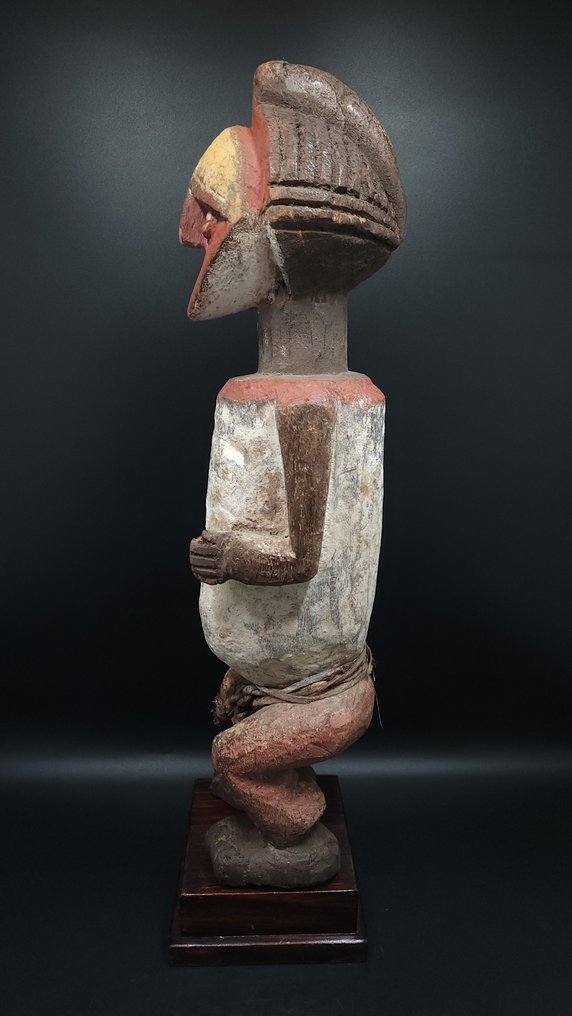
Beautiful reliquary statue - Ambété - Gabon (No reserve price)



03
days
06
hours
34
minutes
05
seconds

No bids placed
Catawiki Buyer Protection
Your payment’s safe with us until you receive your object.View details
Trustpilot 4.4 | 122986 reviews
Rated Excellent on Trustpilot.
Description from the seller
Relicary statue - Mbete / Ambete - Gabon - African reliquary
The Mbété of the upper basin of the Ogooué and its tributaries have developed carved statues used as reliquaries.
These representations contained the bones of the deceased leaders.
Surveys conducted in the 1920s-1930s among the Mbété of the center report a significant cult of relics, the Ngoye, a closed association of clan chiefs attributing supernatural power to certain bones of some of their deceased predecessors.
These relics were kept inside the hollow torsos of wooden statues.
An example observed at that time was called mitsitsi-na-ngoye.
When they were not in use, these statues were hung in special shelters.
Their use seemed to be of an initiatory nature.
During a ceremony, they could be taken out and arranged in front of the candidates at Ngoye to present the names and the history of the relics.
These sacred relics were most often made from fragments of skulls and finger bones.
Relicary statue - Mbete / Ambete - Gabon - African reliquary
The Mbété of the upper basin of the Ogooué and its tributaries have developed carved statues used as reliquaries.
These representations contained the bones of the deceased leaders.
Surveys conducted in the 1920s-1930s among the Mbété of the center report a significant cult of relics, the Ngoye, a closed association of clan chiefs attributing supernatural power to certain bones of some of their deceased predecessors.
These relics were kept inside the hollow torsos of wooden statues.
An example observed at that time was called mitsitsi-na-ngoye.
When they were not in use, these statues were hung in special shelters.
Their use seemed to be of an initiatory nature.
During a ceremony, they could be taken out and arranged in front of the candidates at Ngoye to present the names and the history of the relics.
These sacred relics were most often made from fragments of skulls and finger bones.
Details
Indigenous object name
Beautiful reliquary statue
No. of items
1
Ethnic group/ culture
Ambété
Country of Origin
Gabon
Period
2000-2010
Material
Wood
Sold with stand
No
Condition
Good condition
Height
50 cm
Width
15 cm
Depth
13 cm
