Ancient Roman Terracotta Amphora, Ancient Roman Terracotta Vessel Fragment with Stylised Amphibian Motifs


03
days
19
hours
10
minutes
48
seconds
Starting bid
€ 1
Reserve price not met

Expert
Selected by Peter Reynaers
Has nearly 30 years’ experience and moderated multiple online art research groups.
Estimate € 380 - € 450
No bids placed
Catawiki Buyer Protection
Your payment’s safe with us until you receive your object.View details
Trustpilot 4.4 | 122910 reviews
Rated Excellent on Trustpilot.
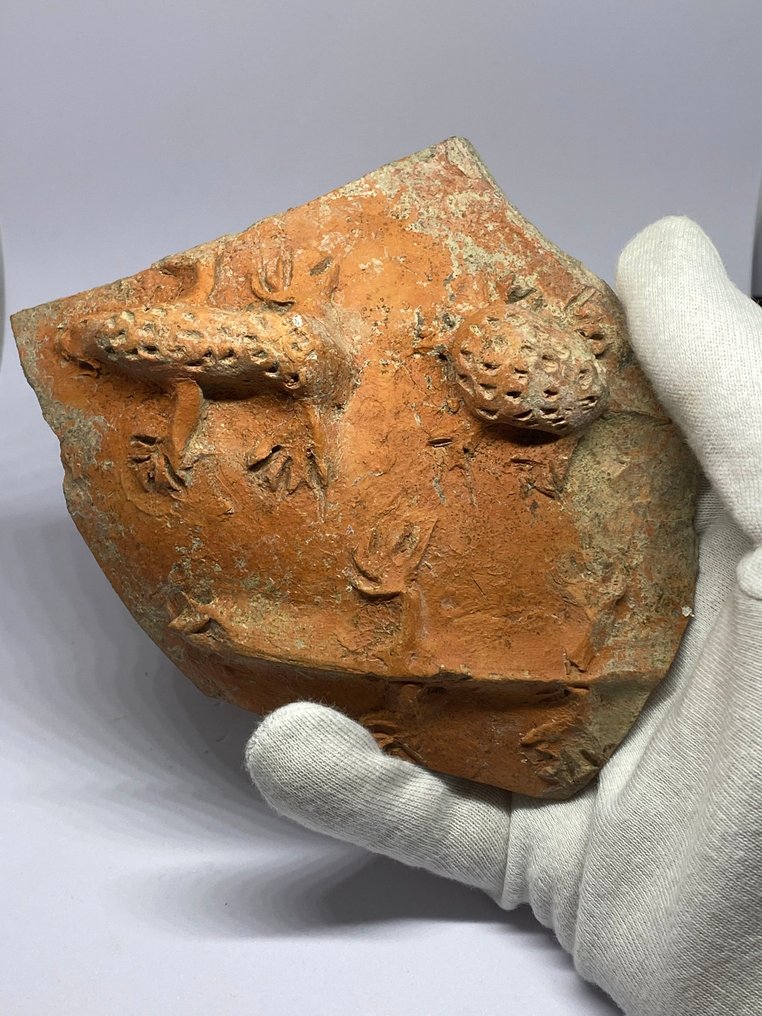
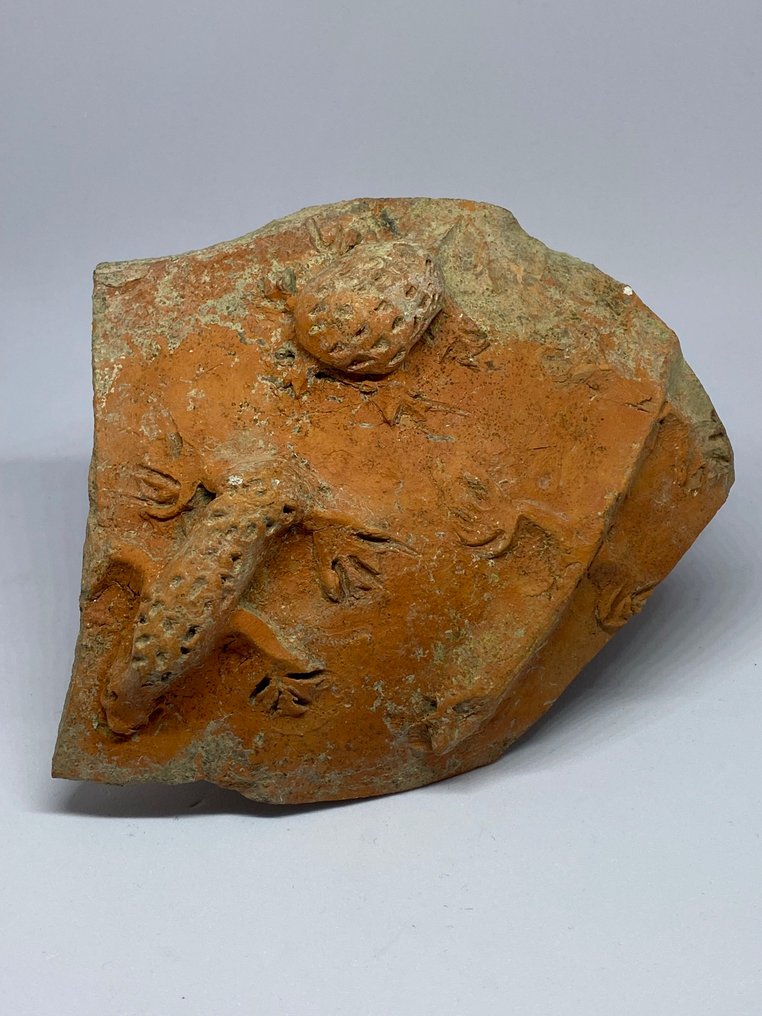
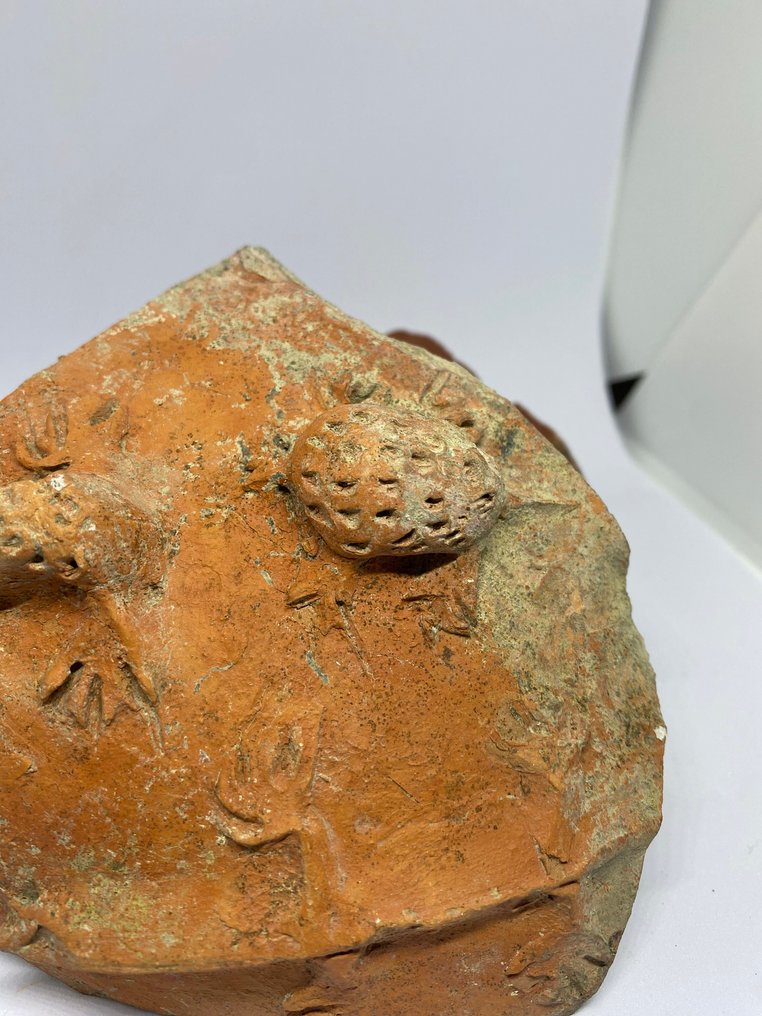
Ancient Roman terracotta amphora fragment with stylised amphibian motifs, dating to the 1st–3rd century AD, in good condition and measuring approximately 13.5 × 11 cm (weighing 148 g).
AI-assisted summary
Description from the seller
Ancient Roman Terracotta Vessel Fragment with Stylised Amphibian Motifs
Roman Empire, c. 1st–3rd century AD
Material: Terracotta
Dimensions: approx. 13.5 × 11 cm
Weight: 148 g
Condition: Fragmentary, as expected; surface wear and mineral accretions consistent with age
This evocative terracotta fragment originates from an ancient Roman ceramic vessel and is distinguished by its stylised relief depictions of amphibians, most likely frogs or toads, modelled in a deliberately schematic and symbolic manner. The figures are rendered with raised, dotted textures and simplified anatomical forms, characteristic of Roman provincial or domestic ceramic ornamentation rather than fine sculptural realism.
The clay body is a warm reddish-orange fabric, typical of Roman utilitarian wares, with visible inclusions and firing variations. The relief decoration appears to have been applied or modelled prior to firing, suggesting intentional iconographic significance rather than purely decorative flourish.
Interpretation & Possible Function
Amphibians held strong symbolic meaning in the Roman world, particularly in relation to water, fertility, renewal, and transformation. Frogs and similar creatures were closely associated with springs, wetlands, and liminal spaces—areas believed to possess protective or regenerative qualities.
It is plausible that this fragment belonged to:
a small domestic vessel used for water, oils, or herbal preparations
a ritual or votive container, possibly linked to household cult practices (lararia)
or a healing or apotropaic object, where amphibian imagery functioned as a charm against illness or misfortune
In Roman folk belief, creatures that thrived between land and water were often regarded as mediators between worlds, making such vessels particularly suitable for medicinal mixtures, libations, or offerings connected to health, fertility, or protection.
Historical Context
Decorated terracotta vessels such as this were widely used throughout the Roman Empire, especially outside elite contexts. While marble and bronze dominated high art, terracotta was the medium of daily Roman life, allowing symbolism and belief to permeate ordinary domestic settings. Fragments like this offer rare insight into the private spiritual and practical lives of Roman households.
Collectability
Authentic Roman terracotta fragments with zoomorphic relief decoration are increasingly scarce on the market, particularly those featuring amphibians, which are less commonly depicted than birds or floral motifs. This piece would make an excellent addition to:
an ancient art or archaeology collection
a study collection focused on Roman domestic life
or a curated display exploring symbolism and ritual in antiquity
A compelling fragment that bridges the practical and the symbolic, preserving the quiet voice of everyday belief in the Roman world. (45)
Ancient Roman Terracotta Vessel Fragment with Stylised Amphibian Motifs
Roman Empire, c. 1st–3rd century AD
Material: Terracotta
Dimensions: approx. 13.5 × 11 cm
Weight: 148 g
Condition: Fragmentary, as expected; surface wear and mineral accretions consistent with age
This evocative terracotta fragment originates from an ancient Roman ceramic vessel and is distinguished by its stylised relief depictions of amphibians, most likely frogs or toads, modelled in a deliberately schematic and symbolic manner. The figures are rendered with raised, dotted textures and simplified anatomical forms, characteristic of Roman provincial or domestic ceramic ornamentation rather than fine sculptural realism.
The clay body is a warm reddish-orange fabric, typical of Roman utilitarian wares, with visible inclusions and firing variations. The relief decoration appears to have been applied or modelled prior to firing, suggesting intentional iconographic significance rather than purely decorative flourish.
Interpretation & Possible Function
Amphibians held strong symbolic meaning in the Roman world, particularly in relation to water, fertility, renewal, and transformation. Frogs and similar creatures were closely associated with springs, wetlands, and liminal spaces—areas believed to possess protective or regenerative qualities.
It is plausible that this fragment belonged to:
a small domestic vessel used for water, oils, or herbal preparations
a ritual or votive container, possibly linked to household cult practices (lararia)
or a healing or apotropaic object, where amphibian imagery functioned as a charm against illness or misfortune
In Roman folk belief, creatures that thrived between land and water were often regarded as mediators between worlds, making such vessels particularly suitable for medicinal mixtures, libations, or offerings connected to health, fertility, or protection.
Historical Context
Decorated terracotta vessels such as this were widely used throughout the Roman Empire, especially outside elite contexts. While marble and bronze dominated high art, terracotta was the medium of daily Roman life, allowing symbolism and belief to permeate ordinary domestic settings. Fragments like this offer rare insight into the private spiritual and practical lives of Roman households.
Collectability
Authentic Roman terracotta fragments with zoomorphic relief decoration are increasingly scarce on the market, particularly those featuring amphibians, which are less commonly depicted than birds or floral motifs. This piece would make an excellent addition to:
an ancient art or archaeology collection
a study collection focused on Roman domestic life
or a curated display exploring symbolism and ritual in antiquity
A compelling fragment that bridges the practical and the symbolic, preserving the quiet voice of everyday belief in the Roman world. (45)
Details
Culture
Ancient Roman
Century/ Timeframe
c. 1st–3rd century AD
Name of object
Ancient Roman Terracotta Vessel Fragment with Stylised Amphibian Motifs, Amphora
Acquired from
Auction house
Year acquired
2020
Material
Terracotta
Country acquired from
United Kingdom
Condition
Good
Previous owner acquired from
Private collection
Previous owner - year acquired
1990
Previous owner - country acquired from
United Kingdom
I verify that I have obtained this object legally and that I am allowed to sell it
Yes
Sold by
Disclaimer
The seller was informed by Catawiki about documentation requirements and guarantees the following: - the object was legally obtained, - the seller has the right to sell and/or export the object, as relevant, - the seller will provide the necessary provenance information and arrange required documentation and permits/licenses, as applicable and as per local laws, - the seller will notify the buyer of any delays in obtaining permits/licenses. By bidding, you acknowledge that import documentation may be required depending on your country of residence and that obtaining permits/licenses may cause delays in the delivery of your object.
The seller was informed by Catawiki about documentation requirements and guarantees the following: - the object was legally obtained, - the seller has the right to sell and/or export the object, as relevant, - the seller will provide the necessary provenance information and arrange required documentation and permits/licenses, as applicable and as per local laws, - the seller will notify the buyer of any delays in obtaining permits/licenses. By bidding, you acknowledge that import documentation may be required depending on your country of residence and that obtaining permits/licenses may cause delays in the delivery of your object.
