Eugène Eechaut (1928-2019) - Abstract landscape - Framed


11
days
04
hours
55
minutes
20
seconds
Starting bid
€ 1
No reserve price

Expert
Selected by Annick van Itallie
Graduated in art history with over 25 years' experience in antiques and applied arts appraisal.
Estimate € 200 - € 300
No bids placed
Catawiki Buyer Protection
Your payment’s safe with us until you receive your object.View details
Trustpilot 4.4 | 122910 reviews
Rated Excellent on Trustpilot.
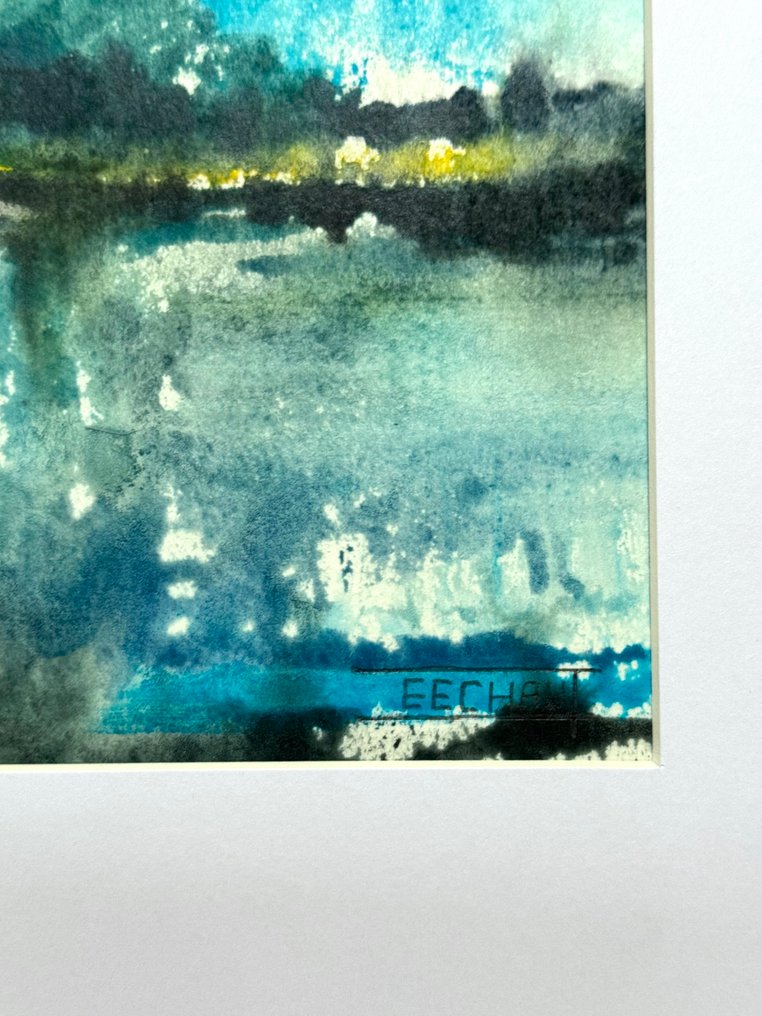
Watercolour painting on paper by Belgian artist Eugène Eechaut (1928–2019), titled Abstract landscape - Framed; original edition, signed and dated 1979, in excellent condition, depicting an abstract landscape and framed to 43 × 33 cm.
AI-assisted summary
Description from the seller
Eugène Eechaut (1928-2019)
Watercolor on paper, signed snd dated.
This watercolor presents an abstract landscape executed in Eugène Eechaut’s immediately recognizable style, characteristic of his mature artistic period. The composition combines fluid vertical washes with denser organic forms, creating a poetic balance between atmosphere, reflection, and structure that defines his approach to landscape abstraction.
The work demonstrates the artist’s refined mastery of watercolor and his distinctive use of color. It is signed by the artist, bears his original studio stamp, and includes an embossed artist’s mark, confirming its authenticity.
The dimensions with a simple frame measure 43 × 33 cm
About the artist:
Eugène Eechaut (1928–2019) was a Belgian artist whose career evolved at the crossroads of imagination, technical discipline, and artistic dialogue. He began gaining recognition in 1958, when he received his first distinctions from the European Center for Art and Aesthetics. Early in his career, Eechaut became a member of the artist collective JECTA, an influential Belgian group that included René Magritte. His participation in this circle is confirmed by two surviving newspaper clippings documenting shared exhibitions and professional activity within the group.
Since the 1960s, Eugène Eechaut became a regular participant in exhibitions at the Tamara Pfeiffer Gallery in Brussels, a venue internationally recognized for presenting leading figures of modern and avant-garde art. A preserved invitation card from the 1968–1969 exhibition season confirms that Eechaut exhibited in the same gallery alongside major artists such as Max Ernst, Jean Cocteau, Paul Klee, Dorothea Tanning, Léon Navez, Dunoyer de Segonzac, and Félix Labisse. These archival materials clearly demonstrate that Eechaut shared exhibition space with some of the most influential artists of the twentieth century.
Over the course of his artistic life, Eechaut developed several distinctive and recognizable artistic styles, rather than adhering to a single visual language. His work is characterized by evolving color palettes and a strong sense of structure, combining elegance with expressive freedom. He gradually refined and mastered ink techniques, achieving a high level of precision and control that became a defining element of his artistic identity.
Despite consistent exhibition activity and professional recognition, Eechaut remained notably discreet and protective of his work, rarely offering pieces for sale—even within his own family. This personal approach has contributed to the rarity of his works on the market today. Supported by archival documents, exhibition invitations, and press records, Eugène Eechaut’s legacy emerges as that of a disciplined and original artist, firmly embedded in the European art scene and in direct dialogue with some of its most celebrated figures.
Will be well packaged, protected and insured
Eugène Eechaut (1928-2019)
Watercolor on paper, signed snd dated.
This watercolor presents an abstract landscape executed in Eugène Eechaut’s immediately recognizable style, characteristic of his mature artistic period. The composition combines fluid vertical washes with denser organic forms, creating a poetic balance between atmosphere, reflection, and structure that defines his approach to landscape abstraction.
The work demonstrates the artist’s refined mastery of watercolor and his distinctive use of color. It is signed by the artist, bears his original studio stamp, and includes an embossed artist’s mark, confirming its authenticity.
The dimensions with a simple frame measure 43 × 33 cm
About the artist:
Eugène Eechaut (1928–2019) was a Belgian artist whose career evolved at the crossroads of imagination, technical discipline, and artistic dialogue. He began gaining recognition in 1958, when he received his first distinctions from the European Center for Art and Aesthetics. Early in his career, Eechaut became a member of the artist collective JECTA, an influential Belgian group that included René Magritte. His participation in this circle is confirmed by two surviving newspaper clippings documenting shared exhibitions and professional activity within the group.
Since the 1960s, Eugène Eechaut became a regular participant in exhibitions at the Tamara Pfeiffer Gallery in Brussels, a venue internationally recognized for presenting leading figures of modern and avant-garde art. A preserved invitation card from the 1968–1969 exhibition season confirms that Eechaut exhibited in the same gallery alongside major artists such as Max Ernst, Jean Cocteau, Paul Klee, Dorothea Tanning, Léon Navez, Dunoyer de Segonzac, and Félix Labisse. These archival materials clearly demonstrate that Eechaut shared exhibition space with some of the most influential artists of the twentieth century.
Over the course of his artistic life, Eechaut developed several distinctive and recognizable artistic styles, rather than adhering to a single visual language. His work is characterized by evolving color palettes and a strong sense of structure, combining elegance with expressive freedom. He gradually refined and mastered ink techniques, achieving a high level of precision and control that became a defining element of his artistic identity.
Despite consistent exhibition activity and professional recognition, Eechaut remained notably discreet and protective of his work, rarely offering pieces for sale—even within his own family. This personal approach has contributed to the rarity of his works on the market today. Supported by archival documents, exhibition invitations, and press records, Eugène Eechaut’s legacy emerges as that of a disciplined and original artist, firmly embedded in the European art scene and in direct dialogue with some of its most celebrated figures.
Will be well packaged, protected and insured
Details
Artist
Eugène Eechaut (1928-2019)
Sold with frame
Yes
Sold by
Owner or reseller
Edition
Original
Title of artwork
Abstract landscape - Framed
Technique
Watercolour painting
Signature
Hand signed
Country of Origin
Belgium
Year
1979
Condition
Excellent condition
Height
43 cm
Width
33 cm
Depiction/Theme
Landscape
Style
Abstract
Period
1970-1980
Sold by