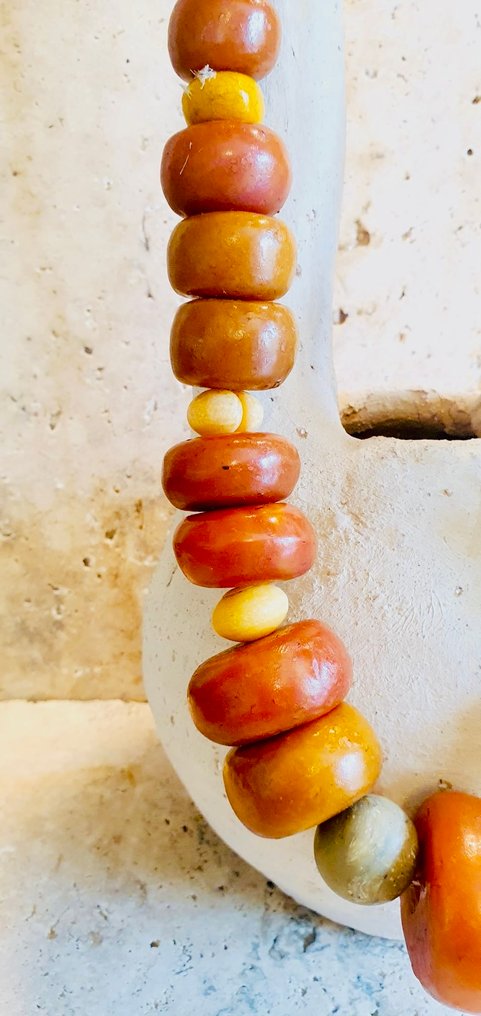
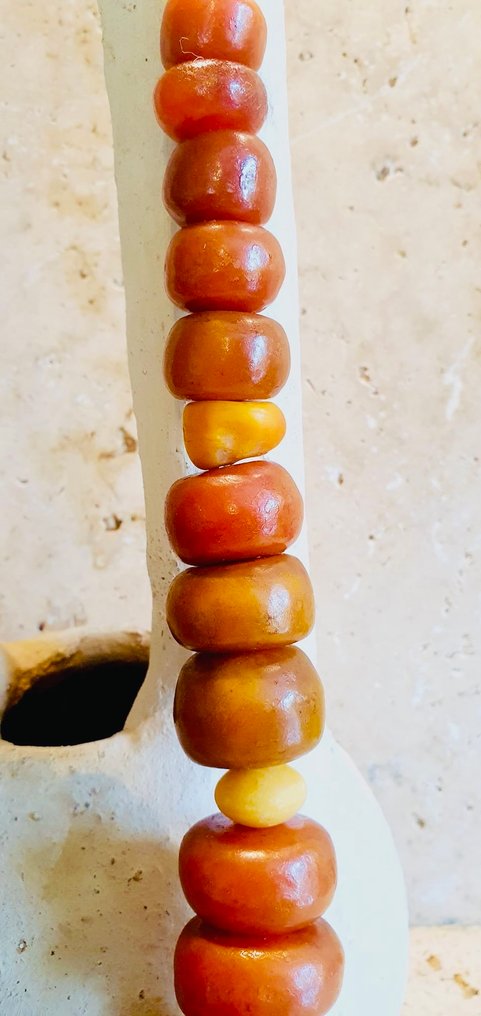
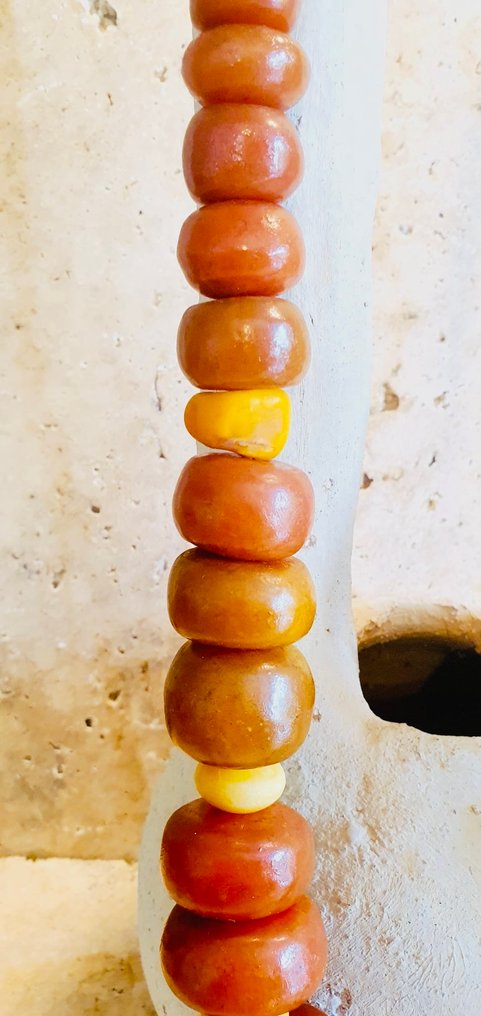
Berber amber phenolic resin - Necklace


00
days
23
hours
50
minutes
53
seconds
Current bid
€ 104
Reserve price met

Expert
Selected by Jonas Rathaj
Has worked with taxidermy since childhood and gained retailer experience.
Estimate € 150 - € 200
10 other people are watching this object
 Bidder 2466 Bidder 2466 | €104 | |
|---|---|---|
 Bidder 2982 Bidder 2982 | €99 | |
| Bidder 2466 | €94 | |
Catawiki Buyer Protection
Your payment’s safe with us until you receive your object.View details
Trustpilot 4.4 | 123253 reviews
Rated Excellent on Trustpilot.
Description from the seller
Magnificent traditional and genuine Berber necklace made of Berber amber dating from the second half of the 20th century.
The Berber necklace is much more than a simple fashion accessory; it is a symbol rich in the history and culture of the Berbers, an indigenous people of North Africa.
Traditionally worn by Berber women, this necklace is often made with local materials.
Each Berber necklace is unique, reflecting the craftsmanship and know-how passed down through generations. The patterns and colors used can vary depending on the region and the Berber tribe from which it originates.
Beyond their aesthetic appeal, Berber necklaces often hold social and cultural significance. They can be worn during traditional ceremonies, weddings, or other important events, symbolizing identity and belonging to a specific community.
The making of a Berber necklace often involves a meticulous process, ranging from material selection to traditional techniques such as lost-wax casting to create unique and beautiful pieces.
Because of their cultural importance and artistic beauty, Berber necklaces are often kept as precious objects and passed down from generation to generation. They are also still proudly worn by many Berber women, thus perpetuating a millennia-old tradition and a unique form of cultural expression.
Berber necklace in amber Berber or alternatively called phenolic resin dating from the mid-20th century comes directly from Morocco.
- Material: Berber amber (phenolic resin) and bronze.
- Weight: approximately 424 grams.
- Dimensions: 60 cm from pearl to pearl.
Mid-20th century.
- Provenance: Morocco.
Support: Not included
Shipping method: colissimo.
Seller's Story
We have been meteorite hunters for a long time. Passionate about these objects which are pieces of interplanetary space, we are delighted to be able to offer, through our collections, exceptional pieces, which everyone can obtain to have a part of the sky in the palm of their hand.
Have you ever observed the Milky Way? Have you ever observed a shooting star? Have you ever wondered where this one fell? In any case, we do and were even able to collect some by hand to send them directly to your home.
Each of our meteorites is unique and carefully selected before sale, cleaned, often treated, sometimes sliced and sometimes polished using specific equipment.
Based in France, we provide meteorites from many different countries across the planet. These objects have traveled staggering distances to end up on our shelves and perhaps even in your home.
We provide certificates of authenticity for each piece.
We make it a point of honor to offer quality batches, sent carefully and quickly across Europe with a tracking number.
Translated by Google TranslateMagnificent traditional and genuine Berber necklace made of Berber amber dating from the second half of the 20th century.
The Berber necklace is much more than a simple fashion accessory; it is a symbol rich in the history and culture of the Berbers, an indigenous people of North Africa.
Traditionally worn by Berber women, this necklace is often made with local materials.
Each Berber necklace is unique, reflecting the craftsmanship and know-how passed down through generations. The patterns and colors used can vary depending on the region and the Berber tribe from which it originates.
Beyond their aesthetic appeal, Berber necklaces often hold social and cultural significance. They can be worn during traditional ceremonies, weddings, or other important events, symbolizing identity and belonging to a specific community.
The making of a Berber necklace often involves a meticulous process, ranging from material selection to traditional techniques such as lost-wax casting to create unique and beautiful pieces.
Because of their cultural importance and artistic beauty, Berber necklaces are often kept as precious objects and passed down from generation to generation. They are also still proudly worn by many Berber women, thus perpetuating a millennia-old tradition and a unique form of cultural expression.
Berber necklace in amber Berber or alternatively called phenolic resin dating from the mid-20th century comes directly from Morocco.
- Material: Berber amber (phenolic resin) and bronze.
- Weight: approximately 424 grams.
- Dimensions: 60 cm from pearl to pearl.
Mid-20th century.
- Provenance: Morocco.
Support: Not included
Shipping method: colissimo.
Seller's Story
We have been meteorite hunters for a long time. Passionate about these objects which are pieces of interplanetary space, we are delighted to be able to offer, through our collections, exceptional pieces, which everyone can obtain to have a part of the sky in the palm of their hand.
Have you ever observed the Milky Way? Have you ever observed a shooting star? Have you ever wondered where this one fell? In any case, we do and were even able to collect some by hand to send them directly to your home.
Each of our meteorites is unique and carefully selected before sale, cleaned, often treated, sometimes sliced and sometimes polished using specific equipment.
Based in France, we provide meteorites from many different countries across the planet. These objects have traveled staggering distances to end up on our shelves and perhaps even in your home.
We provide certificates of authenticity for each piece.
We make it a point of honor to offer quality batches, sent carefully and quickly across Europe with a tracking number.
Translated by Google TranslateDetails
Era
1900-2000
Metal
Berber amber phenolic resin
Total weight
424 g
Condition
Very good condition - slightly used with small signs of wear
Ethnic group/ culture
Berbère
Country of Origin
Morocco
Sold with stand
No
Length
60 cm
Sold by
Disclaimer
Catawiki always aims to offer you the best possible buying experience. Our experts virtually review and select every object in line with our submission guidelines. While we strive to provide a detailed description and photographs of each jewellery object, discrepancies or inaccuracies may occur. It is your responsibility to review all of the information provided about an object, including the condition and description, before placing an order. Sellers are responsible for the information, pictures and description provided, including the quality, quantity and nature of the jewelry supplied. A small imperfection that cannot be seen in the photo but is included in the description is not a non-conformity. A Lab Report is not a guarantee, valuation or appraisal regarding the articles described therein. A Lab Report contains only the characteristics of an article described after it has been graded, tested, examined, and analyzed using the techniques and equipment used at the time of the examination from that specific Lab. The results of any other examination performed on the article may differ depending when, how, by whom and with which grading standard the article is examined. In addition, any changes and improvements in techniques and equipment that may have occurred which may enable the examiner to detect, among other things, the use of processes for altering the characteristics of an article which use was previously undetectable, does not automatically mean the object does not conform to its description.
Catawiki always aims to offer you the best possible buying experience. Our experts virtually review and select every object in line with our submission guidelines. While we strive to provide a detailed description and photographs of each jewellery object, discrepancies or inaccuracies may occur. It is your responsibility to review all of the information provided about an object, including the condition and description, before placing an order. Sellers are responsible for the information, pictures and description provided, including the quality, quantity and nature of the jewelry supplied. A small imperfection that cannot be seen in the photo but is included in the description is not a non-conformity. A Lab Report is not a guarantee, valuation or appraisal regarding the articles described therein. A Lab Report contains only the characteristics of an article described after it has been graded, tested, examined, and analyzed using the techniques and equipment used at the time of the examination from that specific Lab. The results of any other examination performed on the article may differ depending when, how, by whom and with which grading standard the article is examined. In addition, any changes and improvements in techniques and equipment that may have occurred which may enable the examiner to detect, among other things, the use of processes for altering the characteristics of an article which use was previously undetectable, does not automatically mean the object does not conform to its description.