Cartel clock Louis XV In 'Bleu Céleste' martin varnish (Height 84cm) - Around 1765



03
days
19
hours
10
minutes
09
seconds
Current bid
€ 501
Reserve price not met

Expert
Selected by Paula Martin-Calero Toro
Holds a degree in art history; over six years cataloguing and appraising antiques.
Estimate € 3,500 - € 4,000
36 other people are watching this object
 Bidder 4898 Bidder 4898 | €501 | |
|---|---|---|
 Bidder 0048 Bidder 0048 | €1 |
Catawiki Buyer Protection
Your payment’s safe with us until you receive your object.View details
Trustpilot 4.4 | 123113 reviews
Rated Excellent on Trustpilot.
Antique Louis XV–Louis XVI transition cartel clock from Paris, circa 1765, in vernis Martin Bleu Céleste with rocaille gilt bronze ornamentation, violonè shaped case, 84 × 47 × 18 cm, 8-day mechanical movement with anchor escapement, two-bell quarter striking, winding key included, in excellent condition and in working order.
AI-assisted summary
Description from the seller
Magnificent clock from the Louis XV - Louis XVI transition period in Martin varnish with a sky blue background, gilded rocaille bronzes with flambeaux, and a striking mechanism on two bells.
This superb and rare violoné cartel, dating from the third quarter of the 18th century (around 1760-1775), is an authentic example from the transitional period between the Louis XV and Louis XVI styles. It comes from Parisian workshops specialized in painted cases and elegantly combines rococo exuberance with emerging neoclassical accents.
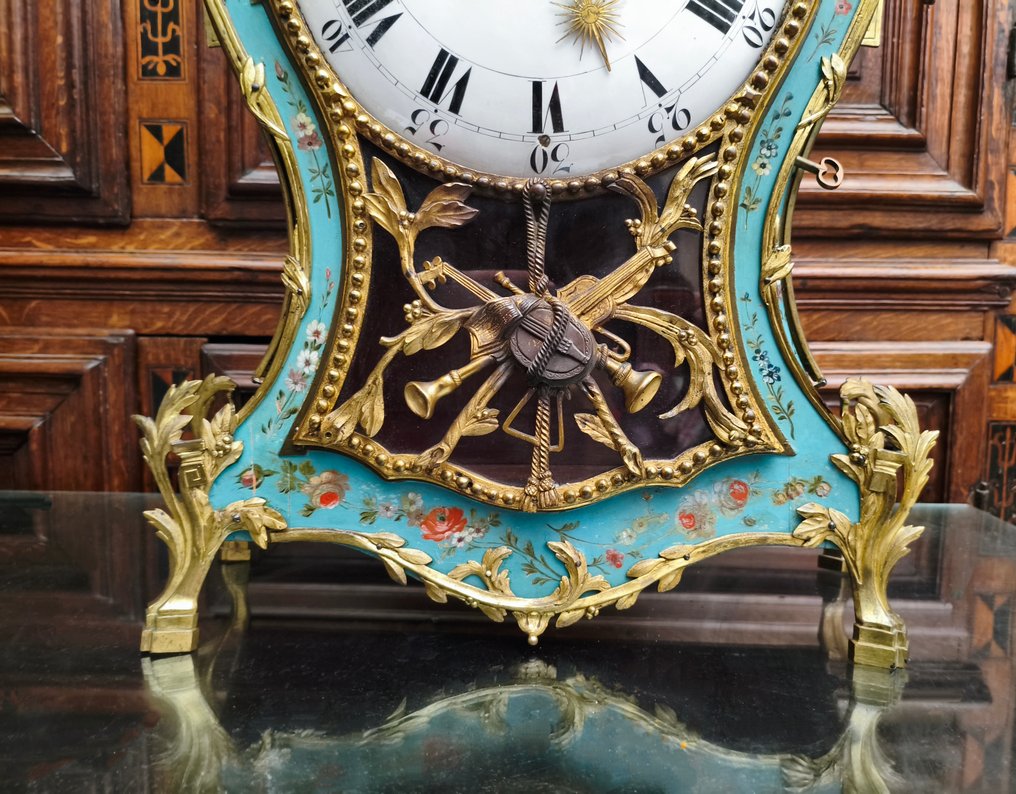
The case features a characteristic violin-shaped form typical of rocaille, with flared sides where the front face is narrower than the back face, creating an effect of depth and elegant perspective. It is entirely covered with a Martin varnish on a celestial blue background. The base is decorated with polychrome flowers painted by hand, including roses, delicate bouquets, and scattered floral motifs with exemplary finesse.
The sides are equipped with hinged panels in gilded bronze, intricately chiseled, in the form of honeycomb lattice grilles that allow for optimal sound diffusion of the bell while adding a refined decorative touch.
The ornamentation is particularly rich in finely chiseled and gold leaf gilded bronzes, including asymmetrical volutes, scrolls, fluttering acanthus leaves, and flowering branches inherited from the Louis XV style, but also stylized torches on the sides, foreshadowing the neoclassical motifs of the Louis XVI period. The top is crowned with a classical urn.
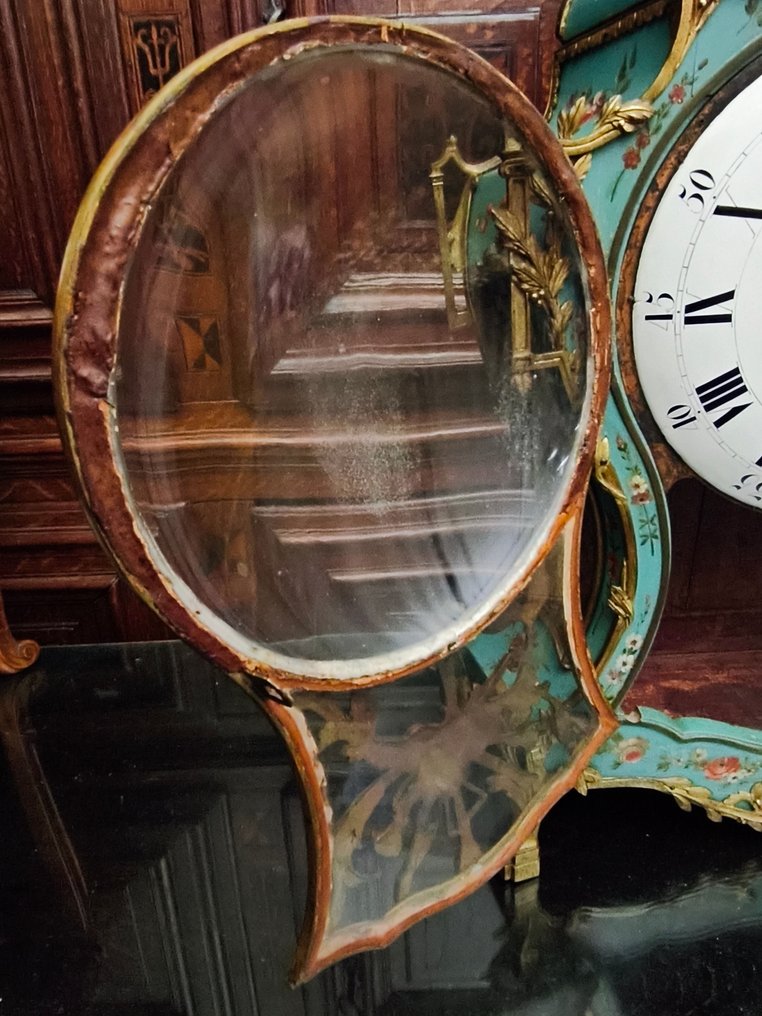
The clock's door is made of two panes of glass, with the main one being convex (bulging, for an elegant magnifying effect on the pendulum). This door features an original pattern of crossed musical trophies (trumpets, drum, and ribbons), a charming and uncommon detail. It is equipped with a functional spring lock located on the right side of the case, allowing secure access to the movement while preserving the aesthetic.
The white enamel dial features black Roman numerals for the hours and Arabic numerals for the minutes, with openwork hands in gilded bronze representing radiant suns. Authentic small signs of wear on the enamel, such as fine scratches and a patina of age, attest to its age.
The original Parisian movement features an anchor escapement with a blade suspension and a lenticular balance wheel. It presents a rare and luxurious complication: a striking mechanism with two superimposed bells (a deep bell for the hours, a high-pitched bell for the quarters), with a quarter repeater activated by a pull cord (visible on the back plate above the engraving 'A H,' likely the workshop initials). This system, ideal for a 'bedside clock,' allowed the time to be known in darkness by pulling a cord (absent today but easily restorable).
The movement is functional but deserves maintenance for optimal operation.
a remarkable state for its time
With its vintage lock key and winding keys.
Magnificent clock from the Louis XV - Louis XVI transition period in Martin varnish with a sky blue background, gilded rocaille bronzes with flambeaux, and a striking mechanism on two bells.
This superb and rare violoné cartel, dating from the third quarter of the 18th century (around 1760-1775), is an authentic example from the transitional period between the Louis XV and Louis XVI styles. It comes from Parisian workshops specialized in painted cases and elegantly combines rococo exuberance with emerging neoclassical accents.
The case features a characteristic violin-shaped form typical of rocaille, with flared sides where the front face is narrower than the back face, creating an effect of depth and elegant perspective. It is entirely covered with a Martin varnish on a celestial blue background. The base is decorated with polychrome flowers painted by hand, including roses, delicate bouquets, and scattered floral motifs with exemplary finesse.
The sides are equipped with hinged panels in gilded bronze, intricately chiseled, in the form of honeycomb lattice grilles that allow for optimal sound diffusion of the bell while adding a refined decorative touch.
The ornamentation is particularly rich in finely chiseled and gold leaf gilded bronzes, including asymmetrical volutes, scrolls, fluttering acanthus leaves, and flowering branches inherited from the Louis XV style, but also stylized torches on the sides, foreshadowing the neoclassical motifs of the Louis XVI period. The top is crowned with a classical urn.
The clock's door is made of two panes of glass, with the main one being convex (bulging, for an elegant magnifying effect on the pendulum). This door features an original pattern of crossed musical trophies (trumpets, drum, and ribbons), a charming and uncommon detail. It is equipped with a functional spring lock located on the right side of the case, allowing secure access to the movement while preserving the aesthetic.
The white enamel dial features black Roman numerals for the hours and Arabic numerals for the minutes, with openwork hands in gilded bronze representing radiant suns. Authentic small signs of wear on the enamel, such as fine scratches and a patina of age, attest to its age.
The original Parisian movement features an anchor escapement with a blade suspension and a lenticular balance wheel. It presents a rare and luxurious complication: a striking mechanism with two superimposed bells (a deep bell for the hours, a high-pitched bell for the quarters), with a quarter repeater activated by a pull cord (visible on the back plate above the engraving 'A H,' likely the workshop initials). This system, ideal for a 'bedside clock,' allowed the time to be known in darkness by pulling a cord (absent today but easily restorable).
The movement is functional but deserves maintenance for optimal operation.
a remarkable state for its time
With its vintage lock key and winding keys.
Details
Over 200 years old
Yes
Specific region of origin
Paris
Style subtype
Louis XV
Era
1400-1900
Clock type
Cartel clock
Material
In 'Bleu Céleste' martin varnish (Height 84cm)
Clock mechanism
Mechanical
Power Reserve
8 day movement
Striking
Quarter-hour chime, two bells.
Style
Antique
Country of Origin
France
Condition
Excellent condition: barely used with minimal signs of wear
In working order
Yes
Height
84 cm
Width
47 cm
Depth
18 cm
Estimated period
Around 1765
Weight
15 kg
Winding Key
Yes
Sold by