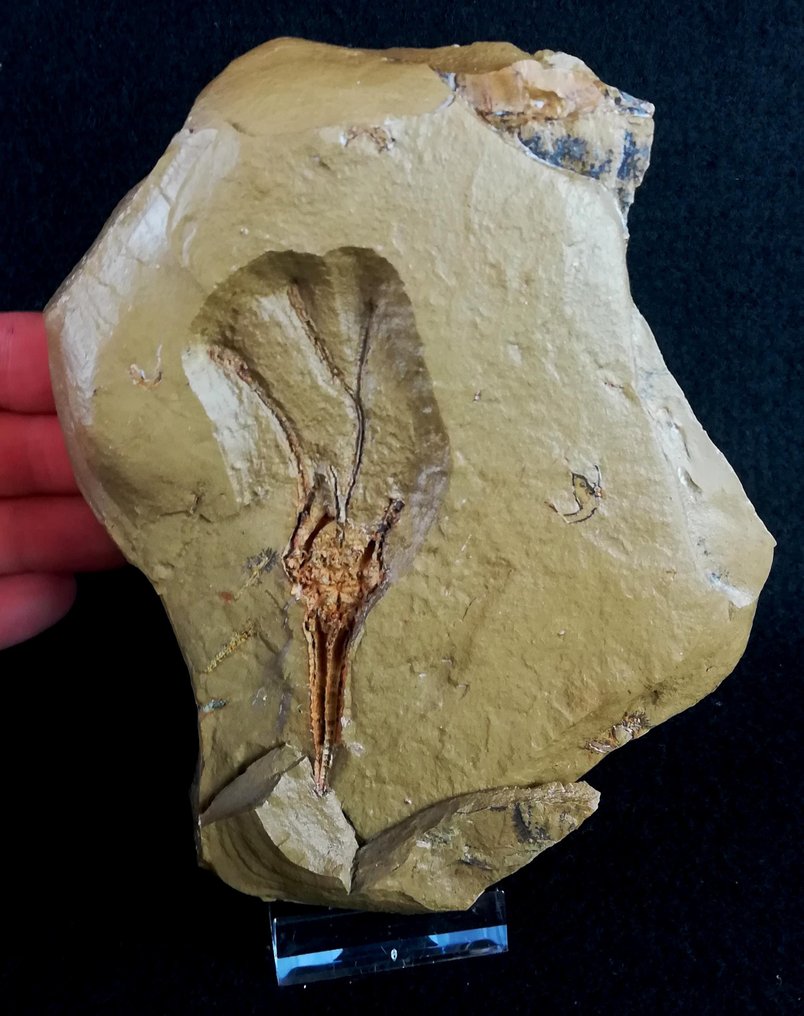
Mysterious primitive crinoid!!! – extremely rare - Fossilised animal - Pareocrinus ljubzovi (Yakolev, 1956) - 14.5 cm - 13 cm



07
days
05
hours
27
minutes
26
seconds

5 other people are watching this object
 Bidder 2913 Bidder 2913 | €50 |
|---|
Catawiki Buyer Protection
Your payment’s safe with us until you receive your object.View details
Trustpilot 4.4 | 123053 reviews
Rated Excellent on Trustpilot.
Pareocrinus ljubzovi (Yakolev, 1956), a very rare primitive crinoid specimen from the Lower Ordovician Fezouata Formation at Zagora, Morocco, with a complete short stem in natural condition, weighing 657 g and measuring 14.5 × 13 × 2 cm.
AI-assisted summary
Description from the seller
Spectacular crinoid from the group Crinoidea. It is probably the species Pareocrinus ljubzovi, although this group has not yet been reviewed in the Fezouata Formation. This crinoid preserves all parts of the animal in great detail and has a very short stalk. The stalk is complete.
This specimen is extremely rare; very few specimens have been found. The contrast of the fossil with the matrix is spectacular. The extraordinary preservation of the fossils allows for detailed observation of the delicate structures of the enigmatic animal. A specimen worthy of a Museum.
Plastic supports included.
Pareocrinus measurements: 85 x 25 mm
Plaque: 657 g; 14.5 x 13 x 2 cm
The Fezouata formation sites, near the Moroccan city of Zagora, are providing a rich and diverse record of fossils with extraordinary preservation, often including soft tissues or soft-bodied animals. This type of preservation is similar, although later in time, to that of the famous Burgess Shale site (Canada).
These are fossils dating from between 480 and 472 million years ago. At that time, Morocco was an ocean and was located over the South Pole.
Spectacular crinoid from the group Crinoidea. It is probably the species Pareocrinus ljubzovi, although this group has not yet been reviewed in the Fezouata Formation. This crinoid preserves all parts of the animal in great detail and has a very short stalk. The stalk is complete.
This specimen is extremely rare; very few specimens have been found. The contrast of the fossil with the matrix is spectacular. The extraordinary preservation of the fossils allows for detailed observation of the delicate structures of the enigmatic animal. A specimen worthy of a Museum.
Plastic supports included.
Pareocrinus measurements: 85 x 25 mm
Plaque: 657 g; 14.5 x 13 x 2 cm
The Fezouata formation sites, near the Moroccan city of Zagora, are providing a rich and diverse record of fossils with extraordinary preservation, often including soft tissues or soft-bodied animals. This type of preservation is similar, although later in time, to that of the famous Burgess Shale site (Canada).
These are fossils dating from between 480 and 472 million years ago. At that time, Morocco was an ocean and was located over the South Pole.
Details
Number of items
1
Specimen
Mysterious primitive crinoid!!! – extremely rare
Scientific name
Pareocrinus ljubzovi (Yakolev, 1956)
Country of Origin
Bou Chrebeb, Zagora, Morocco
Geological Period
Lower Ordovician, Tremadocian - Fezouata formation
Condition
Natural
Weight
657 g
Height
14.5 cm
Width
13 cm
Depth
2 cm