Superb mask - galoa - Gabon (No reserve price)



05
days
04
hours
51
minutes
09
seconds

No bids placed
Catawiki Buyer Protection
Your payment’s safe with us until you receive your object.View details
Trustpilot 4.4 | 122910 reviews
Rated Excellent on Trustpilot.
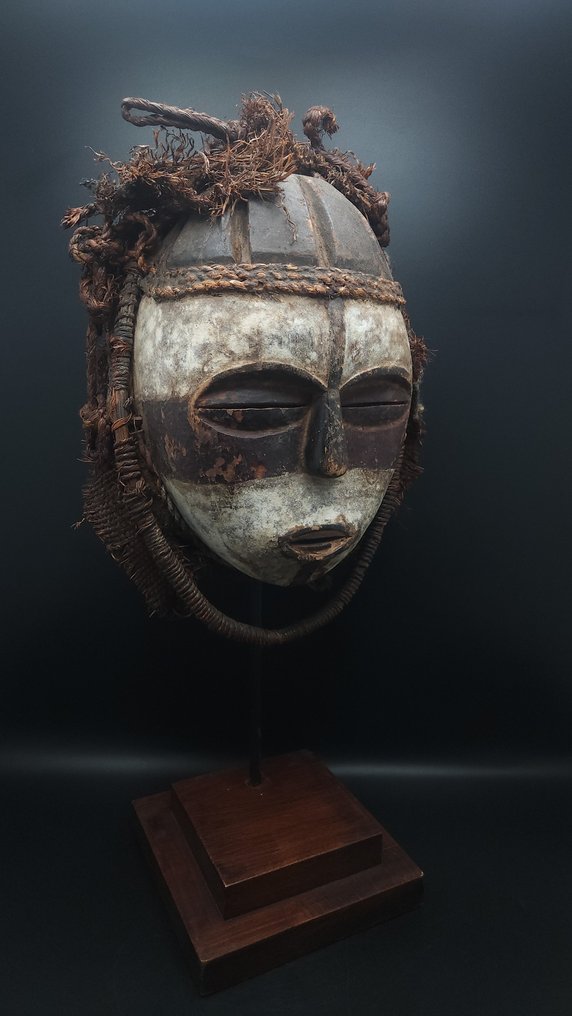
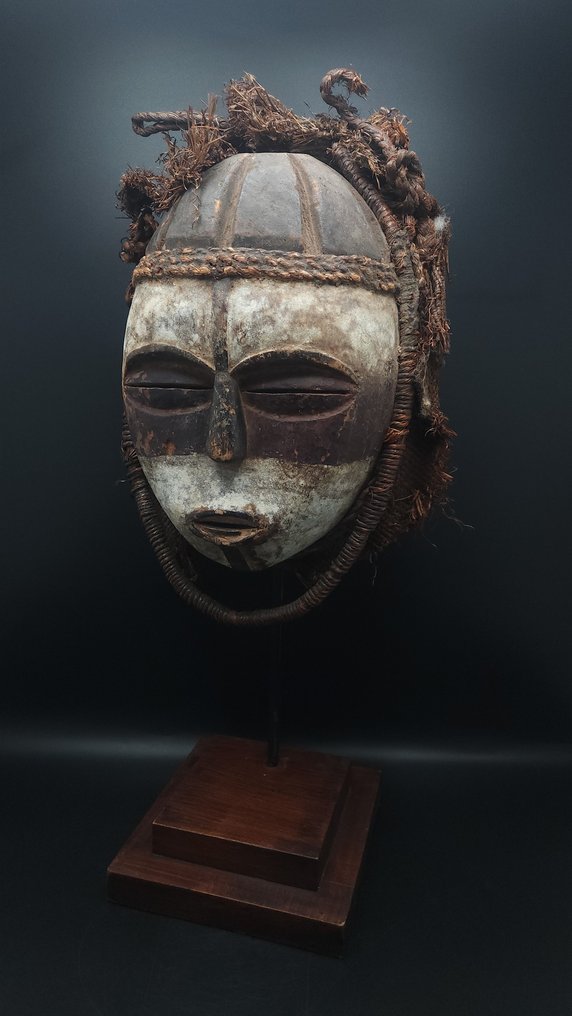
Funerary mask of the Galoa (Galwa) from Gabon, carved in wood and raphia, measuring 29 × 20 × 15 cm, dating to 2000–2010, in good condition.
AI-assisted summary
Description from the seller
Funerary Mask - Galoa / Galwa - Gabon
The Galoa (or Galwas) are a Gabonese ethnic group located downstream of Lambaréné on the lower course of the Ogooué River.
They are part of the Myènè group.
Their masks are not very diverse, generally round, painted in black, red, and white in opposite quarters. This style of face painting is also found among the neighboring Aduma.
The most famous masks of the Galoa are those belonging to the Okukwé society. These, flat and oval, feature a well-recognized painted decoration with a pattern of opposing triangles on the forehead and chin; half-closed eyes, a straight nose, and perfect symmetry in their construction.
This society had a judicial character, with the mirror on the forehead of the mask possibly interpreted as a third eye capable of spotting troublemakers.
According to Louis Perrois (in Art ancestral du Gabon), the mask dance.
Funerary Mask - Galoa / Galwa - Gabon
The Galoa (or Galwas) are a Gabonese ethnic group located downstream of Lambaréné on the lower course of the Ogooué River.
They are part of the Myènè group.
Their masks are not very diverse, generally round, painted in black, red, and white in opposite quarters. This style of face painting is also found among the neighboring Aduma.
The most famous masks of the Galoa are those belonging to the Okukwé society. These, flat and oval, feature a well-recognized painted decoration with a pattern of opposing triangles on the forehead and chin; half-closed eyes, a straight nose, and perfect symmetry in their construction.
This society had a judicial character, with the mirror on the forehead of the mask possibly interpreted as a third eye capable of spotting troublemakers.
According to Louis Perrois (in Art ancestral du Gabon), the mask dance.
Details
Indigenous object name
Superb mask
No. of items
1
Ethnic group/ culture
galoa
Country of Origin
Gabon
Period
2000-2010
Material
wood and raphia
Sold with stand
No
Condition
Good condition
Height
29 cm
Width
20 cm
Depth
15 cm
