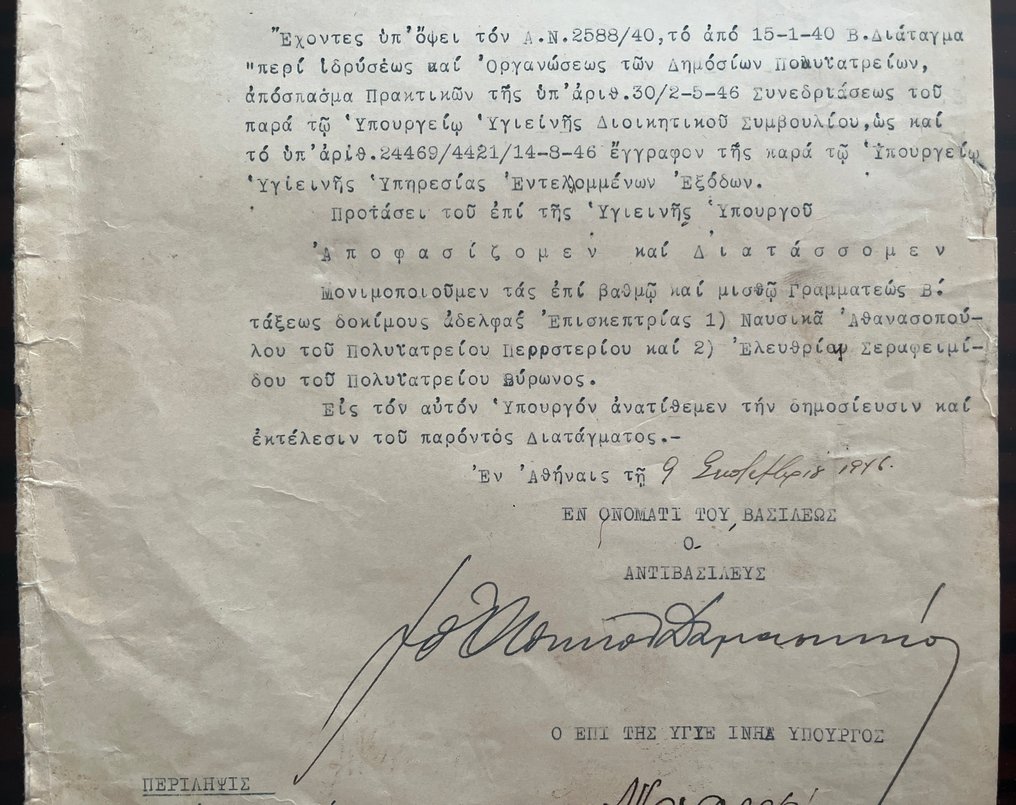
King George II of Greece, Signed by Regent of Greece Archbishop Damaskinos - Royal Decree, Athens - 1946




08
days
20
hours
51
minutes
17
seconds

8 other people are watching this object
 Bidder 0947 Bidder 0947 | €20 |
|---|
Catawiki Buyer Protection
Your payment’s safe with us until you receive your object.View details
Trustpilot 4.4 | 123053 reviews
Rated Excellent on Trustpilot.
Original Greek-language royal decree from Athens, 1946, a single, autographed historical document signed by Regent Archbishop Damaskinos and Minister Alexandros Kalatzakos, 34 cm by 22 cm, in good condition.
AI-assisted summary
Description from the seller
Constantine King of Greece and the Establishment of the Ministry of Health (WWII Era)
Historical Document:
Type: Original Royal Decree
Date: September 9, 1946
Location: Athens
Signatures: Handwritten signatures of Regent Archbishop Damaskinos and Minister of Health Alexandros Kalatzakos
Dimensions: 34cm x 22cm
Pages: 4
This decree marks a significant administrative milestone in Greece’s post-World War II reconstruction, specifically the formal establishment of the Ministry of Health, vital for rebuilding Greece’s healthcare system after the turmoil of war and occupation.
Historical Context of Greek Monarchy & Political Climate:
King George II:
Born July 19, 1890
Reigned: 27 September 1922 – 25 March 1924, and again from 25 November 1935 until his death on 1 April 1947
Son of Constantine I and Princess Sophia of Prussia
His reign was interrupted by exile, political upheavals, and a brief abolition of the monarchy
Timeline of Key Events:
1917: Exile following the National Schism; his younger brother Alexander becomes king
1920: Restoration of Constantine I after Alexander’s death
1923: Greco-Turkish War leads to instability; Constantine I is exiled after a failed royalist coup
March 1924: Greece becomes a republic; Constantine is formally deposed and loses Greek nationality
1935: Monarchy restored via referendum; Constantine resumes his royal duties
1936: Supports Ioannis Metaxas’ dictatorship (4th of August Regime)
1946: Greek monarchy restored amidst post-war reconstruction efforts
Archbishop Damaskinos Papandreou:
Born Dimitrios Papandreou (1891–1949)
Served as Archbishop of Athens from 1941 to 1949
Acted as Regent of Greece from 1944 (post-German occupation withdrawal) until 1946
Played a pivotal role during Greece’s transition from occupation to civil unrest
Alexandros Kalantzakos, née Aristides (1887[1] - 1976) was a Greek physician and politician. He served as a member of parliament and minister.
Significance:
The royal decree of 1946 reflects Greece’s efforts to reestablish its governmental institutions after the devastation of WWII and the occupation. The creation of the Ministry of Health was a critical step in rebuilding the nation’s healthcare infrastructure, with notable figures like Alexandros Kalatzakos contributing significantly to this process.
Constantine King of Greece and the Establishment of the Ministry of Health (WWII Era)
Historical Document:
Type: Original Royal Decree
Date: September 9, 1946
Location: Athens
Signatures: Handwritten signatures of Regent Archbishop Damaskinos and Minister of Health Alexandros Kalatzakos
Dimensions: 34cm x 22cm
Pages: 4
This decree marks a significant administrative milestone in Greece’s post-World War II reconstruction, specifically the formal establishment of the Ministry of Health, vital for rebuilding Greece’s healthcare system after the turmoil of war and occupation.
Historical Context of Greek Monarchy & Political Climate:
King George II:
Born July 19, 1890
Reigned: 27 September 1922 – 25 March 1924, and again from 25 November 1935 until his death on 1 April 1947
Son of Constantine I and Princess Sophia of Prussia
His reign was interrupted by exile, political upheavals, and a brief abolition of the monarchy
Timeline of Key Events:
1917: Exile following the National Schism; his younger brother Alexander becomes king
1920: Restoration of Constantine I after Alexander’s death
1923: Greco-Turkish War leads to instability; Constantine I is exiled after a failed royalist coup
March 1924: Greece becomes a republic; Constantine is formally deposed and loses Greek nationality
1935: Monarchy restored via referendum; Constantine resumes his royal duties
1936: Supports Ioannis Metaxas’ dictatorship (4th of August Regime)
1946: Greek monarchy restored amidst post-war reconstruction efforts
Archbishop Damaskinos Papandreou:
Born Dimitrios Papandreou (1891–1949)
Served as Archbishop of Athens from 1941 to 1949
Acted as Regent of Greece from 1944 (post-German occupation withdrawal) until 1946
Played a pivotal role during Greece’s transition from occupation to civil unrest
Alexandros Kalantzakos, née Aristides (1887[1] - 1976) was a Greek physician and politician. He served as a member of parliament and minister.
Significance:
The royal decree of 1946 reflects Greece’s efforts to reestablish its governmental institutions after the devastation of WWII and the occupation. The creation of the Ministry of Health was a critical step in rebuilding the nation’s healthcare infrastructure, with notable figures like Alexandros Kalatzakos contributing significantly to this process.
Details
Era
1900-2000
Subject
History
Number of Books
1
Height
34 cm
Signed By
Regent of Greece Archbishop Damaskinos
Width
22 cm
Author/ Illustrator
King George II of Greece, Signed by Regent of Greece Archbishop Damaskinos
Title
Royal Decree, Athens
Condition
Good
Year
1946
Language
Greek
Original language
Yes
Extras
Signed by author
Country of Origin
Greece
Autographed by a famous person
Yes
Details signature
Original
Has Certificate of Authenticity
No
Sold by