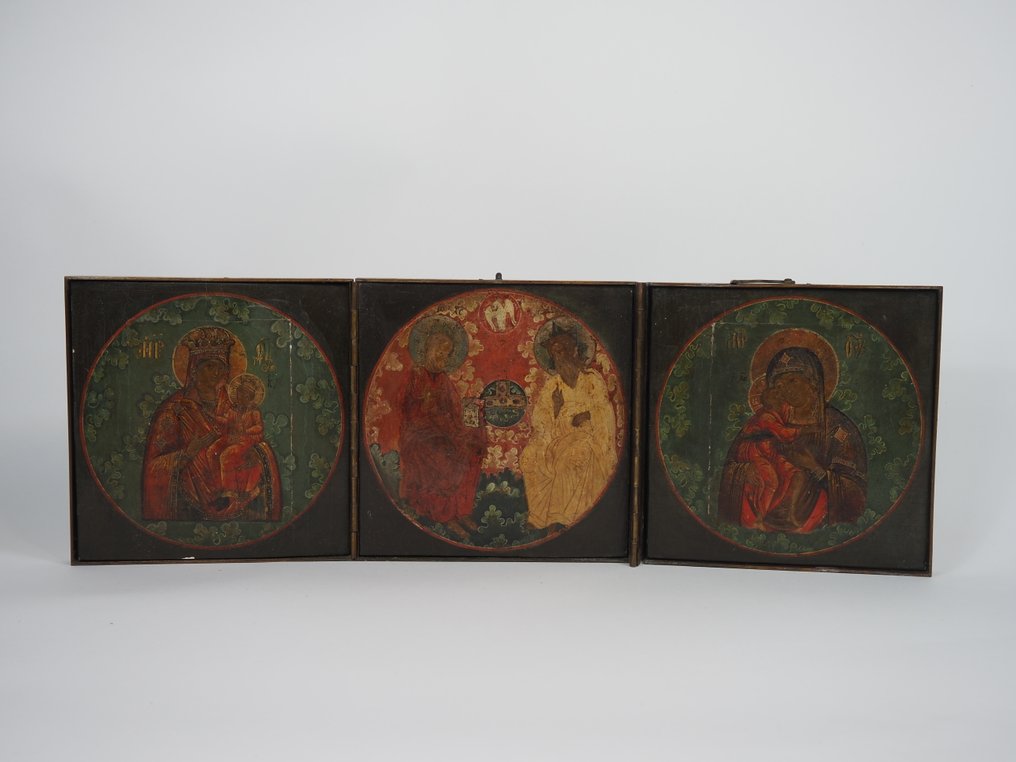
Icon - Triptych with Holy Trinity and two icons of the mother of God - Wood, Brass - Russia



05
days
06
hours
49
minutes
38
seconds
Current bid
€ 550
Reserve price not met

Expert
Selected by Clément Floch
Has 20 years of experience trading curios, including 15 years with a leading French dealer.
Estimate € 2,500 - € 3,000
25 other people are watching this object
 Bidder 5791 Bidder 5791 | €550 | |
|---|---|---|
 Bidder 8346 Bidder 8346 | €500 | |
 Bidder 8867 Bidder 8867 | €8 | |
Catawiki Buyer Protection
Your payment’s safe with us until you receive your object.View details
Trustpilot 4.4 | 123779 reviews
Rated Excellent on Trustpilot.
Description from the seller
# religiouscollection
Triptych with the Holy Trinity of God the Father, Christ the Son and the Holy Spirit and two icons of the Mother of God
Old Believers workshop, probably Murom (Region Vladimir)
Icons of the Mother of God as vrezka (inlay) made in the second half 18th century
Composition into a triptych and icon of the Trinity
Copper casket with clasp. Put together with the Holy Trinity in the 19th century. (see description below)
Egg tempera on wood
Dimensions open: 54,5 x 18,5 x 1,8 cm
Dimensions folded: 18,5 x 18,5 x 5,7 cm
Iconographical description
In three beautifully decorated copper caskets, mounted with hinges are three small icons brought together.
All three are in roundels against a dark olive green background.
The two icons of the Mother of God on the side panels are painted against a blue background, the middle icon of the Trinity is painted against a red background. The decoration looks like oak leaves.
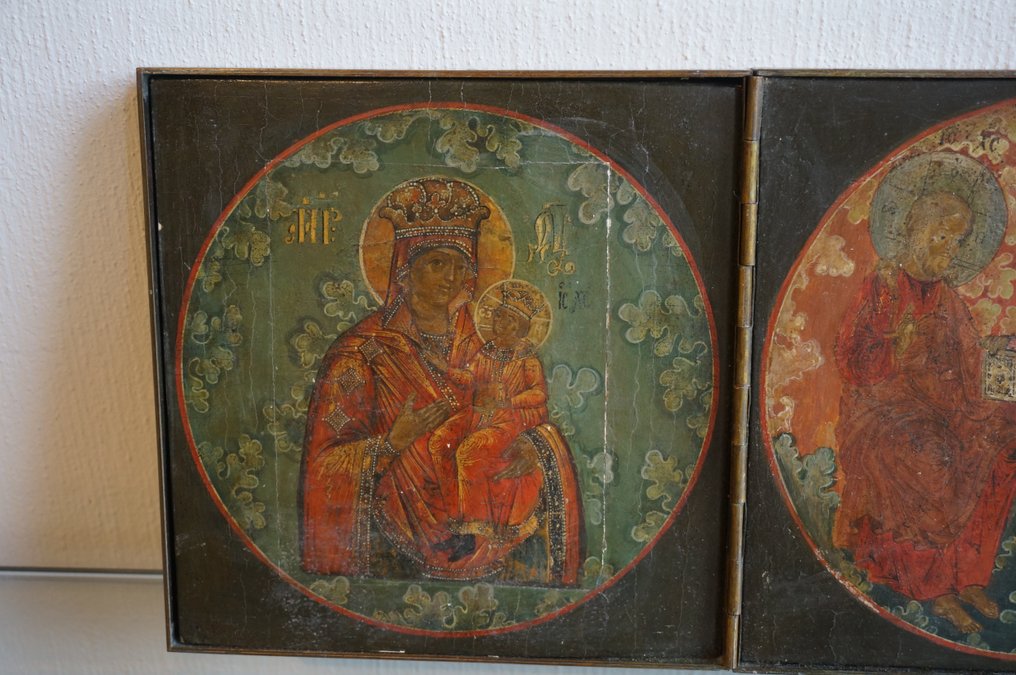
Mother of God Hodegetria
The first icon shows the Mother of God Hodegetria, the One Who Shows the Way. This is one of the main iconographical types of the icons of the Mother of God.
According to the legend the evangelist Luke wrote/painted the first icon. In the fifth century the icon was taken tot he capital of Christianity, Constantinople. There a special church was built in the monastery of Hodegon. Many times the Mother of God saved the city. The icon was placed on the citywalls and enemies went home. Unfortunately the icon was lost, maybe demolished, during the fall of COnstantinople in 1453. But many miracleworking copies had been made already, so the power was not lost.
The Mother of God bears the Child on het left arm and she points to Christ with her right hand. Christ is the Way, according to the Gospel of John 14,6. . The Greek letters MR THOU, calligraphed next to her head are abbreviations for Mother of God. The letters IC XC just beneath are also Greek abbreviations for the name of Jesus Christ.
Mother and Son are both crowned als Queen and King. As a Queen of Heaven and mother of a King the Mother of God is dressed in a purple robe, as is also the secular Empress in the Roman and Byzantine world.
On the shoulder os the Mother of God are three diamond-shaped ornaments. These are normally situated on her head and both shoulders. Probably the painter of the icon wanted to leave all three ornaments visible and therefore painted them one below the other on the right sleeve. The three ornaments originate from secular clothing. They are ‘translations’ of the fibulae (decorative pins) with which the cloths are hold together. In East Christian iconography they got a special meaning, invented by churchfaters. The three ornaments symbolize the Trinity, which is already present in the Mother of God.
Holy Trinity
In the center is the icon of this Holy Trinity. God the Father and Jesus Christ the Son are placed opposite eachother. In between is the dove, symbol of the Holy Spirit. The Three are grouped around the globe, symbolizing the entire world, over which they rule.
Christ is dressed in the red majestic garment and makes a blessing gesture with his right hand. On his knee he holds a Gospel book. Around the head of Christ is a cross nimb. Each of the three visible cross beams is composed out of three lines. These symbolize the Trinity. In the cross nimb is written in Greek ‘The One Who Is’.
God the Father is dressed in a white garment and wears a long gray beard, according to the vision of the prophet Daniel (Daniel 7:9,13,22). He blesses too.
Around the head of God is a faintly visible red and blue coloured eight-pointed star. Seven points symbolize heaven and earth, but also the times. Six times already passed, we are living in the seventh time and are waiting for the eight. This eight time is the eternal time of consummation.
Mother of God Feodorovskaya
The third icon shows again the Mother of God and Christ, but now in the iconography of the Mother of God of Tenderness. Mother and Child are connected to eachother by their cheeks. And the Child puts its arm around his Mother’s neck. The visible naked leg of Christ is one of the characteristics of this particular iconography, that bears the name ‘Mother of God Feodorovskaya’, that means Mother of God of Theodore.
The original icon was found in a tree in the forest by a prince of Kostroma on August 16, 1239.As he wanted to take the icon from the tree the icon rose up into the heaven. After long prayers of the inhabitants of Kostroma the icon could be removed from the tree and brought to the Assumption Cathedral. The church was destroyed in a fire, but the icon survived. People from Gorodets heard from the miracle and realized that the icon was originally from their church, dedicated to saint Theodore Stratelates. Moreover they had seen a vision of the saint with the icon, now named Feodorovskaya. The icon was kept in Kostroma and Tsar Michael Romanov (also from Kostroma) venerated the icon deeply. His mother donated him a copy of the icon as a eternal protector of the dynasty of the Romanovs. The original icon, many times overpainted and affected by fires, is still venerated in Kostroma.
The here described icon is also a true copy of the original from the 13th century. Here we can see two of the three ornaments on the dress of the Mother of God . One on her head and one on the shoulder. The third ornament, symbolizing Christ, is hidden behind Him. It is not necessary to paint the symbol, as the true person is there.
The names are the same as on the icon opposite: MR THOU for Mother of God, IC XC for Jesus Christ and Ho OoN, partly visible in the crossnimb of Christ.
Technical description
The two icons of the Mother of God are taken from another, 18th century icon. As can be seen they are sawn out squarely. Those small squares are placed in a new wooden plank. After this the cracks are closed and the background is newly painted. So the icons got the same appearance. The central icon is painted directly onto a square panel. The crossbar, which should prevent the wood from warping, is still visible at the rear.
The exact history of this triptych is not known. But in the 19th century the owner probably rescued a battered icon with icons of the Mother of God, selected two icons and then had the middle icon with the Trinity painted. So he has created a beautiful ensemble that forms a unity iconographically, but certainly also theologically.
In workshops of Old Believers this practice is usual. They collect old, battered icons and repair and repaint them. So for example 17th/18th century icons have 19th century additions in borders, backgrounds, calligraphy and highlights in faces and clothing. As is mentioned above the three icons have a oak leaves decoration. This kind of decoration is known in the Murom icon painting from the end of the 17th – beginning of the 18th century onwards. Probably the icon painter of this triptychon is from that region or at least educated or influenced by Murom icon painters.
# religiouscollection
Triptych with the Holy Trinity of God the Father, Christ the Son and the Holy Spirit and two icons of the Mother of God
Old Believers workshop, probably Murom (Region Vladimir)
Icons of the Mother of God as vrezka (inlay) made in the second half 18th century
Composition into a triptych and icon of the Trinity
Copper casket with clasp. Put together with the Holy Trinity in the 19th century. (see description below)
Egg tempera on wood
Dimensions open: 54,5 x 18,5 x 1,8 cm
Dimensions folded: 18,5 x 18,5 x 5,7 cm
Iconographical description
In three beautifully decorated copper caskets, mounted with hinges are three small icons brought together.
All three are in roundels against a dark olive green background.
The two icons of the Mother of God on the side panels are painted against a blue background, the middle icon of the Trinity is painted against a red background. The decoration looks like oak leaves.
Mother of God Hodegetria
The first icon shows the Mother of God Hodegetria, the One Who Shows the Way. This is one of the main iconographical types of the icons of the Mother of God.
According to the legend the evangelist Luke wrote/painted the first icon. In the fifth century the icon was taken tot he capital of Christianity, Constantinople. There a special church was built in the monastery of Hodegon. Many times the Mother of God saved the city. The icon was placed on the citywalls and enemies went home. Unfortunately the icon was lost, maybe demolished, during the fall of COnstantinople in 1453. But many miracleworking copies had been made already, so the power was not lost.
The Mother of God bears the Child on het left arm and she points to Christ with her right hand. Christ is the Way, according to the Gospel of John 14,6. . The Greek letters MR THOU, calligraphed next to her head are abbreviations for Mother of God. The letters IC XC just beneath are also Greek abbreviations for the name of Jesus Christ.
Mother and Son are both crowned als Queen and King. As a Queen of Heaven and mother of a King the Mother of God is dressed in a purple robe, as is also the secular Empress in the Roman and Byzantine world.
On the shoulder os the Mother of God are three diamond-shaped ornaments. These are normally situated on her head and both shoulders. Probably the painter of the icon wanted to leave all three ornaments visible and therefore painted them one below the other on the right sleeve. The three ornaments originate from secular clothing. They are ‘translations’ of the fibulae (decorative pins) with which the cloths are hold together. In East Christian iconography they got a special meaning, invented by churchfaters. The three ornaments symbolize the Trinity, which is already present in the Mother of God.
Holy Trinity
In the center is the icon of this Holy Trinity. God the Father and Jesus Christ the Son are placed opposite eachother. In between is the dove, symbol of the Holy Spirit. The Three are grouped around the globe, symbolizing the entire world, over which they rule.
Christ is dressed in the red majestic garment and makes a blessing gesture with his right hand. On his knee he holds a Gospel book. Around the head of Christ is a cross nimb. Each of the three visible cross beams is composed out of three lines. These symbolize the Trinity. In the cross nimb is written in Greek ‘The One Who Is’.
God the Father is dressed in a white garment and wears a long gray beard, according to the vision of the prophet Daniel (Daniel 7:9,13,22). He blesses too.
Around the head of God is a faintly visible red and blue coloured eight-pointed star. Seven points symbolize heaven and earth, but also the times. Six times already passed, we are living in the seventh time and are waiting for the eight. This eight time is the eternal time of consummation.
Mother of God Feodorovskaya
The third icon shows again the Mother of God and Christ, but now in the iconography of the Mother of God of Tenderness. Mother and Child are connected to eachother by their cheeks. And the Child puts its arm around his Mother’s neck. The visible naked leg of Christ is one of the characteristics of this particular iconography, that bears the name ‘Mother of God Feodorovskaya’, that means Mother of God of Theodore.
The original icon was found in a tree in the forest by a prince of Kostroma on August 16, 1239.As he wanted to take the icon from the tree the icon rose up into the heaven. After long prayers of the inhabitants of Kostroma the icon could be removed from the tree and brought to the Assumption Cathedral. The church was destroyed in a fire, but the icon survived. People from Gorodets heard from the miracle and realized that the icon was originally from their church, dedicated to saint Theodore Stratelates. Moreover they had seen a vision of the saint with the icon, now named Feodorovskaya. The icon was kept in Kostroma and Tsar Michael Romanov (also from Kostroma) venerated the icon deeply. His mother donated him a copy of the icon as a eternal protector of the dynasty of the Romanovs. The original icon, many times overpainted and affected by fires, is still venerated in Kostroma.
The here described icon is also a true copy of the original from the 13th century. Here we can see two of the three ornaments on the dress of the Mother of God . One on her head and one on the shoulder. The third ornament, symbolizing Christ, is hidden behind Him. It is not necessary to paint the symbol, as the true person is there.
The names are the same as on the icon opposite: MR THOU for Mother of God, IC XC for Jesus Christ and Ho OoN, partly visible in the crossnimb of Christ.
Technical description
The two icons of the Mother of God are taken from another, 18th century icon. As can be seen they are sawn out squarely. Those small squares are placed in a new wooden plank. After this the cracks are closed and the background is newly painted. So the icons got the same appearance. The central icon is painted directly onto a square panel. The crossbar, which should prevent the wood from warping, is still visible at the rear.
The exact history of this triptych is not known. But in the 19th century the owner probably rescued a battered icon with icons of the Mother of God, selected two icons and then had the middle icon with the Trinity painted. So he has created a beautiful ensemble that forms a unity iconographically, but certainly also theologically.
In workshops of Old Believers this practice is usual. They collect old, battered icons and repair and repaint them. So for example 17th/18th century icons have 19th century additions in borders, backgrounds, calligraphy and highlights in faces and clothing. As is mentioned above the three icons have a oak leaves decoration. This kind of decoration is known in the Murom icon painting from the end of the 17th – beginning of the 18th century onwards. Probably the icon painter of this triptychon is from that region or at least educated or influenced by Murom icon painters.
Details
Era
1400-1900
Iconography
Triptych with Holy Trinity and two icons of the mother of God
Title additional information
Russia
No. of items
1
Material
Brass, Wood
Country of Origin
Russia
Height
18.5 cm
Width
54 cm
Depth
1.8 cm
Condition
Good condition - used with small signs of aging & blemishes
Style
Antique
Estimated period
1800-1850
Sold by