French Colonial Naval Officer’s Camelback Trunk, Belle Époque, ca. 1900's - Travel trunk



06
days
12
hours
42
minutes
22
seconds

No bids placed
Catawiki Buyer Protection
Your payment’s safe with us until you receive your object.View details
Trustpilot 4.4 | 123077 reviews
Rated Excellent on Trustpilot.
Description from the seller
A Witness to Distant Times
This extraordinary travel trunk, of the “camelback” type (with its distinctive domed or camel-hump lid), dates from the early 20th century and is most likely of French origin.
It is believed to have belonged to an officer of the French Navy or the Colonial Corps (Corps d’Infanterie Coloniale).
During the Belle Époque and the era of French colonial expansion, officers, diplomats, and travelers undertook long journeys by ship or train to Africa, Asia, and the overseas territories.
Wardrobe trunks like this were indispensable companions, designed to transport uniforms, boots, garments, and documents in an orderly manner, protected from the humid and brackish sea air.
The camelback model, with its arched lid, was reserved for those who could afford a highend trunk, as the rounded shape made the luggage easily recognizable in ports and allowed rain or sea spray to slide off during travel.
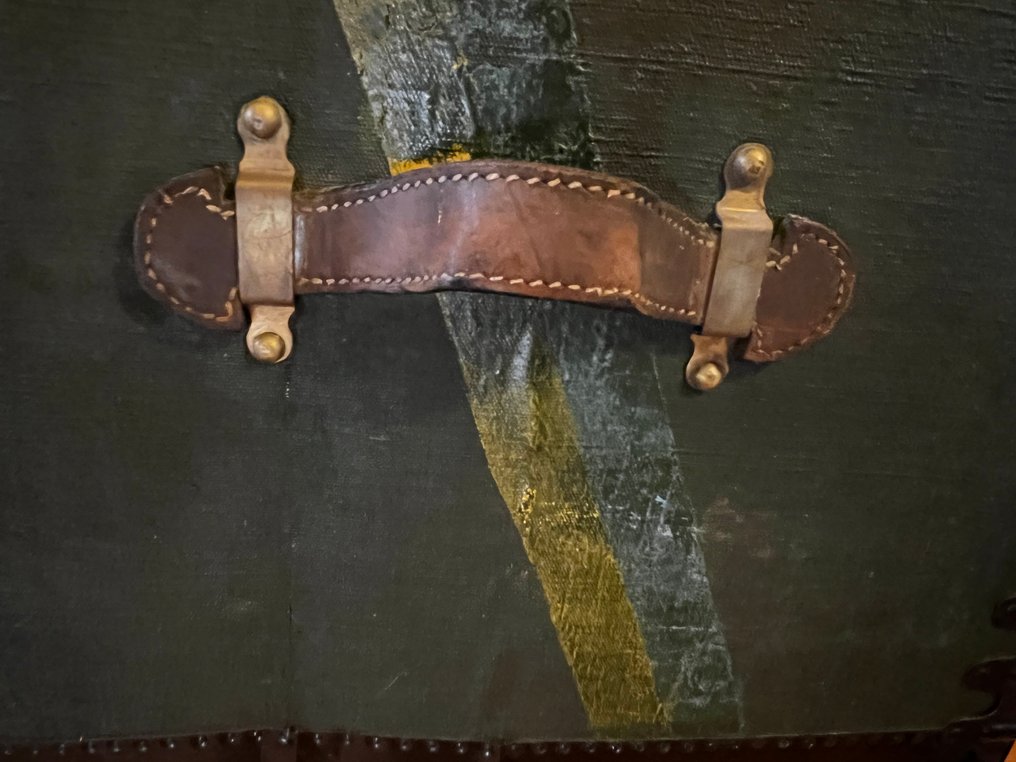
The trunk is covered in olive-green waxed canvas, decorated with hand-painted blue and yellow diagonal bands.
This chromatic combination was not accidental: it echoed the colors used by officers of the French Navy and Colonial Corps of the time.
• Olive green represented the operational tone used in military equipment.
• Blue stood for the Marine Nationale and sea-line officers.
• Golden yellow symbolized the epaulettes and insignia of colonial officers — emblems of authority and honor.
These diagonal bands also served as personal identification markings, allowing the owner to distinguish his trunk among hundreds in colonial port warehouses.
Technical Features
•Solid wood frame reinforced with stitched and riveted leather and metal bindings.
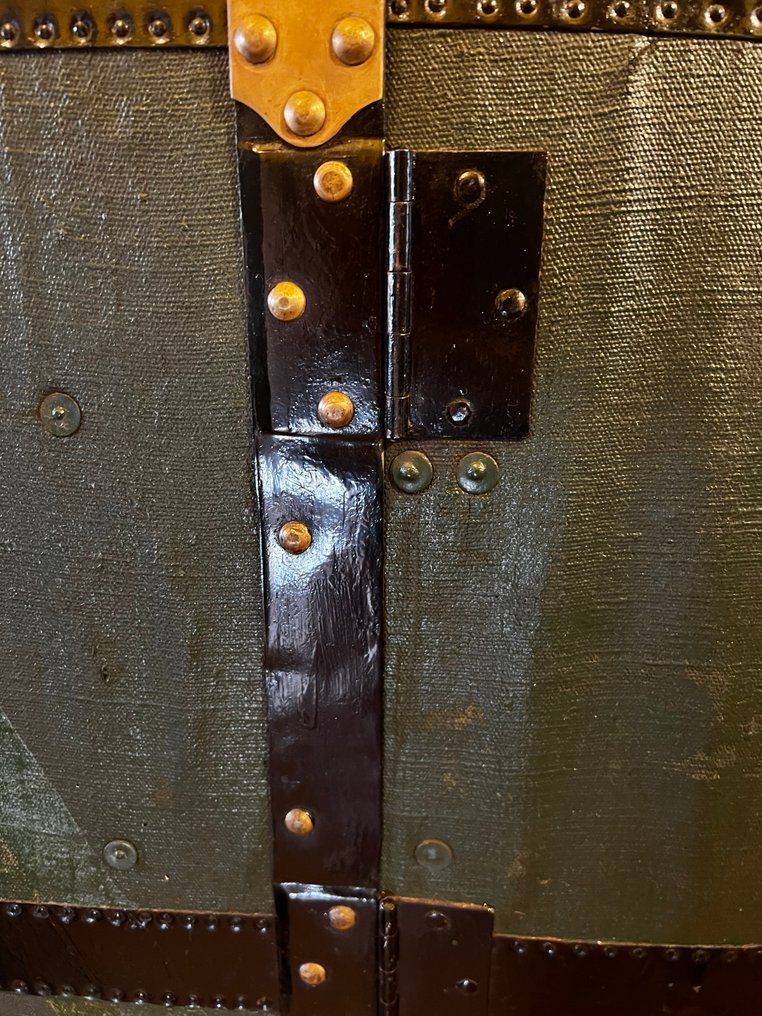
• Original brass hardware, including locks, hinges, and riveted edging with a rich, natural patina.
• Curved camelback lid, typical of luxury French and English travel trunks.
• Original interior lining in small geometric patterned paper, typical of the 1890–1910 Parisian production period.
• Complete hanging rail with wooden coat hangers, original straps, and a drawer compartment system for accessories and uniforms.
• Leather handles with hand stitching and brass fittings, showing remarkable preservation.
• Functional locking mechanisms and robust metal corner reinforcements.
The construction quality, materials, and attention to detail are consistent with the Parisian ateliers of the period, such as those supplying officers and elite travelers (Moynat, Au Départ, etc.), though this piece is of independent master craftsmanship, possibly made for export or private commission.
Every detail reflects the refined craftsmanship of the Parisian and London workshops of the era, which produced custom-made trunks for officers, diplomats, and elite travelers.
Period: ca. 1910-1920
Origin: France (likely Parisian or naval port atelier)
Original use: French Naval or Colonial Corps officer
Materials: Wood, waxed canvas, leather, brass
Style: Empire influence / Colonial Belle Époque
Authentic patina, no structural replacements, interior complete
This trunk is not merely a decorative or collectible object, it is a tangible witness to colonial history and the culture of travel at the turn of the century.
It most likely crossed oceans toward Indochina, North Africa, or the French overseas possessions, accompanying an officer on his missions.
It still preserves its authentic charm today: the aged leather with its natural patina, the original waxed canvas, and the intact interior lining all tell the story of a life of journeys and adventures.
Rarity and Historical Value
“Camelback” trunks intended for military or colonial use are today extremely rare, as few have survived in such fine condition.
This example, with its distinctive military coloration and excellent structural condition, is a museum-worthy collector’s piece, prized by antique dealers, historical memorabilia experts, and lovers of early travel design.
Colonial or military “camelback” wardrobe trunks of this size and preservation are now extremely rare.
Few have survived complete with their internal fittings, hangers, and lining.
It is believed to have belonged to an officer of the French Navy or the Colonial Corps (Corps d’Infanterie Coloniale).
A Witness to Distant Times
This extraordinary travel trunk, of the “camelback” type (with its distinctive domed or camel-hump lid), dates from the early 20th century and is most likely of French origin.
It is believed to have belonged to an officer of the French Navy or the Colonial Corps (Corps d’Infanterie Coloniale).
During the Belle Époque and the era of French colonial expansion, officers, diplomats, and travelers undertook long journeys by ship or train to Africa, Asia, and the overseas territories.
Wardrobe trunks like this were indispensable companions, designed to transport uniforms, boots, garments, and documents in an orderly manner, protected from the humid and brackish sea air.
The camelback model, with its arched lid, was reserved for those who could afford a highend trunk, as the rounded shape made the luggage easily recognizable in ports and allowed rain or sea spray to slide off during travel.
The trunk is covered in olive-green waxed canvas, decorated with hand-painted blue and yellow diagonal bands.
This chromatic combination was not accidental: it echoed the colors used by officers of the French Navy and Colonial Corps of the time.
• Olive green represented the operational tone used in military equipment.
• Blue stood for the Marine Nationale and sea-line officers.
• Golden yellow symbolized the epaulettes and insignia of colonial officers — emblems of authority and honor.
These diagonal bands also served as personal identification markings, allowing the owner to distinguish his trunk among hundreds in colonial port warehouses.
Technical Features
•Solid wood frame reinforced with stitched and riveted leather and metal bindings.
• Original brass hardware, including locks, hinges, and riveted edging with a rich, natural patina.
• Curved camelback lid, typical of luxury French and English travel trunks.
• Original interior lining in small geometric patterned paper, typical of the 1890–1910 Parisian production period.
• Complete hanging rail with wooden coat hangers, original straps, and a drawer compartment system for accessories and uniforms.
• Leather handles with hand stitching and brass fittings, showing remarkable preservation.
• Functional locking mechanisms and robust metal corner reinforcements.
The construction quality, materials, and attention to detail are consistent with the Parisian ateliers of the period, such as those supplying officers and elite travelers (Moynat, Au Départ, etc.), though this piece is of independent master craftsmanship, possibly made for export or private commission.
Every detail reflects the refined craftsmanship of the Parisian and London workshops of the era, which produced custom-made trunks for officers, diplomats, and elite travelers.
Period: ca. 1910-1920
Origin: France (likely Parisian or naval port atelier)
Original use: French Naval or Colonial Corps officer
Materials: Wood, waxed canvas, leather, brass
Style: Empire influence / Colonial Belle Époque
Authentic patina, no structural replacements, interior complete
This trunk is not merely a decorative or collectible object, it is a tangible witness to colonial history and the culture of travel at the turn of the century.
It most likely crossed oceans toward Indochina, North Africa, or the French overseas possessions, accompanying an officer on his missions.
It still preserves its authentic charm today: the aged leather with its natural patina, the original waxed canvas, and the intact interior lining all tell the story of a life of journeys and adventures.
Rarity and Historical Value
“Camelback” trunks intended for military or colonial use are today extremely rare, as few have survived in such fine condition.
This example, with its distinctive military coloration and excellent structural condition, is a museum-worthy collector’s piece, prized by antique dealers, historical memorabilia experts, and lovers of early travel design.
Colonial or military “camelback” wardrobe trunks of this size and preservation are now extremely rare.
Few have survived complete with their internal fittings, hangers, and lining.
It is believed to have belonged to an officer of the French Navy or the Colonial Corps (Corps d’Infanterie Coloniale).
Details
Era
1900-2000
Model Name
French Colonial Naval Officer’s Camelback Trunk, Belle Époque, ca. 1900's
Colour
Green
Material
Wood
Condition
Good condition, used with some signs of wear
Height
140 cm
Width
62 cm
Depth
55 cm
Sold by