Vase - A cobalt blue Austrian-Bohemian Jugendstil vase with tin frame • lily of the valley decor • - Glass, Tin



06
days
13
hours
10
minutes
01
second
Current bid
€ 2
No reserve price

Expert
Selected by Michel Karis
Art historian with extensive experience working at various auction houses in antiques.
Estimate € 180 - € 220
9 other people are watching this object
 Bidder 4166 Bidder 4166 | €2 |
|---|
Catawiki Buyer Protection
Your payment’s safe with us until you receive your object.View details
Trustpilot 4.4 | 122910 reviews
Rated Excellent on Trustpilot.
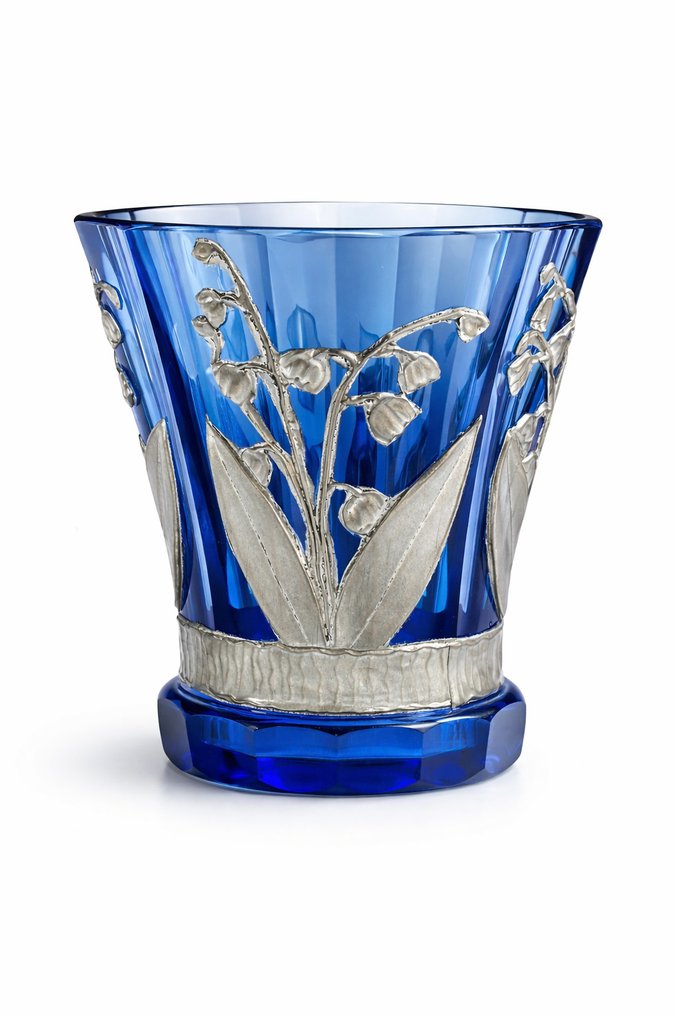
An cobalt blue Bohemian–Austrian Jugendstil vase with a tin-mounted frame, circa 1900–1910, 12 cm high, 11 cm in diameter and weighing 770 g.
AI-assisted summary
Description from the seller
Title: A cobalt blue Austrian or Bohemian Jugendstil vase with lily of the valley decor.
At the time of the production of your vase (ca. 1900), Bohemia and Austria were one and the same country.
Specifications:
• Period: Jugendstil
Year: circa 1900-1910
Origin: Austria or Bohemia.
Material: Faceted cobalt blue glass and tin.
• Decor: Lily of the valley (Convallaria majalis)
Dimensions: 12 cm high, 11 cm diameter.
Weight: 770 grams
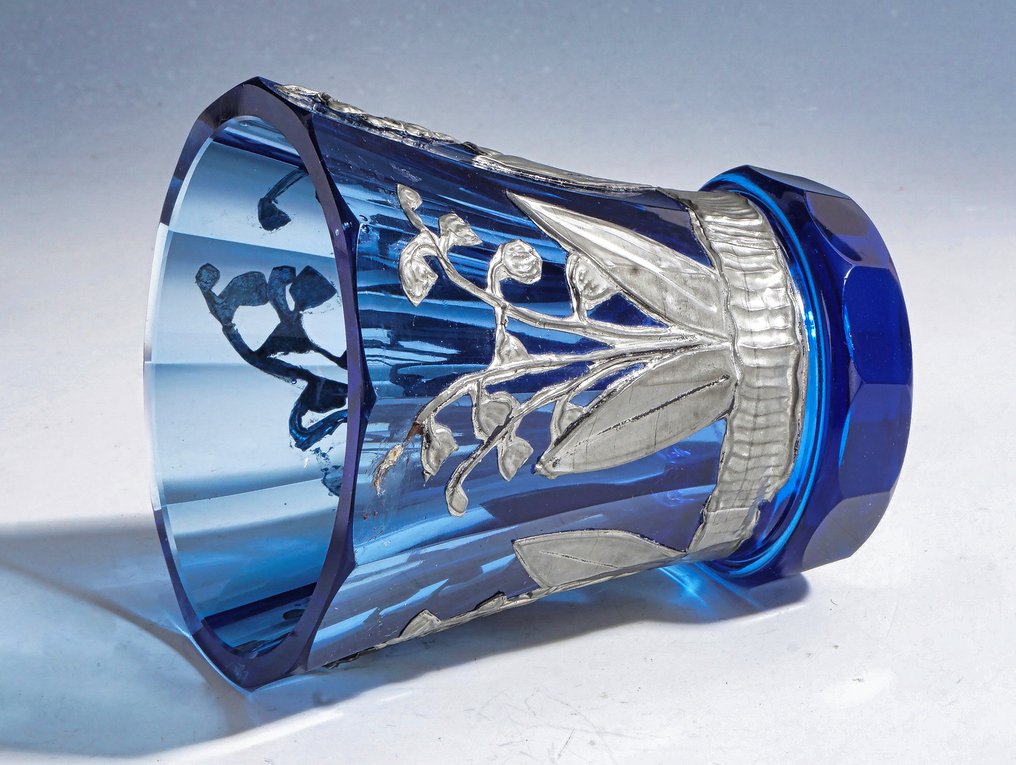
Description: The conical body is made of thick-walled, deep cobalt blue glass. The walls are adorned with broad, flat faceted cuts that extend into the flaring foot, creating an architectural and robust base shape. The glass is set in an openwork mount made of tin. This mount features a naturalistic depiction of lily of the valley, with stems and leaves emerging in relief from a structured band at the base and winding organically around the glass body. The flower heads hang freely, breaking the clean lines of the cut glass. The metalwork construction shows a vertical solder seam at the back, typical of the assembly of cast mounts around a glass core. The underside of the foot shows significant age-related wear and scuff marks, consistent with a dating around the turn of the century.
Biography & context: This object is a characteristic example of the interaction between the Bohemian glass industry and the Austrian or German metalware industry during the fin de siècle. While in France the emphasis was often on pâte-de-verre or etched glass, Central European Jugendstil was more frequently characterized by the use of heavy, cut colored glass combined with metal mounts. The motif of lily of the valley was particularly popular across Europe during this period and symbolized happiness and the return of spring. Although the object is unmarked, it shows strong stylistic similarities with the productions of Argentor Werke (Vienna) or Orivit, which often sourced glassware from Bohemian houses such as Loetz or Kralik for their more luxurious items.
Expert note: The small vase is in good condition, appropriate for its age and use. The combination of its heavy weight, the deep color of the glass, and the quality of the casting in tin give the object a sculptural quality that sets it apart from mass production from later periods. A representative piece of the Viennese or Bohemian interpretation of floral Art Nouveau.
Seller's Story
Decaders Gallery – Eindhoven Region, Netherlands
Our passion lies in 20th century applied arts and design, with a particular focus on the Art Nouveau, Art Deco and Mid-Century Modern periods. But styles from the sixties, seventies and later also attract our attention. Each decade has made a unique contribution to the art world, which our name – *Decaders Gallery* – perfectly reflects.
Thanks to our love for art and design, we present new, special decorative objects every week. In addition, we have a broad interest in Asian art, antiques and collectibles. Our searches throughout Europe have led to a valuable network of like-minded enthusiasts, who help us track down unique finds.
This network has paid off: we are proud to have supplied artworks to renowned museums, including:
**The Netherlands:**
- CODA Museum, Apeldoorn
- Drents Museum, Assen
- National Textile Museum, Tilburg
- National Glass Museum, Leerdam
- Museum 'Amsterdam School' (*'t Schip*), Amsterdam
- PSV Football Museum, Eindhoven
- National War Museum, Overloon
**Belgium:**
- Musée de la Famenne, Marche-en-Famenne
- Museum of Natural Sciences, Belgium
**Spain:**
- Maritime Museum, Barcelona
We warmly invite you to visit our auctions with surprising artworks and follow us on Instagram. Discover your favorite decade at *Decaders Gallery*!
**Marc van der Heijden**
*Decaders Gallery, Netherlands*
Translated by Google TranslateTitle: A cobalt blue Austrian or Bohemian Jugendstil vase with lily of the valley decor.
At the time of the production of your vase (ca. 1900), Bohemia and Austria were one and the same country.
Specifications:
• Period: Jugendstil
Year: circa 1900-1910
Origin: Austria or Bohemia.
Material: Faceted cobalt blue glass and tin.
• Decor: Lily of the valley (Convallaria majalis)
Dimensions: 12 cm high, 11 cm diameter.
Weight: 770 grams
Description: The conical body is made of thick-walled, deep cobalt blue glass. The walls are adorned with broad, flat faceted cuts that extend into the flaring foot, creating an architectural and robust base shape. The glass is set in an openwork mount made of tin. This mount features a naturalistic depiction of lily of the valley, with stems and leaves emerging in relief from a structured band at the base and winding organically around the glass body. The flower heads hang freely, breaking the clean lines of the cut glass. The metalwork construction shows a vertical solder seam at the back, typical of the assembly of cast mounts around a glass core. The underside of the foot shows significant age-related wear and scuff marks, consistent with a dating around the turn of the century.
Biography & context: This object is a characteristic example of the interaction between the Bohemian glass industry and the Austrian or German metalware industry during the fin de siècle. While in France the emphasis was often on pâte-de-verre or etched glass, Central European Jugendstil was more frequently characterized by the use of heavy, cut colored glass combined with metal mounts. The motif of lily of the valley was particularly popular across Europe during this period and symbolized happiness and the return of spring. Although the object is unmarked, it shows strong stylistic similarities with the productions of Argentor Werke (Vienna) or Orivit, which often sourced glassware from Bohemian houses such as Loetz or Kralik for their more luxurious items.
Expert note: The small vase is in good condition, appropriate for its age and use. The combination of its heavy weight, the deep color of the glass, and the quality of the casting in tin give the object a sculptural quality that sets it apart from mass production from later periods. A representative piece of the Viennese or Bohemian interpretation of floral Art Nouveau.
Seller's Story
Decaders Gallery – Eindhoven Region, Netherlands
Our passion lies in 20th century applied arts and design, with a particular focus on the Art Nouveau, Art Deco and Mid-Century Modern periods. But styles from the sixties, seventies and later also attract our attention. Each decade has made a unique contribution to the art world, which our name – *Decaders Gallery* – perfectly reflects.
Thanks to our love for art and design, we present new, special decorative objects every week. In addition, we have a broad interest in Asian art, antiques and collectibles. Our searches throughout Europe have led to a valuable network of like-minded enthusiasts, who help us track down unique finds.
This network has paid off: we are proud to have supplied artworks to renowned museums, including:
**The Netherlands:**
- CODA Museum, Apeldoorn
- Drents Museum, Assen
- National Textile Museum, Tilburg
- National Glass Museum, Leerdam
- Museum 'Amsterdam School' (*'t Schip*), Amsterdam
- PSV Football Museum, Eindhoven
- National War Museum, Overloon
**Belgium:**
- Musée de la Famenne, Marche-en-Famenne
- Museum of Natural Sciences, Belgium
**Spain:**
- Maritime Museum, Barcelona
We warmly invite you to visit our auctions with surprising artworks and follow us on Instagram. Discover your favorite decade at *Decaders Gallery*!
**Marc van der Heijden**
*Decaders Gallery, Netherlands*
Translated by Google TranslateDetails
Era
1900-2000
Weight
770 g
Style subtype
Jugendstil
Specific region of origin
Bohemia
Country of Origin
Austria
Model
A cobalt blue Austrian-Bohemian Jugendstil vase with tin frame • lily of the valley decor •
Material
Glass, Tin
Style
Art Nouveau
Colour
Blue
Condition
Good condition - used with small signs of aging & blemishes
Height
12 cm
Width
11 cm
Depth
11 cm
Diameter
11 cm
Estimated Period
1900-1910
Sold by
