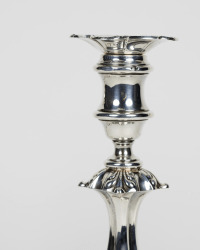
Gustaf Möllenborg - Carl Teodor Feron - Candelabrum - .830 silver - 1868 year Neo-Rococo



04
days
23
hours
34
minutes
15
seconds
Current bid
€ 55
Reserve price not met

Expert
Selected by Inés Fernández
Specialised in Spanish and Portuguese silver with over 10 years in galleries and auctions.
Estimate € 350 - € 430
6 other people are watching this object
 Bidder 0202 Bidder 0202 | €55 |
|---|
Catawiki Buyer Protection
Your payment’s safe with us until you receive your object.View details
Trustpilot 4.4 | 123077 reviews
Rated Excellent on Trustpilot.
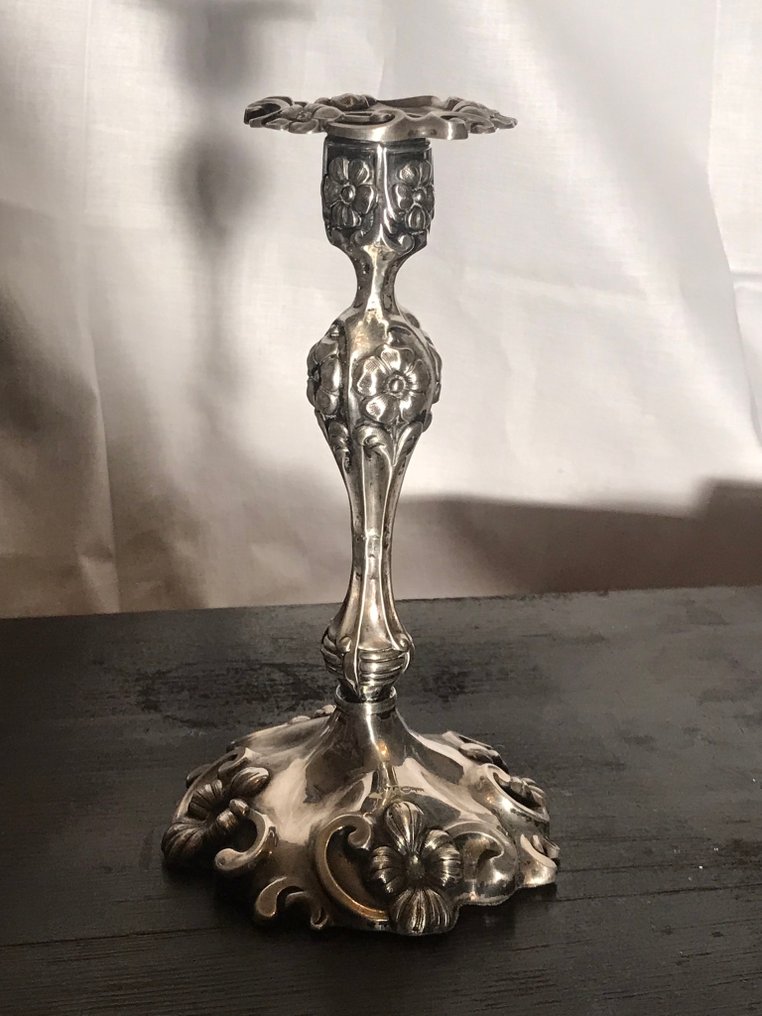
Antique Swedish 830 silver single-light candlestick in Rococo Revival style, made in Stockholm by Gustaf Möllenborg-Féron (GMF) and dated 1868, about 20 cm tall with a triangular base and rich repoussé floral and scroll decoration.
AI-assisted summary
Description from the seller
Antique Swedish 830 silver single-light candlestick in Rococo Revival style, crafted by the renowned firm of Gustaf Möllenborg (mark GMF), Stockholm, 1868 (date letter O5). Rich repoussé floral and scroll decoration on baluster stem and shaped triangular base with shell motifs. Good antique condition with minor central wear as shown. Height approx. 20 cm. A fine example of mid-19th century Swedish silverwork.
Gustaf Möllenborg (1796–1851) was a prominent Swedish silversmith born in Dädesjö socken, Småland, as an illegitimate son. He began his apprenticeship at age 13 in Växjö, moved to Stockholm in 1819, and became a master silversmith in 1823 at age 26.
His workshop grew rapidly: by the 1840s, it employed over 40 workers, making it Sweden's largest producer of decorative gold and silver items during that era. Known for high-quality pieces in Empire, Rococo Revival, and naturalistic styles—including candlesticks, clocks, and tableware—his works often featured elaborate repoussé floral and scroll motifs.
In 1850, he passed the business to a journeyman (later associated with Carl Teodor Féron), and the firm continued under variations like Gustaf Möllenborg-Féron until 1927. The workshop's tools and inventory were donated to museums, forming the basis for displays at Skansen and Nordiska Museet.
His pieces (commonly marked GMF or similar) are held in collections like Nationalmuseum in Stockholm and remain highly regarded in antique Swedish silver.
Carl Teodor Féron (also known as Louis Constant Féron) was a Swedish silversmith active in the mid-to-late 19th century. He worked as a journeyman (gesäll) in the renowned workshop of Gustaf Möllenborg in Stockholm.
In 1850, shortly before Möllenborg's death in 1851, Féron took over the firm. He continued operations under variations of the name, such as Gustaf Möllenborg-Féron or simply Möllenborg Féron, preserving the established reputation and maker's mark (often GMF or similar).
Pieces from this period (1850s–1880s and beyond) frequently bear combined attributions like "Gustaf Möllenborg Féron," reflecting the transition. The workshop remained one of Sweden's leading producers of high-quality silver in Rococo Revival and naturalistic styles, including elaborate candlesticks, urns, and tableware.
The firm operated into the early 20th century, with some production continuing until around 1927. Féron's role ensured the continuity of Möllenborg's legacy as a major figure in 19th-century Swedish silver craftsmanship.
Antique Swedish 830 silver single-light candlestick in Rococo Revival style, crafted by the renowned firm of Gustaf Möllenborg (mark GMF), Stockholm, 1868 (date letter O5). Rich repoussé floral and scroll decoration on baluster stem and shaped triangular base with shell motifs. Good antique condition with minor central wear as shown. Height approx. 20 cm. A fine example of mid-19th century Swedish silverwork.
Gustaf Möllenborg (1796–1851) was a prominent Swedish silversmith born in Dädesjö socken, Småland, as an illegitimate son. He began his apprenticeship at age 13 in Växjö, moved to Stockholm in 1819, and became a master silversmith in 1823 at age 26.
His workshop grew rapidly: by the 1840s, it employed over 40 workers, making it Sweden's largest producer of decorative gold and silver items during that era. Known for high-quality pieces in Empire, Rococo Revival, and naturalistic styles—including candlesticks, clocks, and tableware—his works often featured elaborate repoussé floral and scroll motifs.
In 1850, he passed the business to a journeyman (later associated with Carl Teodor Féron), and the firm continued under variations like Gustaf Möllenborg-Féron until 1927. The workshop's tools and inventory were donated to museums, forming the basis for displays at Skansen and Nordiska Museet.
His pieces (commonly marked GMF or similar) are held in collections like Nationalmuseum in Stockholm and remain highly regarded in antique Swedish silver.
Carl Teodor Féron (also known as Louis Constant Féron) was a Swedish silversmith active in the mid-to-late 19th century. He worked as a journeyman (gesäll) in the renowned workshop of Gustaf Möllenborg in Stockholm.
In 1850, shortly before Möllenborg's death in 1851, Féron took over the firm. He continued operations under variations of the name, such as Gustaf Möllenborg-Féron or simply Möllenborg Féron, preserving the established reputation and maker's mark (often GMF or similar).
Pieces from this period (1850s–1880s and beyond) frequently bear combined attributions like "Gustaf Möllenborg Féron," reflecting the transition. The workshop remained one of Sweden's leading producers of high-quality silver in Rococo Revival and naturalistic styles, including elaborate candlesticks, urns, and tableware.
The firm operated into the early 20th century, with some production continuing until around 1927. Féron's role ensured the continuity of Möllenborg's legacy as a major figure in 19th-century Swedish silver craftsmanship.
Details
Specific region of origin
Stockholm
Silver type
.830 silver
Gross weight
327.4 g
Manufacturer/ Brand
Gustaf Möllenborg
Era
1400-1900
Title additional information
1868 year Neo-Rococo
No. of items
1
Country of Origin
Sweden
Designer/Artist/Maker
Carl Teodor Feron
Material
Silver
Style
Design
Colour
Silver
Condition
Good condition - used with small signs of aging & blemishes
Height
20 cm
Width
0 cm
Depth
20 cm
Estimated period
1850-1900
Sold by