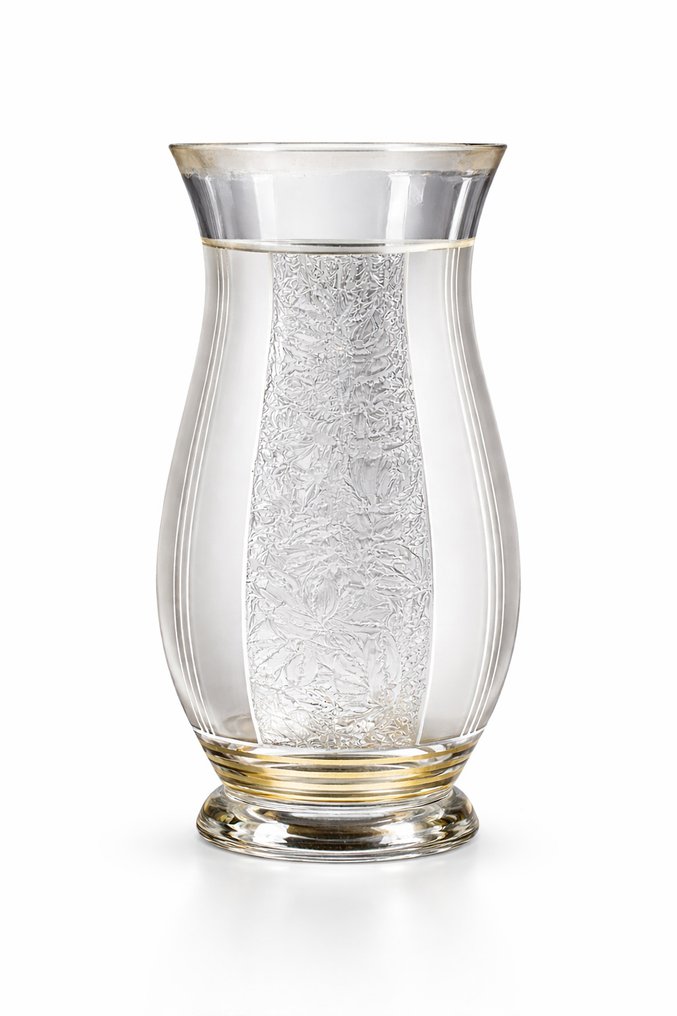
Haida of Steinschönau Attrib. - Decanter - Bohemian Art Deco 'Glue Chip' and frosted glass vase with gilding - Crystal

06
days
11
hours
58
minutes
07
seconds
Starting bid
€ 1
No reserve price

Expert
Selected by Michel Karis
Art historian with extensive experience working at various auction houses in antiques.
Estimate € 180 - € 220
No bids placed
Catawiki Buyer Protection
Your payment’s safe with us until you receive your object.View details
Trustpilot 4.4 | 122910 reviews
Rated Excellent on Trustpilot.
Bohemian Art Deco glass vase with glue chip and a satin finish, circa 1930, in green crystal glass with gilded rims, height 21 cm and diameter 9 cm.
AI-assisted summary
Description from the seller
A Bohemian Art Deco 'Glue Chip' and satin-finished glass vase with gilding, from the Haida or Steinschönau region, circa 1930.
Specifications:
Period: Art Deco
Circa 1930
Origin: Bohemia (Czechoslovakia), probably from the Haida region (Nový Bor) or Steinschönau.
Type of decor: Glue Chip (frosted glass / Verre Givré), satinized glass, and enamel edges.
• Dimensions: Height 21 cm, diameter 9 cm
Description:
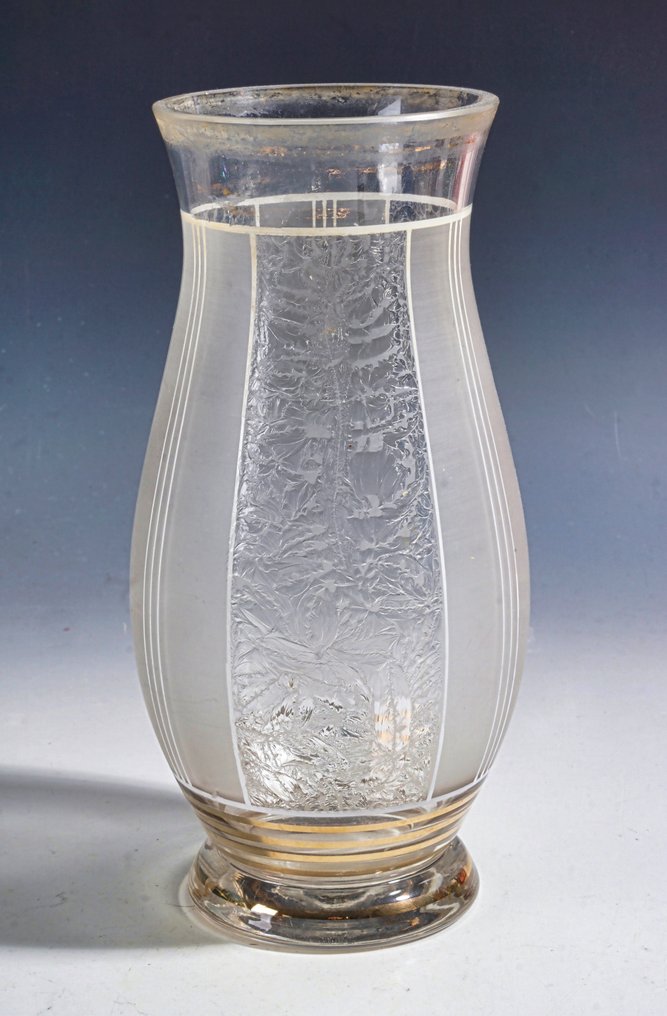
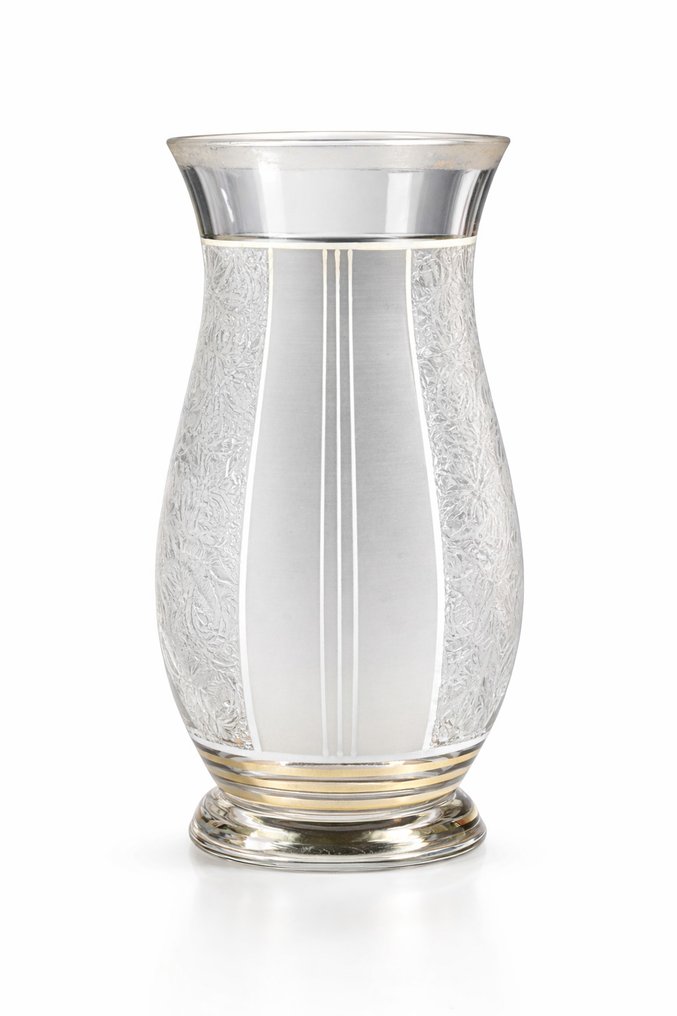
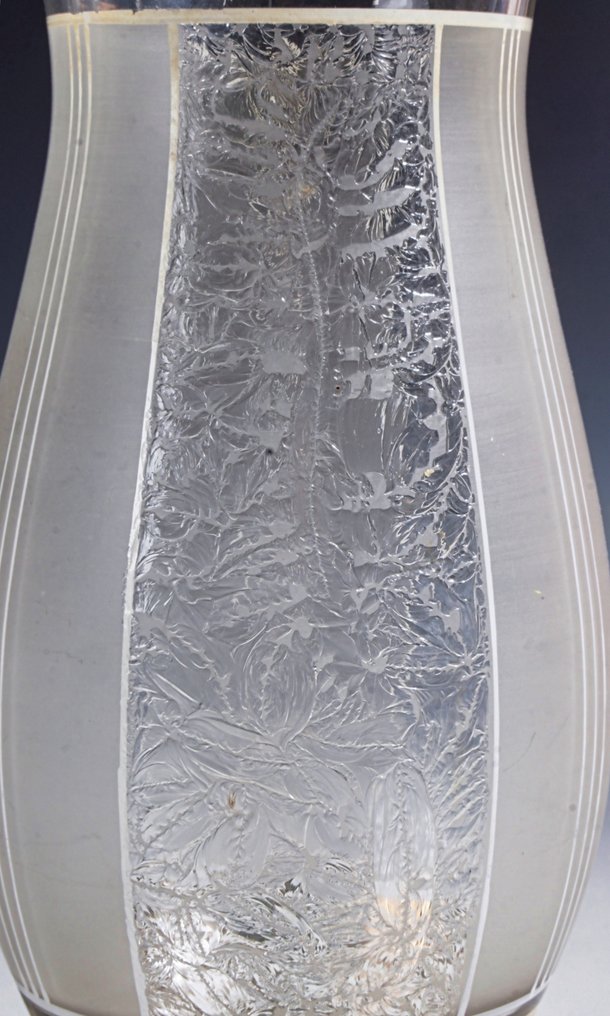
The vase has a classic, lightly tapered baluster shape that tapers upward into a flat, beveled mouth rim with an inner facet. The decoration consists of a clean, geometric flat pattern characteristic of Art Deco. Vertical bands of clear glass are worked with the 'glue chip' technique, resulting in a jagged, ice-like texture that feels sharp and rough. These textured panels are alternated with vertical bands of smooth, satin (matte) glass. The transitions between the different textures are accentuated by fine white enamel borders, which enhance the vertical rhythm of the object. The foot and the upper rim are adorned with broad and narrow gold bands, creating a luxurious contrast with the matte surface. The underside is flat and shows signs of use consistent with its age.
Photos: See all photos for a complete impression. They were taken in a photo studio.
Biography & context
During the Interwar period (1918-1939), the Bohemian glass industry experienced a peak. In the region around Haida and Steinschönau, numerous 'refineries' were active: workshops that purchased glass semi-finished products and decorated them with advanced techniques such as etching, grinding, enameling, and the 'glue chip' method shown here. This technique, in which animal glue was applied to the glass and flakes from the surface were pulled off during the drying process, created a unique organic pattern reminiscent of ice flowers or frozen windows.
Condition: Gold loss at the top edge; see photos.
Expert note:
This object is a representative example of Bohemian export glass from the 1930s. The combination of tactile contrasts—the rough ice glass against the soft satin glass—testifies to a thoughtful design. The condition is generally good, with a note of some wear to the gilding around the upper rim, which is consistent with the age and use. The absence of a signature is common for this type of production, which was often only marked with a paper label.
Seller's Story
Decaders Gallery – Eindhoven Region, Netherlands
Our passion lies in 20th century applied arts and design, with a particular focus on the Art Nouveau, Art Deco and Mid-Century Modern periods. But styles from the sixties, seventies and later also attract our attention. Each decade has made a unique contribution to the art world, which our name – *Decaders Gallery* – perfectly reflects.
Thanks to our love for art and design, we present new, special decorative objects every week. In addition, we have a broad interest in Asian art, antiques and collectibles. Our searches throughout Europe have led to a valuable network of like-minded enthusiasts, who help us track down unique finds.
This network has paid off: we are proud to have supplied artworks to renowned museums, including:
**The Netherlands:**
- CODA Museum, Apeldoorn
- Drents Museum, Assen
- National Textile Museum, Tilburg
- National Glass Museum, Leerdam
- Museum 'Amsterdam School' (*'t Schip*), Amsterdam
- PSV Football Museum, Eindhoven
- National War Museum, Overloon
**Belgium:**
- Musée de la Famenne, Marche-en-Famenne
- Museum of Natural Sciences, Belgium
**Spain:**
- Maritime Museum, Barcelona
We warmly invite you to visit our auctions with surprising artworks and follow us on Instagram. Discover your favorite decade at *Decaders Gallery*!
**Marc van der Heijden**
*Decaders Gallery, Netherlands*
Translated by Google TranslateA Bohemian Art Deco 'Glue Chip' and satin-finished glass vase with gilding, from the Haida or Steinschönau region, circa 1930.
Specifications:
Period: Art Deco
Circa 1930
Origin: Bohemia (Czechoslovakia), probably from the Haida region (Nový Bor) or Steinschönau.
Type of decor: Glue Chip (frosted glass / Verre Givré), satinized glass, and enamel edges.
• Dimensions: Height 21 cm, diameter 9 cm
Description:
The vase has a classic, lightly tapered baluster shape that tapers upward into a flat, beveled mouth rim with an inner facet. The decoration consists of a clean, geometric flat pattern characteristic of Art Deco. Vertical bands of clear glass are worked with the 'glue chip' technique, resulting in a jagged, ice-like texture that feels sharp and rough. These textured panels are alternated with vertical bands of smooth, satin (matte) glass. The transitions between the different textures are accentuated by fine white enamel borders, which enhance the vertical rhythm of the object. The foot and the upper rim are adorned with broad and narrow gold bands, creating a luxurious contrast with the matte surface. The underside is flat and shows signs of use consistent with its age.
Photos: See all photos for a complete impression. They were taken in a photo studio.
Biography & context
During the Interwar period (1918-1939), the Bohemian glass industry experienced a peak. In the region around Haida and Steinschönau, numerous 'refineries' were active: workshops that purchased glass semi-finished products and decorated them with advanced techniques such as etching, grinding, enameling, and the 'glue chip' method shown here. This technique, in which animal glue was applied to the glass and flakes from the surface were pulled off during the drying process, created a unique organic pattern reminiscent of ice flowers or frozen windows.
Condition: Gold loss at the top edge; see photos.
Expert note:
This object is a representative example of Bohemian export glass from the 1930s. The combination of tactile contrasts—the rough ice glass against the soft satin glass—testifies to a thoughtful design. The condition is generally good, with a note of some wear to the gilding around the upper rim, which is consistent with the age and use. The absence of a signature is common for this type of production, which was often only marked with a paper label.
Seller's Story
Decaders Gallery – Eindhoven Region, Netherlands
Our passion lies in 20th century applied arts and design, with a particular focus on the Art Nouveau, Art Deco and Mid-Century Modern periods. But styles from the sixties, seventies and later also attract our attention. Each decade has made a unique contribution to the art world, which our name – *Decaders Gallery* – perfectly reflects.
Thanks to our love for art and design, we present new, special decorative objects every week. In addition, we have a broad interest in Asian art, antiques and collectibles. Our searches throughout Europe have led to a valuable network of like-minded enthusiasts, who help us track down unique finds.
This network has paid off: we are proud to have supplied artworks to renowned museums, including:
**The Netherlands:**
- CODA Museum, Apeldoorn
- Drents Museum, Assen
- National Textile Museum, Tilburg
- National Glass Museum, Leerdam
- Museum 'Amsterdam School' (*'t Schip*), Amsterdam
- PSV Football Museum, Eindhoven
- National War Museum, Overloon
**Belgium:**
- Musée de la Famenne, Marche-en-Famenne
- Museum of Natural Sciences, Belgium
**Spain:**
- Maritime Museum, Barcelona
We warmly invite you to visit our auctions with surprising artworks and follow us on Instagram. Discover your favorite decade at *Decaders Gallery*!
**Marc van der Heijden**
*Decaders Gallery, Netherlands*
Translated by Google TranslateDetails
Era
1900-2000
Style subtype
Jugendstil
Specific region of origin
Bohemia
Material
Crystal
Manufacturer/ Brand
Haida of Steinschönau Attrib.
Country of Origin
Czechia
Model
Bohemian Art Deco 'Glue Chip' and frosted glass vase with gilding
Style
Art Nouveau
Colour
Green
Condition
Good condition - used with small signs of aging & blemishes
Height
21 cm
Width
9 cm
Diameter
9 cm
Estimated Period
1930-1940
Sold by