Technical instrument - France - 1900-1910 - Medical instrument - Electrotherapy


00
days
09
hours
09
minutes
32
seconds
Current bid
€ 80
Reserve price not met

Expert
Selected by Paula Martin-Calero Toro
Holds a degree in art history; over six years cataloguing and appraising antiques.
Estimate € 250 - € 300
26 other people are watching this object
 Bidder 7288 Bidder 7288 | €80 | |
|---|---|---|
| Bidder 7288 | €55 | |
 Bidder 7265 Bidder 7265 | €50 |
Catawiki Buyer Protection
Your payment’s safe with us until you receive your object.View details
Trustpilot 4.4 | 123878 reviews
Rated Excellent on Trustpilot.
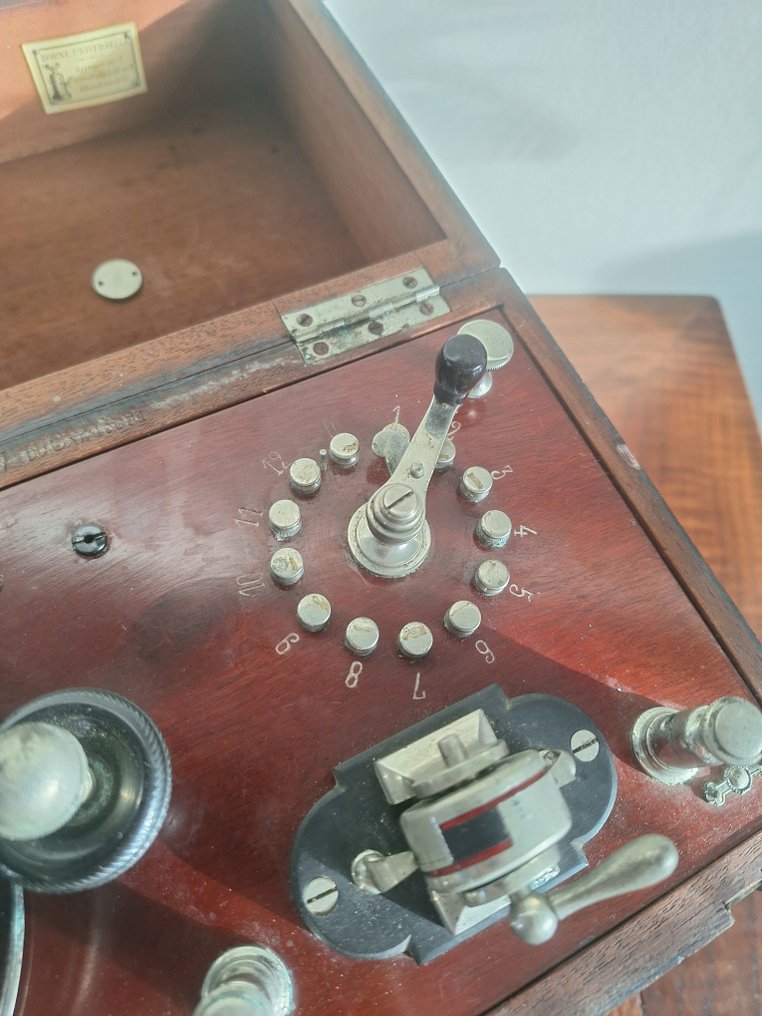
French wooden electrotherapy instrument from 1900–1910 by Charles Chardin, with a milliampere dial, on/off crank, a variable resistance knob, glass cylinders and an original instruction plate, housed in its box and in good used condition with patina.
AI-assisted summary
Description from the seller
Rare antique French 'wet cell battery' electrical medical instrument, dating from the late 19th century.
The instrument was made in Paris by Charles Chardin. It consists of a dial for measuring milliamperes, an on/off handle, and an additional rotary knob that allows the resistance of the current through the two electrodes to be adjusted when applied to the patient. In the center of the console, there is a screw rod that, when turned, moves a set of separate glass cylinders (still intact) up and down. These cylinders are attached via the screw rod and are housed in a separate wooden base inside the box below.
Lifting the glass cylinders brings a chemical solution, which was inside the cylinders, into contact with a set of 32 zinc anodes attached to the bottom of the console. This interaction causes a chemical reaction that results in an electric current, the strength of which can be controlled with the lever.
The device is equipped with.
Original instruction plate with French text (“Do not overturn the box – Hold it by the handle”).
The device is offered in its original, unrestored condition, with a beautiful authentic patina. Functionality has not been tested, but all visible parts appear to be original and intact.
A decorative and historically valuable collectible object.
The box has some engraved plates on the inside of the lid that advertise Chardins' products. On the edge of the box, there is also the stamp 'Appareil No B17 du catalogue,' indicating the early model number. Its first model was the A17, and this popular model had several variants. The B17 is a variant of its original design.
Charles Chardin was the inventor of a form of electrotherapy called 'electrokinetic vascular therapy.' It was believed that this therapy influenced blood circulation by exerting pressure on different parts of the body. This was presumably achieved through the body's reaction to the application of electricity to muscle tissue. The difference in Chardin's approach to electrotherapy at that time was his preference for applying weak currents to the body rather than the shock therapy that had become common since the 1850s. He said about this:
The electrical current that controls our organism is so weak that it escapes our investigations, so it is foolish to try to assist it with powerful currents. Convinced of his methods, Chardin warned against the use of surgery and used Galvini's eighteenth-century experiments with frog muscles to support his argument. Although it may seem far-fetched, Chardin's devices became extremely popular and were even used during World War I.
The instruction was that one electrode was placed on the head and the other on the body part considered to be the treatment area. Once applied, these electrodes had to remain on the patient for 6 to 10 hours each night and were said to provide healing for an endless list of conditions: paralysis, epilepsy, muscle pain, flu, asthma, fever, menstrual pain, tumors, cancer, gangrene, anemia, and even flatulence! Chardin's instruments were originally developed with wet batteries and later with dry batteries, making this an early example of his very successful career.
The device is offered in its original, unrestored condition, with a beautiful authentic patina. Functionality has not been tested, but all visible parts appear to be original and intact.
A decorative and historically valuable collectible object.
Rare antique French 'wet cell battery' electrical medical instrument, dating from the late 19th century.
The instrument was made in Paris by Charles Chardin. It consists of a dial for measuring milliamperes, an on/off handle, and an additional rotary knob that allows the resistance of the current through the two electrodes to be adjusted when applied to the patient. In the center of the console, there is a screw rod that, when turned, moves a set of separate glass cylinders (still intact) up and down. These cylinders are attached via the screw rod and are housed in a separate wooden base inside the box below.
Lifting the glass cylinders brings a chemical solution, which was inside the cylinders, into contact with a set of 32 zinc anodes attached to the bottom of the console. This interaction causes a chemical reaction that results in an electric current, the strength of which can be controlled with the lever.
The device is equipped with.
Original instruction plate with French text (“Do not overturn the box – Hold it by the handle”).
The device is offered in its original, unrestored condition, with a beautiful authentic patina. Functionality has not been tested, but all visible parts appear to be original and intact.
A decorative and historically valuable collectible object.
The box has some engraved plates on the inside of the lid that advertise Chardins' products. On the edge of the box, there is also the stamp 'Appareil No B17 du catalogue,' indicating the early model number. Its first model was the A17, and this popular model had several variants. The B17 is a variant of its original design.
Charles Chardin was the inventor of a form of electrotherapy called 'electrokinetic vascular therapy.' It was believed that this therapy influenced blood circulation by exerting pressure on different parts of the body. This was presumably achieved through the body's reaction to the application of electricity to muscle tissue. The difference in Chardin's approach to electrotherapy at that time was his preference for applying weak currents to the body rather than the shock therapy that had become common since the 1850s. He said about this:
The electrical current that controls our organism is so weak that it escapes our investigations, so it is foolish to try to assist it with powerful currents. Convinced of his methods, Chardin warned against the use of surgery and used Galvini's eighteenth-century experiments with frog muscles to support his argument. Although it may seem far-fetched, Chardin's devices became extremely popular and were even used during World War I.
The instruction was that one electrode was placed on the head and the other on the body part considered to be the treatment area. Once applied, these electrodes had to remain on the patient for 6 to 10 hours each night and were said to provide healing for an endless list of conditions: paralysis, epilepsy, muscle pain, flu, asthma, fever, menstrual pain, tumors, cancer, gangrene, anemia, and even flatulence! Chardin's instruments were originally developed with wet batteries and later with dry batteries, making this an early example of his very successful career.
The device is offered in its original, unrestored condition, with a beautiful authentic patina. Functionality has not been tested, but all visible parts appear to be original and intact.
A decorative and historically valuable collectible object.
Details
Era
1900-2000
No. of items
1
Country of Origin
France
Material
Wood
Condition
Good condition - used with small signs of aging & blemishes
Height
28 cm
Width
27 cm
Depth
15.5 cm
Estimated Period
1900-1910
Title additional information
Medical instrument - Electrotherapy
Sold by