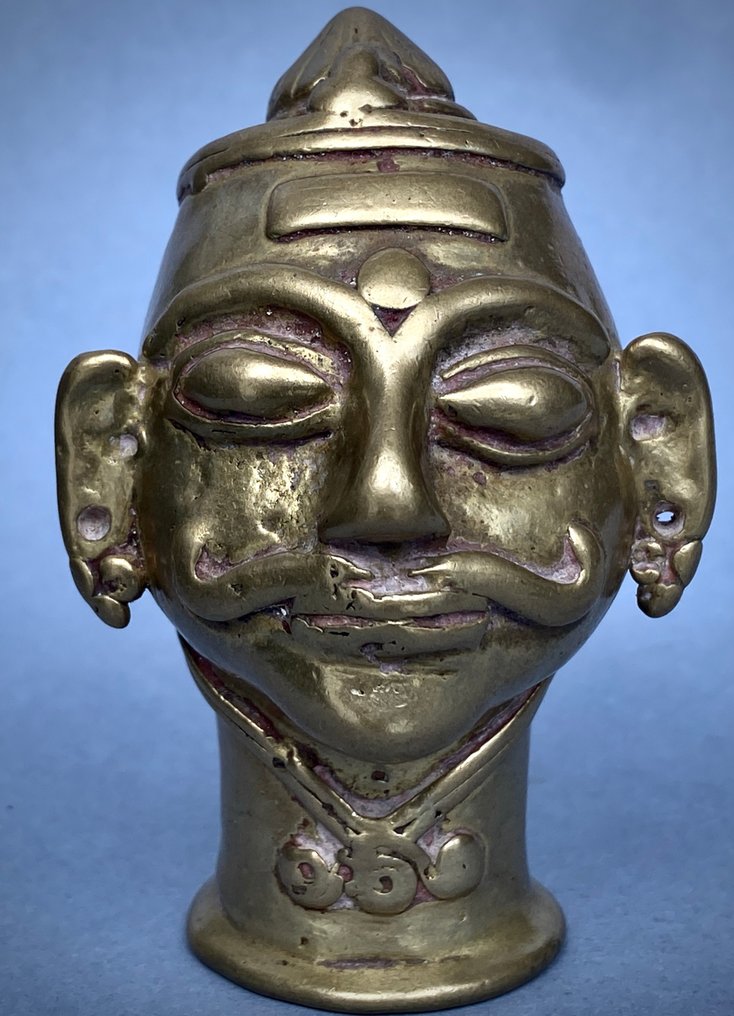
Sculpture, Mukhaliṅga con śivaliṅga apicale e banda di vibhūti con bindu centrale, India, XVIII–XIX secolo - 8.5 cm - Lost wax bronze casting


02
days
09
hours
01
minute
37
seconds
Current bid
€ 40
Reserve price not met

Expert
Selected by Marion Oliviero
Holds a master's in Chinese archaeology with extensive expertise in Japanese art.
Estimate € 450 - € 500
11 other people are watching this object
 Bidder 8239 Bidder 8239 | €40 | |
|---|---|---|
| Bidder 3652 | €35 | |
| Bidder 8239 | €30 | |
Catawiki Buyer Protection
Your payment’s safe with us until you receive your object.View details
Trustpilot 4.4 | 123779 reviews
Rated Excellent on Trustpilot.
India, Mukhaliṅga with apex śivaliṅga, three-medallion necklace and broad kuṇḍala, bronze fused by Persian cire-perdue, dating to the XVIII–XIX century during the Maratha Empire period, from a private collection, good condition, unsigned.
AI-assisted summary
Description from the seller
Mukhaliṅga with an apical śivaliṅga, a necklace with three medallions and large kuṇḍala, India, 18th–19th century
Mukhaliṅga with apical śivaliṅga, a necklace with three medallions, and broad kuṇḍala – Śaiva culture.
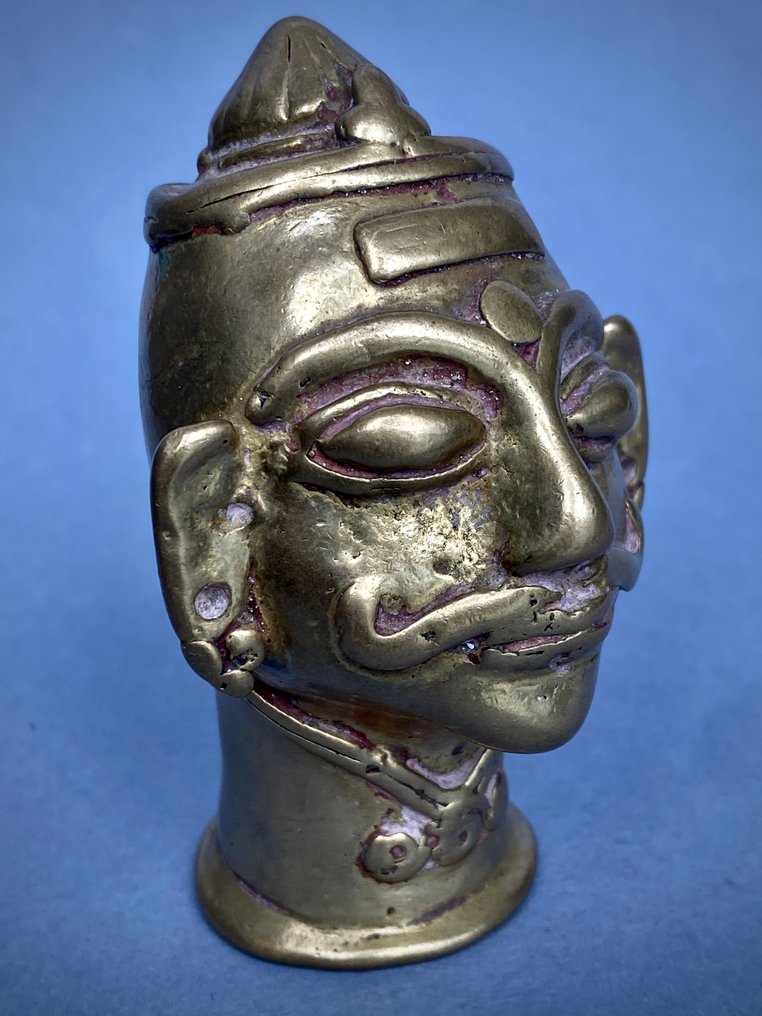
Bronze cast in lost wax technique, with a gold patina and traces of red pigment from pūjā; male head with a strong regal expression, arched mustache, yogic-posed eyes, large disk earrings (kuṇḍala), and a necklace with a pendant featuring three relief medallions. On the forehead, the tripuṇḍra—the bands of vibhūti with a central bindu—is present, while near the apex of the headdress, modeled as a small cusp, a tiny śivaliṅga appears, reaffirming the identification with Śiva. The interior is hollow; on the side, a casting cavity of the core is visible, typical of the lost wax technique. The object belongs to the mukhaliṅga type, 'līṅga with a face,' a superstructure that during pūjā and abhiṣeka is lowered onto the aniconic līṅga to 'anthropomorphize' the presence of the deity: the priest anoints the face with water, milk, and sacred ointments that flow down the head, while the tripuṇḍra and the small cusp-līṅga refer to the original form of Śaiva worship.
The iconography—distinctive mustaches, a three-element necklace, large earrings, and a conical headdress—is consistent with devotional examples from peninsular India in the Deccan area, likely originating from Maharashtra or Karnataka, where the veeraśaiva/lingāyat tradition has remained particularly vibrant.
Good overall condition, solid and well-balanced structure, heavy, with signs of ritual handling and lateral casting cavity; beautiful oxidations at the intersections.
Mukhaliṅga with an apical śivaliṅga, a necklace with three medallions and large kuṇḍala, India, 18th–19th century
Mukhaliṅga with apical śivaliṅga, a necklace with three medallions, and broad kuṇḍala – Śaiva culture.
Bronze cast in lost wax technique, with a gold patina and traces of red pigment from pūjā; male head with a strong regal expression, arched mustache, yogic-posed eyes, large disk earrings (kuṇḍala), and a necklace with a pendant featuring three relief medallions. On the forehead, the tripuṇḍra—the bands of vibhūti with a central bindu—is present, while near the apex of the headdress, modeled as a small cusp, a tiny śivaliṅga appears, reaffirming the identification with Śiva. The interior is hollow; on the side, a casting cavity of the core is visible, typical of the lost wax technique. The object belongs to the mukhaliṅga type, 'līṅga with a face,' a superstructure that during pūjā and abhiṣeka is lowered onto the aniconic līṅga to 'anthropomorphize' the presence of the deity: the priest anoints the face with water, milk, and sacred ointments that flow down the head, while the tripuṇḍra and the small cusp-līṅga refer to the original form of Śaiva worship.
The iconography—distinctive mustaches, a three-element necklace, large earrings, and a conical headdress—is consistent with devotional examples from peninsular India in the Deccan area, likely originating from Maharashtra or Karnataka, where the veeraśaiva/lingāyat tradition has remained particularly vibrant.
Good overall condition, solid and well-balanced structure, heavy, with signs of ritual handling and lateral casting cavity; beautiful oxidations at the intersections.
Details
Era
1400-1900
Over 200 years old
No
Country of Origin
India
Style
Antique
Material
Lost wax bronze casting
Title of artwork
Mukhaliṅga con śivaliṅga apicale e banda di vibhūti con bindu centrale, India, XVIII–XIX secolo
Dynastic Style/Period
Maratha Empire (1674-1818)
Signature
Not signed
Provenance
Private collection
Condition
Good condition
Sold with stand
No
Height
8.5 cm
Width
0 cm
Depth
0 cm
Sold by