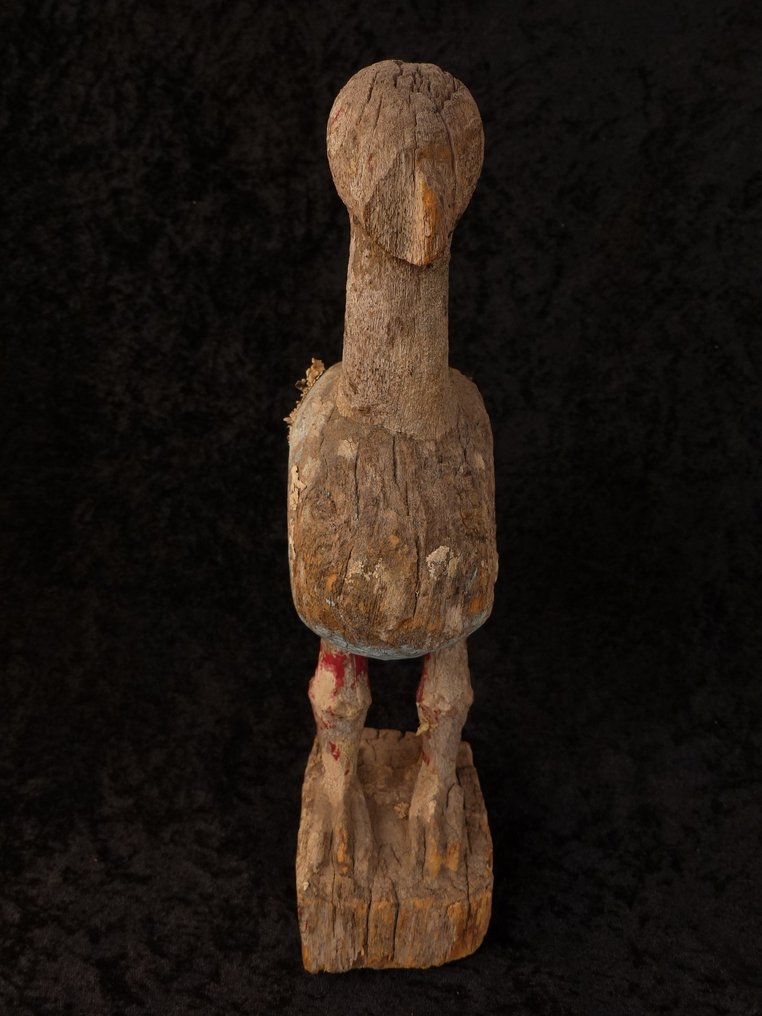
Ancestor figure - Mahafaly - Madagascar - Head of a gravestone



03
days
09
hours
05
minutes
45
seconds
Current bid
€ 90
Reserve price not met

Expert
Selected by Julien Gauthier
With almost a decade of experience bridging science, museum curation, and traditional blacksmithing, Julien has developed a unique expertise in historical arms, armour, and African art.
Estimate € 220 - € 250
9 other people are watching this object
 Bidder 0113 Bidder 0113 | €90 | |
|---|---|---|
 Bidder 2760 Bidder 2760 | €85 | |
| Bidder 2561 | €1 |
Catawiki Buyer Protection
Your payment’s safe with us until you receive your object.View details
Trustpilot 4.4 | 123951 reviews
Rated Excellent on Trustpilot.
Description from the seller
MF117 head part of a gravestone of the Sakalava, death bird Lolo, circa 1960, Belo Sur Tsiribihina region, height 35 cm, width 13 cm, depth 7 cm, 870 g
The southern peoples do not perform the tradition of burying the dead as in the highlands. The Sakalava maintain contact with the deceased through ceremonial communication in trance (tromba). This is a significant event and very mysterious, as the participants are formally 'possessed,' and at the same time, there is a washing of relics (fitampoha). The importance of the relics is high, but they are quickly lost again, because the soul of the deceased ultimately enters into unity with the creator god, and contact is broken. This happens according to the interpretation of the 'sorcerer' or upon the instructions of family elders. Afterwards, the sculptures and the grave are neglected, or they change owners and are also sold.
Islamic religious influences lead to the belief in bird beings and death birds called Ziny (Arabic for Djinns), which can become places of soul spirits and are thus found in many AloAlo of the southern tribes. The Malagasy names for the Ziny are 'Lolo'. At burial sites, these artworks are usually left alone, emphasizing the transience of life. The dry climate preserves the wood quite well for a long time, but the elements leave their marks on the sculptures.
Unfortunately, this sacred bird is missing its beak, but since the break point is just as weathered as the rest of the torso, it is assumed that it was broken off shortly after it was erected. The dry climate preserves the wood quite well over time, but the elements leave their marks on the sculptures. The extremely hard tropical wood has eroded over decades of outdoor exposure, and the rare rain and intense sun have created erosion cracks in the corpus. Remnants of the originally blue paint can still be seen. However, the wood is neither brittle nor decayed. This gives the object a special aura and a certain mystique.
The genuine AloAlo are a artistic rarity because the ancestor cult, which originates from Papa Neuginea, found only in Madagascar in these steles a physical expression worldwide. The export of cultural property / antiques is strictly limited in Madagascar. Our old originals have been in family possession since 1975 and, due to their increasing collector value, also represent a fruitful investment.
This item is suitable for standard insured parcel shipping and will be carefully and break-proof packed by us.
Seller's Story
Mahafaly acts with a passion for natural materials and according to a certified fair trade concept. The special contact with Madagascar arose at home, my father worked there for years. He laid the foundation for my collection of the famous AloAlo totems and artifacts. I myself was involved in setting up a social project and speak the local language. More than 20 years ago I started working with traditionally working manufacturers in the country. Mahafaly imports attractive recycled and natural goods such as tin models, items made from horn, raphia and typical minerals.
Translated by Google TranslateMF117 head part of a gravestone of the Sakalava, death bird Lolo, circa 1960, Belo Sur Tsiribihina region, height 35 cm, width 13 cm, depth 7 cm, 870 g
The southern peoples do not perform the tradition of burying the dead as in the highlands. The Sakalava maintain contact with the deceased through ceremonial communication in trance (tromba). This is a significant event and very mysterious, as the participants are formally 'possessed,' and at the same time, there is a washing of relics (fitampoha). The importance of the relics is high, but they are quickly lost again, because the soul of the deceased ultimately enters into unity with the creator god, and contact is broken. This happens according to the interpretation of the 'sorcerer' or upon the instructions of family elders. Afterwards, the sculptures and the grave are neglected, or they change owners and are also sold.
Islamic religious influences lead to the belief in bird beings and death birds called Ziny (Arabic for Djinns), which can become places of soul spirits and are thus found in many AloAlo of the southern tribes. The Malagasy names for the Ziny are 'Lolo'. At burial sites, these artworks are usually left alone, emphasizing the transience of life. The dry climate preserves the wood quite well for a long time, but the elements leave their marks on the sculptures.
Unfortunately, this sacred bird is missing its beak, but since the break point is just as weathered as the rest of the torso, it is assumed that it was broken off shortly after it was erected. The dry climate preserves the wood quite well over time, but the elements leave their marks on the sculptures. The extremely hard tropical wood has eroded over decades of outdoor exposure, and the rare rain and intense sun have created erosion cracks in the corpus. Remnants of the originally blue paint can still be seen. However, the wood is neither brittle nor decayed. This gives the object a special aura and a certain mystique.
The genuine AloAlo are a artistic rarity because the ancestor cult, which originates from Papa Neuginea, found only in Madagascar in these steles a physical expression worldwide. The export of cultural property / antiques is strictly limited in Madagascar. Our old originals have been in family possession since 1975 and, due to their increasing collector value, also represent a fruitful investment.
This item is suitable for standard insured parcel shipping and will be carefully and break-proof packed by us.
Seller's Story
Mahafaly acts with a passion for natural materials and according to a certified fair trade concept. The special contact with Madagascar arose at home, my father worked there for years. He laid the foundation for my collection of the famous AloAlo totems and artifacts. I myself was involved in setting up a social project and speak the local language. More than 20 years ago I started working with traditionally working manufacturers in the country. Mahafaly imports attractive recycled and natural goods such as tin models, items made from horn, raphia and typical minerals.
Translated by Google TranslateDetails
Era
1900-2000
Weight
870 g
Specific region of origin
Ampanihy, Tomboko
Title additional information
Head of a gravestone
No. of items
1
Material
Hardwood Menabe
Country of Origin
Madagascar
Ethnic group/ culture
Mahafaly
Height
35 cm
Indigenous object name
Hello
Width
13 cm
Sold with stand
No
Depth
7 cm
Condition
Fair condition - heavily used & with possibly minor parts missing
Estimated Period
1960-1970
